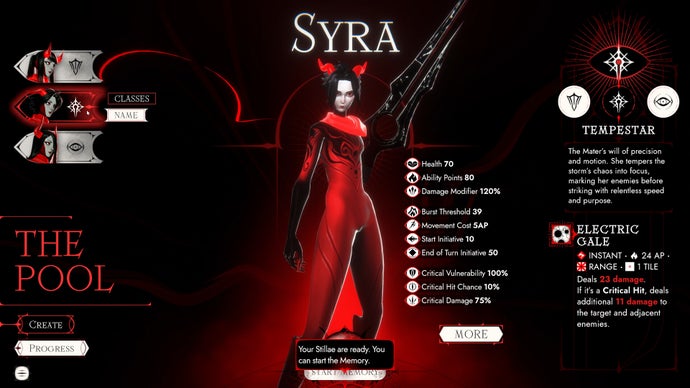
Ex Sanguis blends the intricate timeline manipulation of Othercide with a streamlined roguelike structure. It challenges players to master time rather than space in a haunting, blood-soaked world.
- Innovative timeline-based combat focusing on pre-empting and interrupting enemy actions.
- A leaner, more focused roguelike campaign compared to its predecessor, Othercide.
- Dynamic environmental hazards like blood blisters that alter battlefield positioning.
Ex Sanguis is not merely a grid-based tactics RPG; it is a masterclass in the manipulation of time. While novice strategy gamers often view victory as a matter of brute force and spatial dominance, this title posits that true strategy is the mastery of the clock. By shifting the focus from 'where' to 'when,' the game creates a high-stakes dance of anticipation.
The core mechanic revolves around a fluctuating timeline. Abilities are not simply executed; they are queued. Some trigger instantly, while others carry a delay. This delay, initially appearing as a handicap, becomes a primary asset for the experienced player. By calculating enemy movement ticks, players can launch artillery strikes precisely where a foe is destined to be several turns later.
Why This Matters
BozokMedia analysis shows that Ex Sanguis shares a spiritual kinship with Into The Breach. The emphasis is on surgical precision rather than total annihilation. The game encourages a 'lean' approach to combat—identifying high-value targets (VIPs) and eliminating them quickly to avoid being overwhelmed by the inevitable hatching of reinforcements from grotesque egg-sacs.
"By treating time as a tangible battlefield, Ex Sanguis elevates the tactics genre from simple chess-like movement to a complex predictive simulation."
The narrative setting is a gothic fever dream. A 'vampire moon' has drained the world of its essence, leaving behind an ivory void. The player controls the Mater, a goddess who spawns lethal clones—Swordlady, Gunlass, and Time Wizardress—to reclaim the wasteland. While the plot is shrouded in 'cod Latin' and vague metaphors, the attitude and aesthetic are undeniably potent.
Environmental interaction adds a layer of chaotic strategy. The maps are littered with blood blisters that explode upon impact, launching characters across the grid. This allows for creative combos, such as knocking a delayed enemy attack off-target or pushing a foe into a pre-queued area-of-effect (AOE) blast.
The transition to a roguelike structure has streamlined the progression. Each run involves trekking across a cratered world map, collecting Corrupted Blood, and choosing from randomized ability boosts after each victory. This loop mirrors the addictive quality of Vampire Survivors, encouraging repeated runs to unlock meta-progression and hidden lore.
Comparative Analysis: Othercide vs. Ex Sanguis
| Feature | Othercide | Ex Sanguis |
|---|---|---|
| Campaign Structure | Dense, Narrative-Heavy | Streamlined Roguelike |
| Combat Pacing | Methodical and Slow | Fast and Aggressive |
| Progression | Deep Clone Management | Ability-Based Upgrades |
Frequently Asked Questions
1. Is Ex Sanguis a direct sequel to Othercide?
While it shares mechanics and a thematic DNA, it is more of a spiritual successor with a different structural approach.
2. What is the 'Burst bar' in the game?
The Burst bar allows players to execute extra attacks immediately, but at the cost of significantly delaying that character's next turn on the timeline.