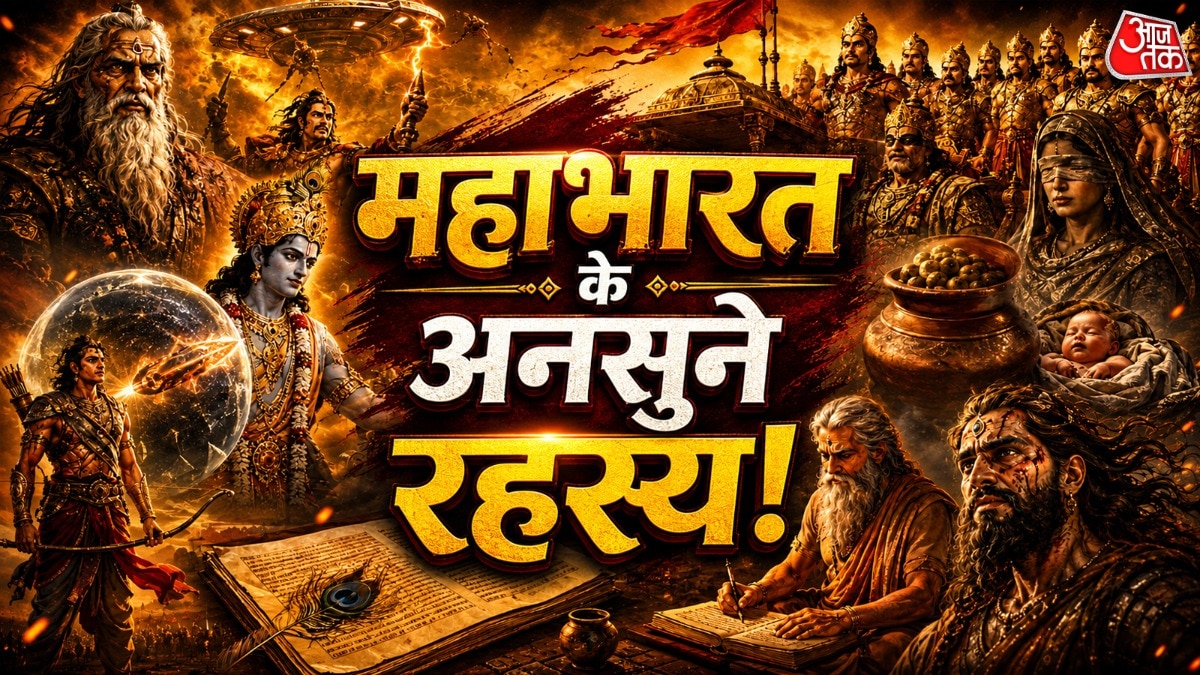
The Mahabharat is more than an epic; it is a repository of enigmas. From the significance of the number 18 to the existence of nuclear-like weapons, these mysteries continue to baffle scientists today.
- The number 18 holds profound mathematical and spiritual significance throughout the epic.
- Legends suggest Ashwatthama may still be roaming the Earth due to an ancient curse.
- Descriptions of 'Brahmastra' align closely with modern nuclear weapon effects.
- The epic evolved through three distinct stages: Jaya, Bharata, and Mahabharata.
In Hindu tradition, the Mahabharat is revered as the 'Fifth Veda.' Composed by Sage Ved Vyas, it stands as one of the largest epics in human history. However, a question persists: is it merely a collection of myths, or does it contain historical truths that modern science is yet to grasp? The mysteries embedded in its verses continue to challenge our understanding of the past.
The Enigma of the Number 18
The recurring pattern of the number 18 in the Mahabharat is nothing short of extraordinary. The Great War lasted for 18 days, the combined strength of the armies totaled 18 Akshauhinis (11 for Kauravas and 7 for Pandavas), and the epic itself is divided into 18 Parvas (books). Even the Bhagavad Gita, delivered by Lord Krishna to Arjuna, consists of 18 chapters. Whether this is a cosmic coincidence or a manifestation of advanced mathematical structuring remains an unsolved mystery.
Why This Matters
BozokMedia analysis shows that the recurring patterns of numerology in ancient texts suggest a highly advanced understanding of mathematical precision and cosmic synchronization that modern scholars are still trying to decode.
The mysteries of the Mahabharat are not just religious; they are echoes of an advanced civilization and scientific knowledge lost to time.
Ashwatthama: The Immortal Wanderer?
One of the most chilling legends involves Ashwatthama, the son of Dronacharya. According to the scriptures, after the misuse of the Brahmastra, Lord Krishna cursed him to wander the Earth for thousands of years, bearing the weight of his sins. Local legends in various parts of India, including near the Asirgarh Fort, claim sightings of a mysterious, wounded man, fueling the belief that the curse remains active to this day.
Ancient Nuclear Weapons and Vimanas
The description of the Brahmastra—a weapon capable of devastating entire populations—parallels the effects of modern nuclear warfare. Some researchers point toward findings in Mohenjo-daro, where skeletal remains showing signs of radiation have been discovered, attempting to link them to the era of the Mahabharat. Furthermore, the mention of 'Vimanas' (flying machines) suggests an ancient grasp of aeronautics that predates modern flight by millennia.
| Element | Mahabharat Description | Modern Science Perspective |
|---|---|---|
| Brahmastra | Divine Destructive Weapon | Nuclear-like devastation |
| Vimana | Flying Celestial Vehicles | Advanced Aviation Technology |
| Ashwatthama | Immortal due to curse | Mythological Legend |
Frequently Asked Questions
1. Was the Mahabharat a real historical war?
While debates continue, many archeological findings and astronomical alignments suggest that the Mahabharat was based on a real historical conflict.
2. How were Gandhari's 100 sons born?
According to legend, through the grace of Ved Vyas, a mass of flesh was divided into 101 pieces and kept in jars, leading to the birth of the 100 Kauravas and one daughter, Duhshala.
