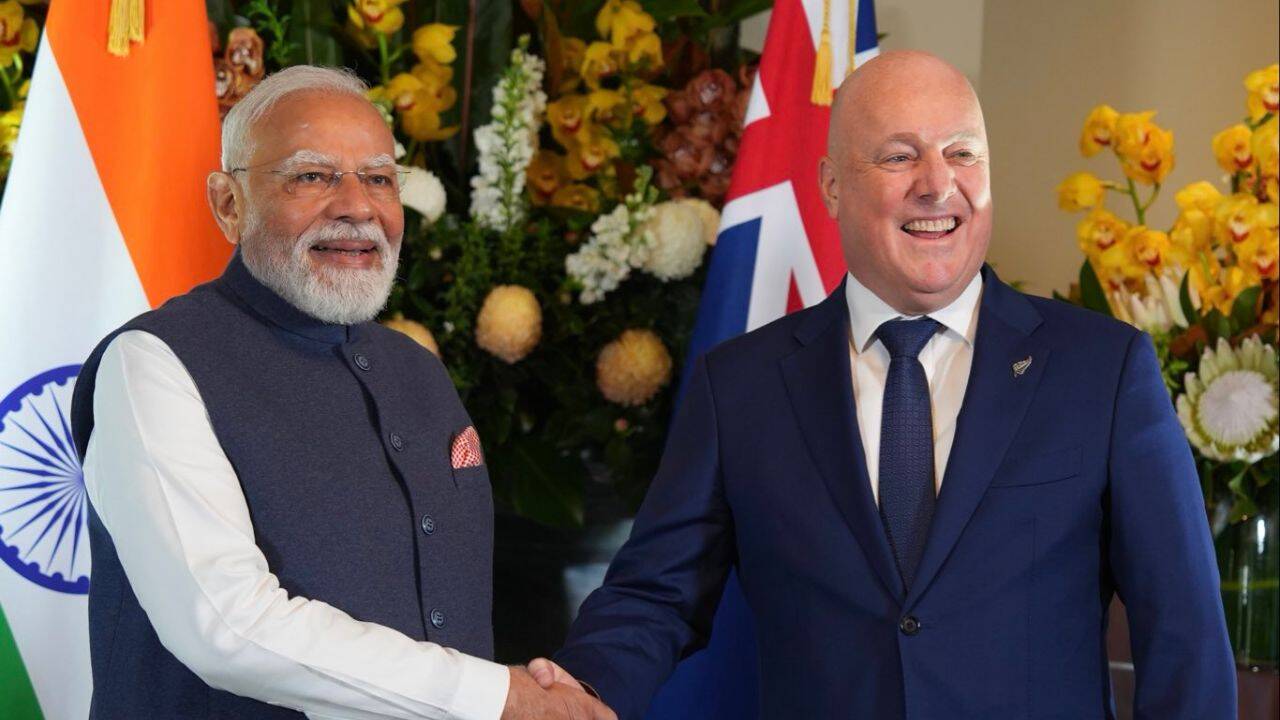
Prime Minister Narendra Modi and New Zealand’s Christopher Luxon signed 18 agreements, elevating bilateral ties to a strategic partnership. The roadmap targets NZ$7 billion trade by 2030 and deeper maritime security cooperation across the Indo‑Pacific.
मुख्य बिंदु (Key Takeaways)
- 18 comprehensive agreements signed under a Strategic Partnership
- Goal to expand bilateral trade to NZ$7 billion (≈ ₹35 trillion) by 2030
- Enhanced maritime security, disaster response and Indo‑Pacific cooperation
On July 11, 2026, Prime Minister Narendra Modi visited Auckland at the invitation of Prime Minister Christopher Luxon, formally elevating India‑New Zealand relations to a Strategic Partnership. During the visit, the two leaders inked 18 agreements covering defence, trade, agri‑tech, education, sport, culture and tourism, laying out an ambitious “Roadmap to 2030”.
Historical Context and Strategic Rationale
India and New Zealand have maintained diplomatic ties since 1955, but recent years have seen a surge in economic and security collaboration. Both nations now view each other as vital partners in the Indo‑Pacific, a region where China’s growing influence prompts a need for balanced multilateral engagement. The roadmap provides a structured, time‑bound plan to deepen cooperation over the next four years.
Key Sectors Covered by the Agreements
In defence, a Memorandum of Arrangement on maritime cooperation and a logistics support pact between the Indian Navy and the New Zealand Defence Force aim to improve interoperability, joint exercises, and humanitarian assistance‑disaster relief (HADR) capabilities. An anti‑terrorism joint working group institutionalises intelligence sharing and counter‑extremism dialogue.
On the economic front, the parties have pledged to boost bilateral trade from roughly NZ$2 billion in 2026 to NZ$7 billion (≈ ₹35 trillion) by 2030. Initiatives include joint ventures in biofuels—New Zealand has joined the Global Biofuels Alliance—digital payments, start‑up ecosystems, and a Kiwi‑fruit Action Plan that will establish two Centres of Excellence in Nagaland and Uttarakhand.
Maritime Security and Disaster Management
Both countries will co‑host a Maritime Security Dialogue under the Indo‑Pacific Oceans Initiative, focusing on illegal, unreported and unregulated (IUU) fishing, hydrographic data sharing, and capacity‑building for coastal states. A memorandum between India’s National Disaster Management Authority and New Zealand’s National Emergency Management Agency will enhance joint preparedness, response mechanisms and knowledge exchange.
Future Outlook and Implementation Challenges
While the strategic partnership promises economic growth and regional stability, effective implementation will require sustained political will, budget allocations, and private‑sector participation. If the roadmap is executed as intended, it could serve as a template for other mid‑size Indo‑Pacific nations seeking deeper security and trade ties.