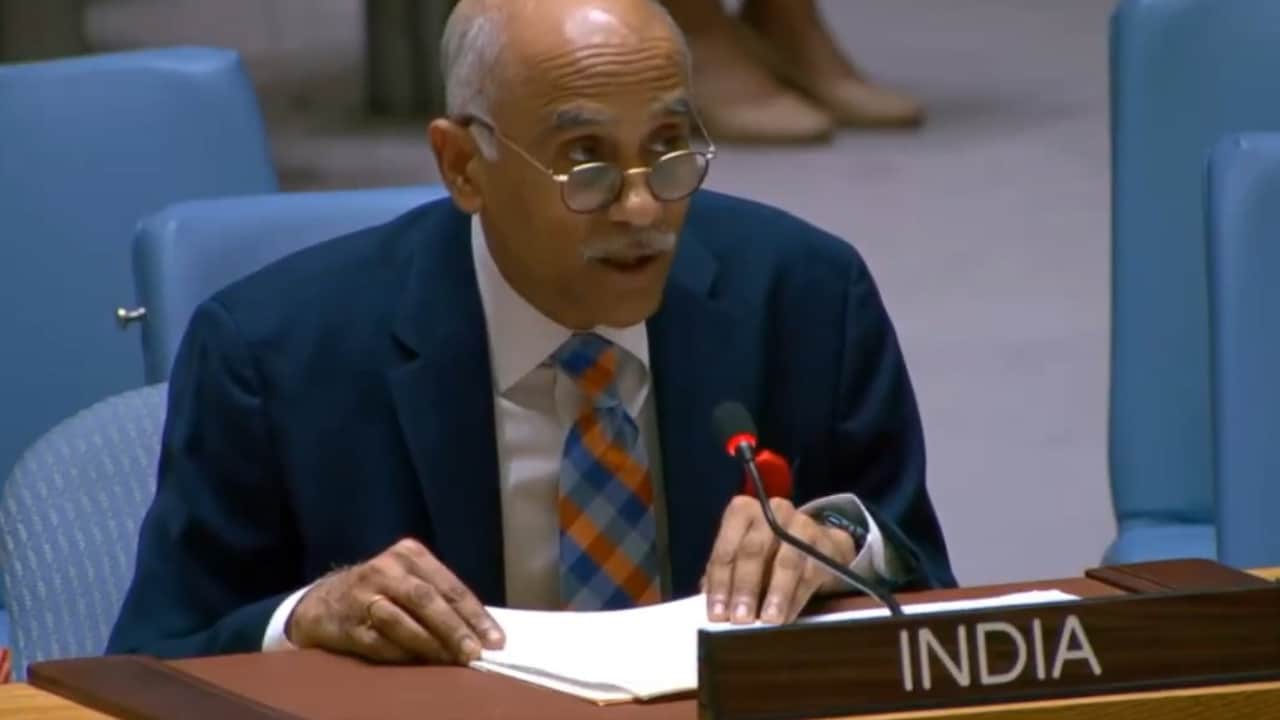
India delivered a scathing rebuke to Pakistan at the United Nations, condemning the use of cross-border terrorism as a tool of state policy.
Key Takeaways
- India condemned Pakistan for using terrorism as a state policy tool.
- India reiterated that Kashmir is an integral part of its territory.
- Pakistan was accused of misusing UN debates to peddle false narratives.
In a decisive diplomatic move at the United Nations, India has strongly slammed Pakistan for its continuous use of cross-border terrorism. Indian representative Parvathaneni Harish criticized Pakistan for attempting to hijack high-level international debates to promote its 'false narratives' regarding the region. India emphasized that terrorism is not just an incident but has become a 'tool of state policy' for Pakistan.
The Indian delegation further reinforced the nation's unwavering stance on Kashmir, stating that the region remains an integral and inalienable part of India. This direct confrontation comes at a time when Pakistan continues to attempt the internationalization of the Kashmir issue, a move India has consistently rejected.
Why This Matters (इसके मायने क्या हैं)
BozokMedia analysis shows that India's aggressive stance at the UN marks a shift from traditional diplomacy to a more proactive 'assertive diplomacy.' By calling out Pakistan's state-sponsored terrorism on a global stage, India is attempting to isolate its neighbor and force the international community to address the root cause of regional instability.
For the global community and the economy, a stable South Asia is crucial. India's refusal to entertain Pakistan's rhetoric ensures that the focus remains on development and security rather than being diverted by manufactured geopolitical tensions.
"Terrorism cannot be used as a diplomatic lever in the modern era of international law."
Historical Background
The conflict between India and Pakistan dates back to the 1947 Partition. Since then, the status of Jammu and Kashmir has been a central point of contention. Additionally, the Indus Waters Treaty, brokered by the World Bank in 1960, governs the sharing of the Indus river system, often serving as a point of friction during bilateral tensions.
| Issue | India's Position | Pakistan's Position |
|---|---|---|
| Terrorism | State-sponsored tool | Claims insurgency is local |
| Kashmir | Integral part of India | Disputed territory claim |
| Indus Treaty | Adherence to legal framework | Often disputes water allocation |
Frequently Asked Questions (अक्सर पूछे जाने वाले प्रश्न)
Question 1: What was India's main accusation against Pakistan at the UN?
Answer: India accused Pakistan of using terrorism as a tool of state policy and misusing UN platforms for false narratives.
Question 2: What is India's official stance on Kashmir?
Answer: India maintains that Kashmir is an integral and inalienable part of the country.
