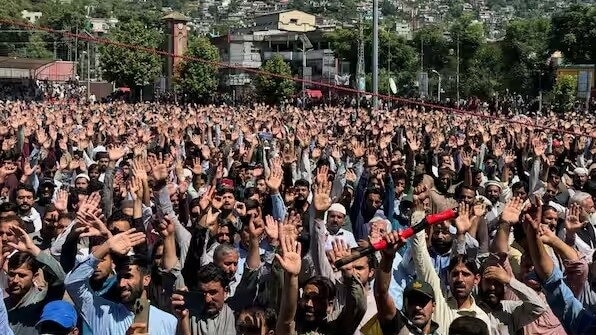
Amid escalating protests and violent clashes in Pakistan-occupied Kashmir (PoK), a prominent religious leader has warned that Pakistan is on the verge of disintegration. Army Chief General Asim Munir's grip on the region is rapidly slipping, raising major alarms in Islamabad.
Key Takeaways
- Protests in PoK highlight growing resentment against Islamabad's economic and political policies.
- A prominent Maulana warns that Pakistan is on the brink of further territorial disintegration.
- Army Chief General Asim Munir faces unprecedented challenges to military authority in the region.
The situation in Pakistan-occupied Kashmir (PoK) is rapidly spiraling out of control. Driven by skyrocketing flour prices, exorbitant electricity bills, and a complete lack of basic rights, local citizens have taken to the streets in massive numbers. Amidst this chaos, a stark warning from a prominent Maulana has sent shockwaves through Pakistan's military and political establishment, suggesting that the country is headed toward another partition.
This crisis comes at a time when Pakistan's Army Chief, General Asim Munir, is already struggling to maintain internal security and political stability. While the military has historically maintained an iron grip on PoK, recent civilian uprisings targeting military posts and government offices indicate that the local population has lost its fear of the armed forces.
Historical Background
For Pakistan, this scenario is a haunting echo of the past. History shows that whenever Islamabad has suppressed the rights of its administrative territories, it has faced catastrophic consequences. The most notable example is the 1971 disintegration of Pakistan, which led to the creation of Bangladesh. Today, similar conditions of economic exploitation and military high-handedness are breeding rebellion in both PoK and Balochistan.
Why This Matters
BozokMedia analysis shows that the instability in PoK is not just an internal issue for Pakistan; it has the potential to fundamentally alter the geopolitical landscape of South Asia. A full-scale rebellion in PoK could force neighboring nations to recalibrate their security postures and shift Islamabad's focus away from its other borders.
"The unrest in PoK is no longer just about subsidies; it is a fundamental rejection of Islamabad’s colonial-style administration that cannot be silenced by military might."
| Parameters | Mainland Pakistan (e.g., Punjab) | Pakistan-occupied Kashmir (PoK) |
|---|---|---|
| Resource Allocation | High (Prioritized) | Extremely Low (Exploitative) |
| Military Presence | Moderate (Political Control) | Extremely High (Suppressive) |
| Civil Rights | Constitutionally Guaranteed | Highly Restricted & Uncertain |
Frequently Asked Questions
1. Why are people protesting in PoK?
Residents of PoK are protesting against the lack of basic rights, severe shortages of wheat and flour, highly inflated electricity bills, and the exploitation of their local natural resources by Islamabad.
2. How is the Pakistan Army responding to this crisis?
Under General Asim Munir, the army initially attempted to suppress the movement with force. However, facing unprecedented public resistance, the military has been forced onto the defensive, fearing a larger civil uprising.