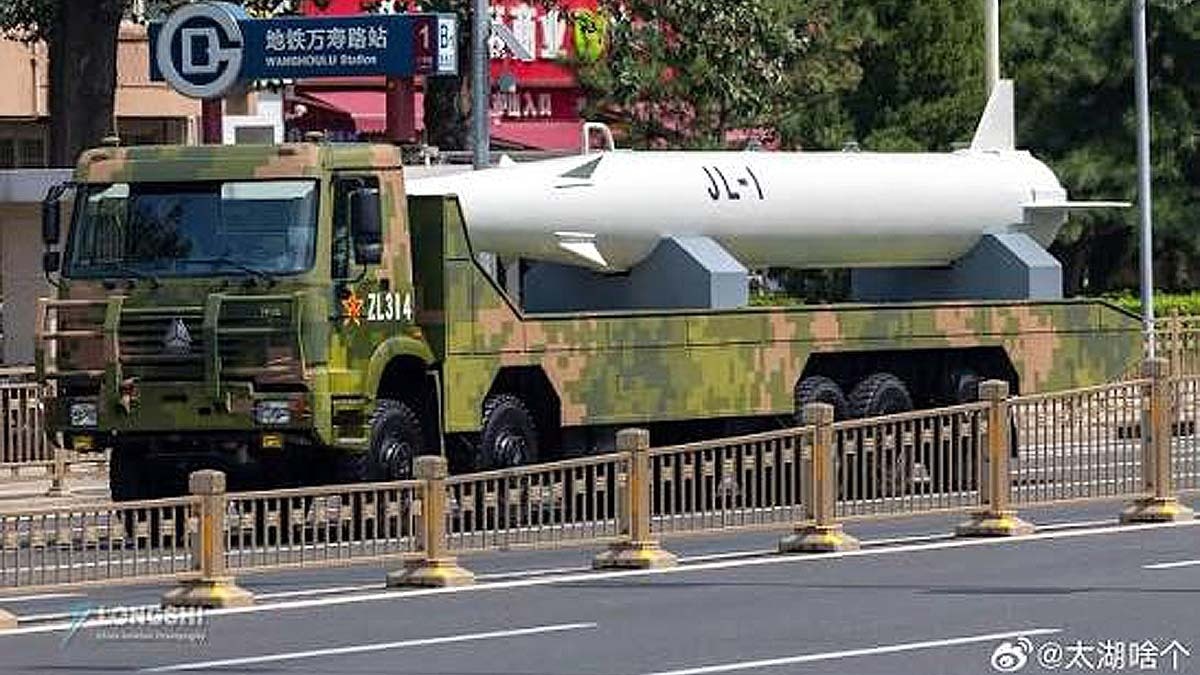
China has officially showcased its advanced air-launched nuclear-capable ballistic missile, capable of targeting any location in India. Carried by the H-6N strategic bomber, this weapon system significantly alters the strategic balance in the Indo-Pacific region.
Key Takeaways
- China's new air-launched ballistic missile (ALBM) puts the entire Indian subcontinent within its operational strike range.
- The missile is deployed via the Xian H-6N bomber, enhancing China's air-leg of its nuclear triad.
- This development escalates regional security tensions and forces India to reassess its air defense capabilities.
In a highly provocative display of military modernization, China has officially unveiled its state-of-the-art air-launched ballistic missile (ALBM), widely believed to be the CH-AS-X-13. Mounted on the specialized Xian H-6N bomber, this nuclear-capable missile possesses an estimated range that places the entirety of India, along with key US bases in the Pacific, well within its strike zone. This development marks a significant leap in Beijing's quest to solidify a robust and highly survivable nuclear triad.
The integration of a ballistic missile onto a strategic bomber platform provides China with unprecedented operational flexibility. Unlike ground-launched systems, air-launched ballistic missiles can be deployed rapidly over vast distances, bypassing traditional early-warning radar networks. Defense analysts warn that this capability dramatically reduces the reaction time for targeted nations, raising the stakes for regional deterrence.
Why This Matters
BozokMedia analysis shows that this deployment is not merely a technological showcase but a strategic message aimed at India and the broader Quad alliance. By ensuring that its bombers can strike deep within Indian territory from safe stand-off distances within Chinese airspace, Beijing is establishing a formidable deterrent designed to restrict India's strategic options during border disputes.
"The deployment of the CH-AS-X-13 on the H-6N bomber completes China's air-based nuclear deterrent, presenting a complex multi-directional threat that India's current air defense systems will struggle to intercept." - Dr. Evelyn Vance, Strategic Defense Analyst.
Historical Background
For decades, China relied heavily on its land-based rocket forces (PLARF) and submarine-launched ballistic missiles (SLBMs) for nuclear deterrence. The air leg of its nuclear triad was historically the weakest, relying on aging bomber designs. However, the modification of the H-6 bomber series, particularly the refueling-capable H-6N, has transformed China's air power, allowing it to project nuclear force far beyond its immediate borders.
| Feature | China (CH-AS-X-13 / H-6N) | India (Agni-V / Rafale) |
|---|---|---|
| Platform Type | Air-Launched Ballistic Missile (ALBM) | Land-Based ICBM / Air-Launched Cruise |
| Estimated Range | 3,000+ km (Missile) + Bomber Radius | 5,000+ km (Agni-V) |
| Warhead Capability | Nuclear / Conventional | Nuclear / Conventional |
| Reaction Time | Extremely Short (Air-launched) | Standard (Silo/Mobile launcher) |
Frequently Asked Questions
Q1: What is the CH-AS-X-13 missile?
Answer: It is China's advanced air-launched ballistic missile (ALBM) designed to carry nuclear warheads and launched from strategic bombers.
Q2: How does this impact India's security?
Answer: It exposes the entire Indian landmass to potential nuclear strikes from Chinese airspace, necessitating advanced air defense systems like the S-400.