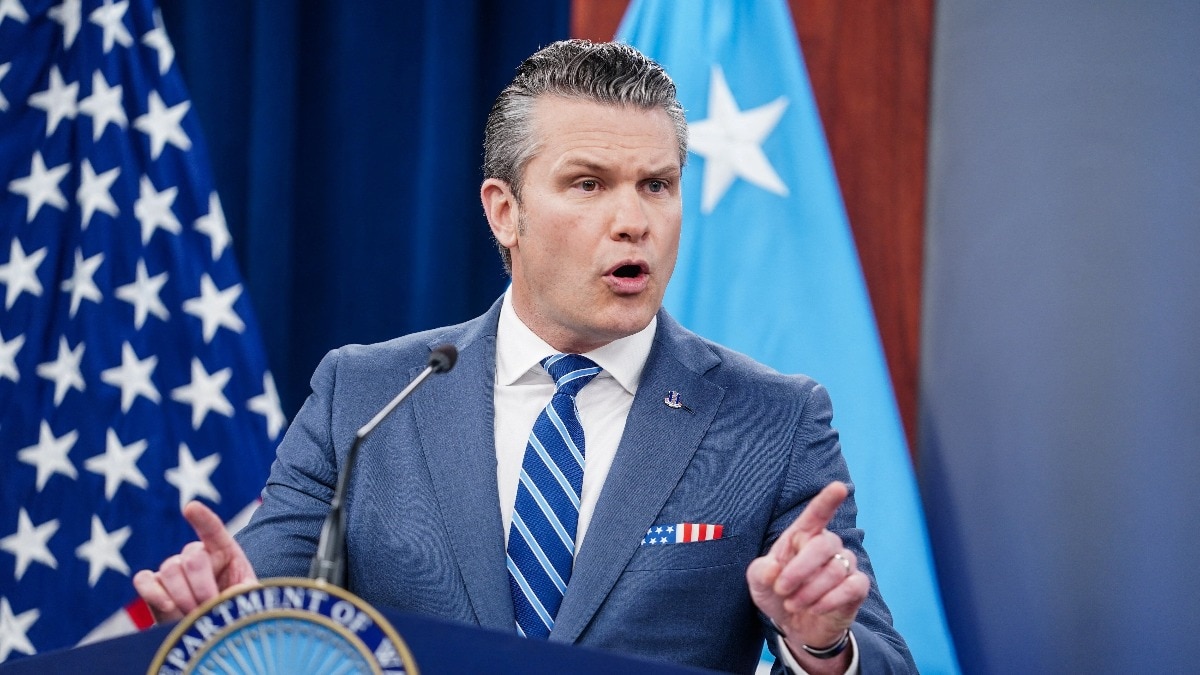
US War Secretary Pete Hegseth has warned that the US Navy can maintain a blockade on Iranian ports indefinitely through ship rotations. This follows President Trump's claim of 'total control' over the Strait of Hormuz, met with fierce rejection from Tehran.
Key Takeaways
- US War Secretary Pete Hegseth confirmed the US Navy's ability to sustain an indefinite blockade via ship rotation.
- President Donald Trump claimed 'total control' over the Strait of Hormuz, calling it a 'Steel Wall'.
- Iran's PGSA rejected US claims, asserting the strategic waterway remains closed.
- The escalating tension poses a massive risk to global crude oil markets and shipping routes.
In a high-stakes development, US War Secretary Pete Hegseth stated in Panama City that the United States possesses the naval capacity to maintain a blockade on Iranian ports for an indefinite period. Hegseth emphasized that by rotating naval vessels within the region, the US Navy can ensure a continuous and prolonged presence to enforce its strategic objectives.
This warning underscores the aggressive stance of the Trump administration. President Donald Trump recently asserted on Truth Social that the US has 'complete control' over the Strait of Hormuz. Describing the naval blockade as a 'Steel Wall,' Trump claimed that Iran's regional dominance has vanished and highlighted the country's internal economic struggles, including a staggering 300% inflation rate.
Why This Matters
BozokMedia analysis shows that the Strait of Hormuz is one of the world's most critical geopolitical 'chokepoints.' Any prolonged military standoff in this narrow corridor threatens to disrupt the global energy supply chain, potentially sending crude oil prices into a volatile spiral and forcing commercial shipping companies to seek much costlier alternative routes.
The US strategy of naval rotation signals a shift from temporary pressure to a long-term containment policy designed to neutralize Iranian maritime influence.
However, the Iranian Persian Gulf Strait Authority (PGSA) has hit back, dismissing the US claims as mere rhetoric. Tehran has maintained that the strategic waterway remains closed and will not reopen until their specific conditions are met, highlighting a dangerous deadlock between the two powers.
Frequently Asked Questions
1. What is the significance of the Strait of Hormuz?
It is a vital maritime passage through which a significant portion of the world's oil supply transits daily.
2. How does the US plan to maintain the blockade?
The US Navy intends to use a continuous rotation of warships to ensure a permanent naval presence in the area.