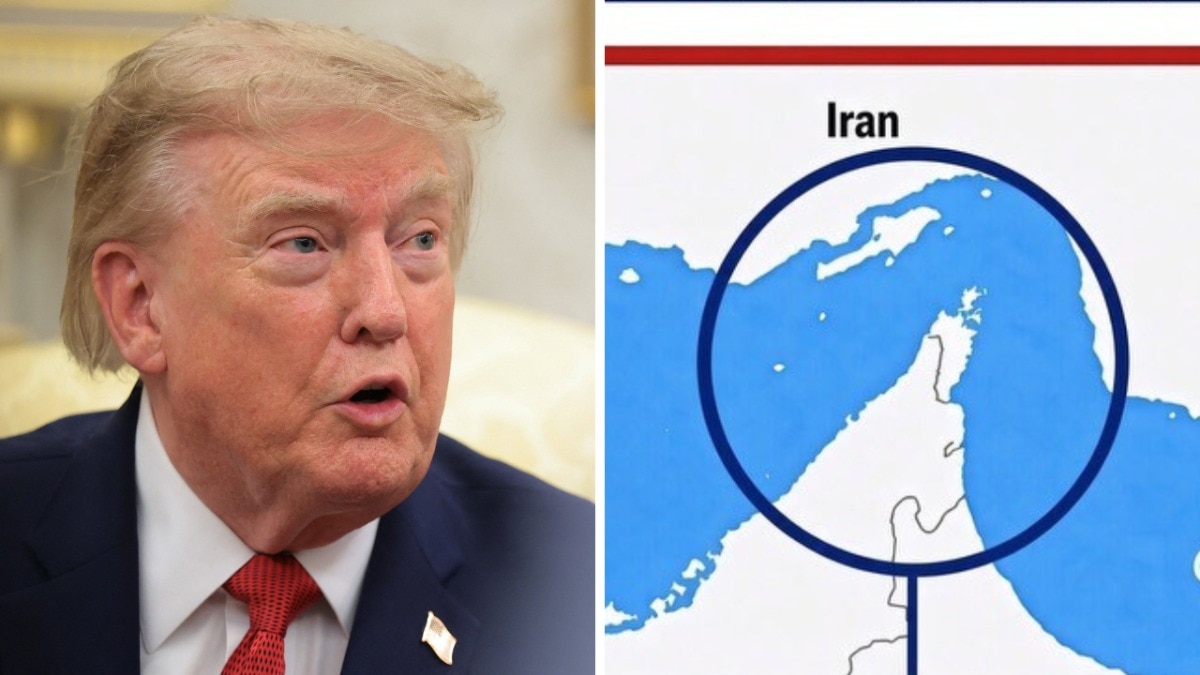
U.S. President Donald Trump has sparked global controversy by posting a map on Truth Social declaring the Strait of Hormuz as new American territory. Iran has vehemently rejected these claims, warning of severe consequences.
- Donald Trump posted a graphic on Truth Social labeling the Strait of Hormuz as 'NEW U.S. Territory'.
- The claim involves the strategic waterway located between Iran and Oman.
- Iran and the Persian Gulf Strait Authority have officially debunked the claims.
- The Strait of Hormuz remains a critical chokepoint for global oil supplies.
In a move that has sent shockwaves through the international diplomatic community, U.S. President Donald Trump has claimed sovereignty over the Strait of Hormuz. On Tuesday, using his social media platform Truth Social, Trump shared a map that explicitly encircles the strategic waterway and labels it as 'NEW U.S. Territory'. This provocative assertion comes amidst escalating tensions between the United States and Iran.
This is not the first time Trump has targeted this specific maritime corridor. He had previously asserted that the U.S. maintains absolute control over the region, describing the American naval blockade as a 'Steel Wall' that Iran is powerless to breach. Trump has frequently criticized Iran's domestic stability, citing hyperinflation and a weakened military infrastructure as evidence of the nation's decline.
Why This Matters
BozokMedia analysis shows that the Strait of Hormuz is the world's most critical oil transit chokepoint. Any claim of territorial sovereignty over this area could trigger a massive geopolitical conflict, affecting global energy prices and international maritime laws. The tension between the US and Iran in this region is not just a bilateral issue but a global economic concern.
The claim of control over Hormuz represents a significant escalation in the rhetoric of maritime dominance.
The response from Tehran was swift and uncompromising. The Persian Gulf Strait Authority (PGSA) issued a statement on X (formerly Twitter), stating that the repetitive claims made by American officials do not alter the reality on the ground. They emphasized that the maritime status quo remains unchanged despite the rhetoric coming from Washington.
Furthermore, Mohsen Rezaee, the head of Iran's Supreme National Security Council (SNSC), made it clear that the Strait would remain under Iranian influence unless the U.S. agrees to a ceasefire in Lebanon and Gaza, restores seized Iranian assets, and ends its military blockades. The diplomatic standoff has reached a fever pitch, with both sides exchanging increasingly hostile rhetoric.
Iranian leaders have also resorted to sarcasm. Ebrahim Azizi mocked Trump's ambitions, suggesting that instead of making territorial claims, the U.S. President should focus on his own domestic security concerns. This exchange highlights the deep-seated animosity that continues to define U.S.-Iran relations.
Historical Background
The Strait of Hormuz is a narrow waterway that connects the Persian Gulf with the Gulf of Oman and the Arabian Sea. For decades, it has been the most vital artery for the global petroleum market. Because a significant portion of the world's liquefied natural gas and crude oil passes through this narrow gap, it has become a perennial flashpoint for military exercises and geopolitical brinkmanship.
Frequently Asked Questions
1. Does the U.S. actually own the Strait of Hormuz?
No. The Strait is international waters, though it lies adjacent to the territorial waters of Iran and Oman. Trump's statement is a political claim, not a legal reality.
2. How does this affect global oil prices?
Any military escalation or perceived threat to the freedom of navigation in the Strait typically causes oil prices to rise due to market uncertainty.