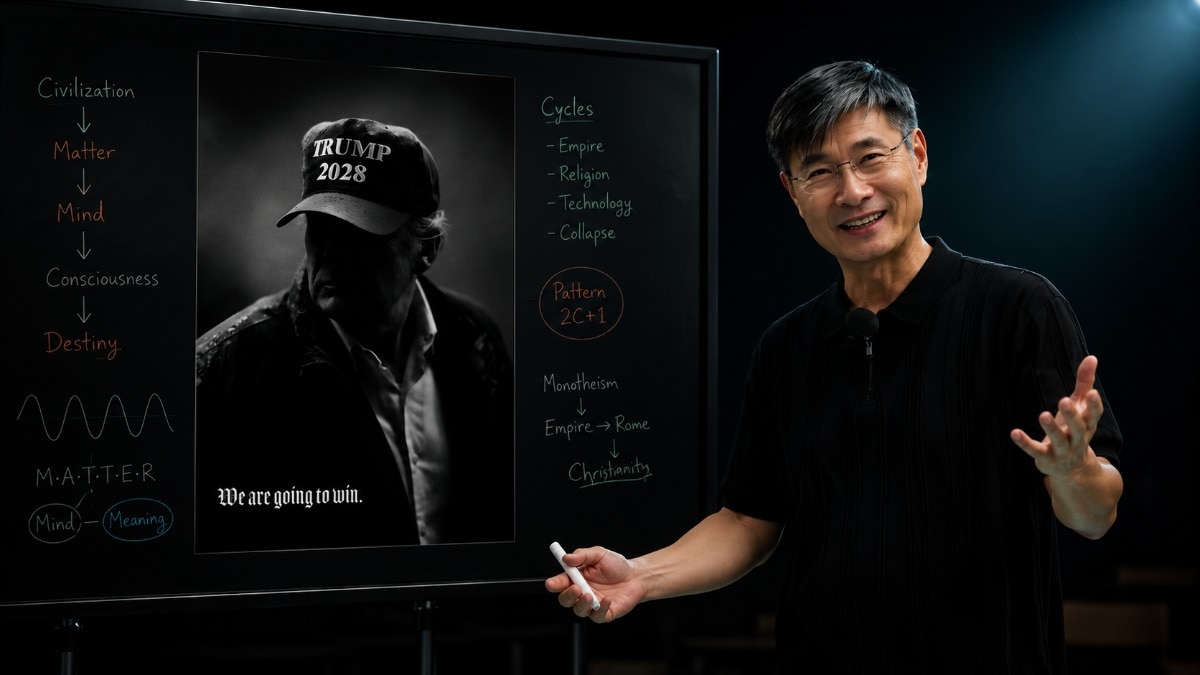
Former US President Donald Trump has ignited a political firestorm by posting an image in a 'Trump 2028' cap. This move brings renewed attention to Professor Jiang Xueqin's provocative theory regarding a constitutional loophole for a third term.
- Donald Trump posted a 'Trump 2028' cap image on Truth Social, claiming "We are going to win."
- The 22nd Amendment of the US Constitution generally prohibits a person from being elected president more than twice.
- Professor Jiang Xueqin predicts Trump could bypass this by running for Vice President first.
- Legal experts remain divided on whether the 12th Amendment blocks this specific pathway.
The political landscape of the United States has been thrown into a state of intense speculation following a provocative social media post by Donald Trump. The 80-year-old leader shared an image on his platform, Truth Social, sporting a cap emblazoned with "Trump 2028," accompanied by the defiant caption, "We are going to win." While Trump has previously acknowledged that the law presents a significant hurdle, this latest gesture suggests he is either trolling his political adversaries or actively exploring a path back to the White House beyond the traditional limits.
This development has cast a bright spotlight on the predictions of Professor Jiang Xueqin, a Chinese-born Canadian educator. During a recent appearance on the Raj Shamani podcast, Jiang posited that Trump would somehow secure a third term in office. While such a notion sounds like political science fiction, Jiang's previous track record—including predictions regarding the US-Israel conflict with Iran and Trump's 2024 return—has given his theories a newfound level of scrutiny.
Why This Matters
BozokMedia analysis shows that this is not merely about a cap; it is about the testing of democratic norms and constitutional boundaries. If a leader attempts to circumvent term limits, it could lead to a fundamental restructuring of the American executive branch or, as Professor Jiang warns, a political "dumpster fire" that could trigger civil unrest.
The crux of the issue lies in the 22nd Amendment, which states that no person shall be elected to the office of the President more than twice. Since Trump won in 2016 and 2024, he is constitutionally barred from being elected again in 2028. However, Professor Jiang points to a subtle linguistic loophole: the amendment prohibits being "elected," but it does not explicitly forbid serving as president through other means.
"There is nothing in the constitution that says that a president cannot run as vice president and then the president resigns and he becomes the president."
The theory suggests Trump could run for Vice President in 2028. If the sitting President were to resign or become incapacitated, Trump would ascend to the presidency. However, legal scholars argue that the 12th Amendment complicates this, as it states that no person constitutionally ineligible to be President shall be eligible to that of Vice-President. Whether the 22nd Amendment's limit on being "elected" creates a total "ineligibility" remains a point of fierce legal debate.
| Pathway | Constitutional Status | Feasibility |
|---|---|---|
| Direct Election (2028) | Prohibited by 22nd Amendment | Impossible |
| VP Succession Route | Debatable (12th vs 22nd Amendment) | Highly Unlikely/Theoretical |
| Constitutional Amendment | Requires 2/3 Congress & 3/4 States | Politically Improbable |
Frequently Asked Questions
Q1: Can Donald Trump legally run for President in 2028?
Under the 22nd Amendment, he cannot be elected to the presidency a third time.
Q2: What is Professor Jiang's specific theory?
He suggests Trump could run for Vice President and then ascend to the presidency if the elected President resigns.