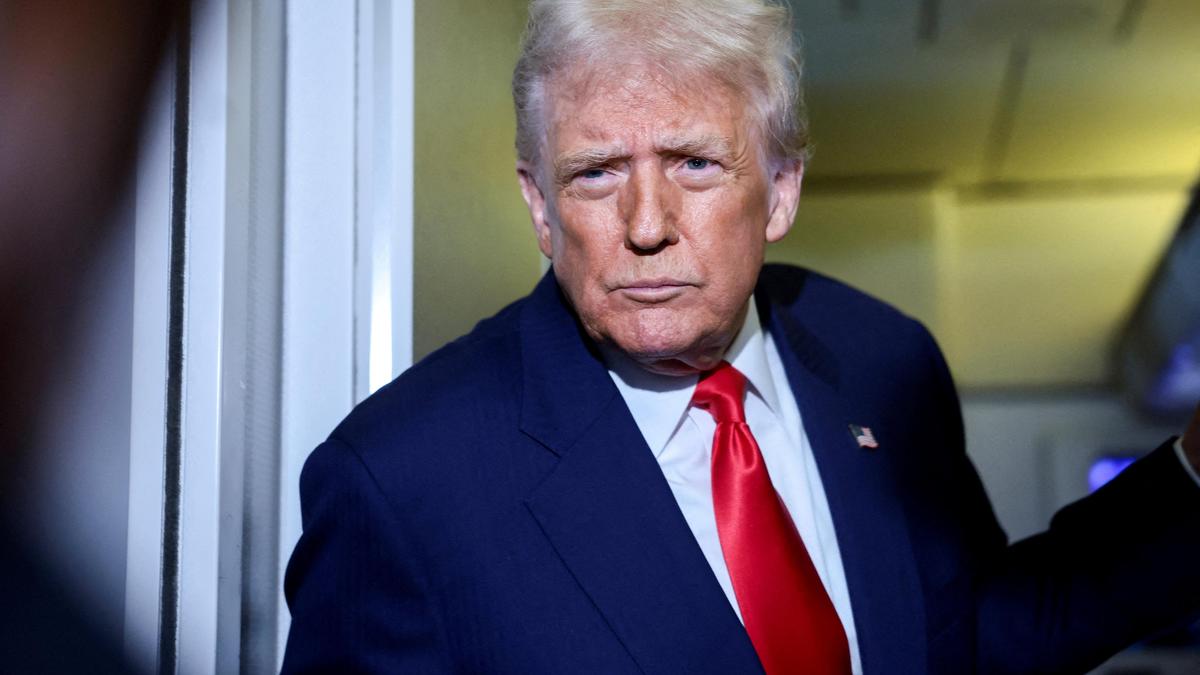
President Donald Trump has urged Republicans to eliminate the Senate filibuster to break a legislative deadlock during a prolonged government shutdown. This move would allow the GOP to pass legislation with a simple majority, fundamentally altering U.S. legislative dynamics.
- President Trump advocates for the 'Nuclear Option' to remove the 60-vote filibuster requirement.
- The U.S. government remains in a partial shutdown for 30 days, threatening the economy.
- CBO estimates the shutdown could cost the U.S. between $7 billion and $14 billion.
In a bold move to dismantle long-standing legislative hurdles, President Donald Trump has declared that the time has come to eliminate the U.S. Senate's filibuster custom. The President's call comes amid a high-stakes political standoff and a government shutdown that has now entered its 30th day, leaving federal agencies in limbo and the economy under significant pressure.
The filibuster is a procedural mechanism in the Senate that effectively requires a supermajority of 60 votes—out of the 100 total seats—to end debate and move to a final vote on most pieces of legislation. While Republicans currently hold a 53-47 majority in the Senate and a 219-213 majority in the House of Representatives, they lack the 60-vote threshold necessary to bypass Democratic opposition on key spending bills.
Taking to social media, Trump urged his party to play their "TRUMP CARD" by employing what is known in Washington as the "Nuclear Option." This refers to a parliamentary procedure that allows the Senate to change its rules with a simple majority vote, potentially permanently removing the filibuster requirement for legislation.
Why This Matters
BozokMedia analysis shows that this is not merely a procedural dispute but a fundamental shift in how the United States governs. If the filibuster is removed, the governing party can pass sweeping legislative agendas without any bipartisan support. This could lead to extreme policy swings every time the White House changes hands, creating an era of legislative volatility.
"The removal of the filibuster would transform the U.S. Senate from a deliberative body into a majoritarian chamber, accelerating the polarization of American lawmaking."
The urgency of this move is underscored by the dire warnings from the nonpartisan Congressional Budget Office (CBO). According to recent data, the ongoing lapse in government spending could cost the U.S. economy between $7 billion and $14 billion, potentially shaving up to 2% off the gross domestic product (GDP) in the fourth quarter.
Historical Background
The filibuster has been a staple of the U.S. Senate for over a century, originally designed to protect the interests of the minority party and ensure that legislation is thoroughly debated. However, in recent decades, it has been increasingly viewed by both parties as a tool for total obstruction rather than constructive deliberation.
| Feature | Current Rule (Filibuster) | Proposed Change (Nuclear Option) |
|---|---|---|
| Votes Required | 60 Votes (Supermajority) | 51 Votes (Simple Majority) |
| Minority Power | High (Can block bills) | Low (Cannot block bills) |
| Legislative Speed | Slow/Deliberative | Fast/Decisive |
Frequently Asked Questions
What is the 'Nuclear Option' in the Senate?
It is a parliamentary procedure that allows the Senate to override a rule (like the filibuster) by a simple majority vote, rather than the usual two-thirds majority required to change Senate rules.
How does the government shutdown affect the GDP?
The CBO suggests that the lack of government spending leads to lost productivity and reduced economic activity, which could lower the overall GDP by up to 2%.