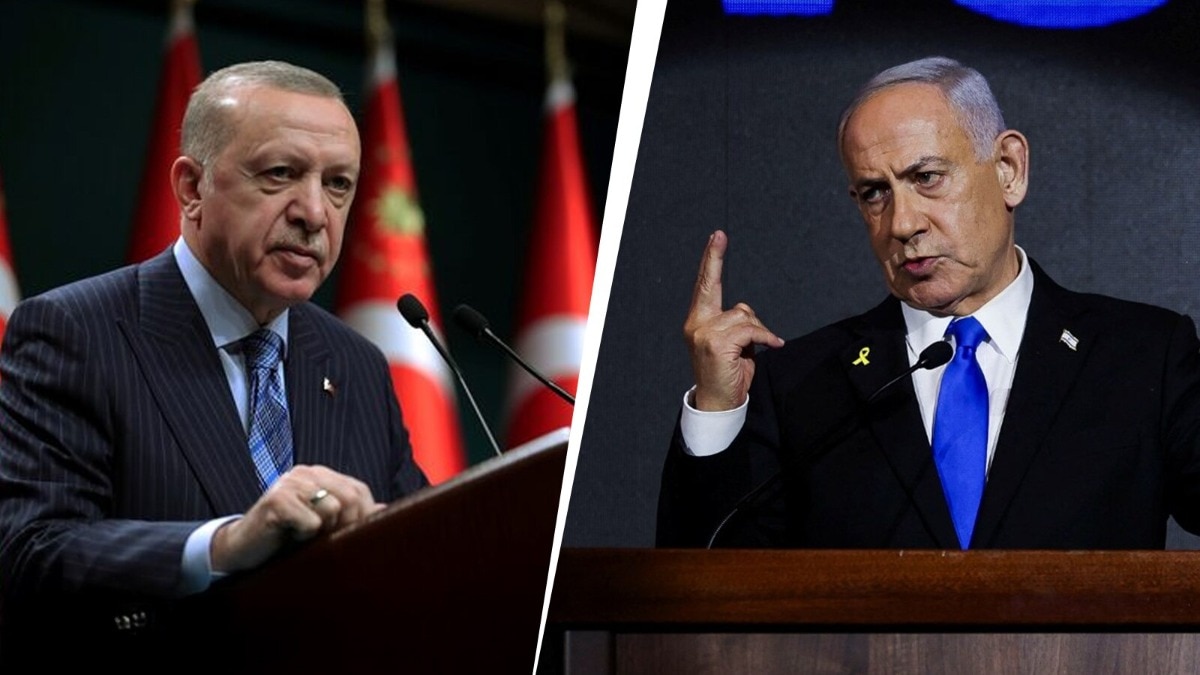
Rising tensions between Israel and Turkey over Syria have taken a dramatic turn. A recent report reveals that if Israeli forces target Turkish military assets deployed in Syria, NATO's Article 5 collective defense clause will not protect Turkey.
- A loophole in NATO's Article 5 means collective defense does not apply to member troops stationed on foreign soil like Syria.
- Israel fears Turkey's growing military footprint and training programs in Syrian territory.
- Recent Israeli airstrikes on Syrian airbases highlight the imminent threat of a direct Israel-Turkey military confrontation.
Geopolitical tensions in the Middle East have escalated to a critical threshold as Israel and Turkey edge closer to a potential military showdown over Syria. A prominent analysis published in the right-leaning Israeli daily Israel Hayom has sent shockwaves through international diplomatic circles. The report asserts that if Israel launches airstrikes against Turkish military personnel or assets deployed within Syria, Turkey cannot invoke NATO’s famous Article 5 to rally its Western allies for defense.
Underpinning this claim is the specific legal phrasing of the North Atlantic Treaty. Article 5, the cornerstone of NATO, establishes the principle of collective defense, declaring that an attack against one member is an attack against all. However, this guarantee is strictly bound by geography; it applies only to attacks occurring on the sovereign territory of member states. Because Syria is an independent nation and not Turkish territory, Turkish forces operating there fall outside the protective umbrella of Article 5.
Syria has long served as a proxy battleground for various regional powers, and Israel is increasingly alarmed by Turkey's expanding military influence there. According to intelligence assessments, Turkish military delegations have recently inspected strategic Syrian bases, including T4, Palmyra, and Hama, to assist in training Syrian forces and rebuilding military infrastructure. This expanding footprint is viewed by Jerusalem as a direct threat to its northern security corridor.
Why This Matters
BozokMedia analysis shows that the potential bypass of NATO's Article 5 creates a highly volatile security vacuum in the Levant. If Israel feels legally and militarily unconstrained to target Turkish assets in Syria, the risk of a miscalculation leading to a wider regional war increases exponentially. It also tests the limits of NATO's commitments to its easternmost member, Turkey, at a time when Ankara's relations with Western allies are already strained.
In a clear demonstration of this volatile dynamic, Israel recently conducted an airstrike on an inactive Syrian airbase, pre-empting what it believed was an imminent Turkish military deployment. While Syrian officials claimed the site was only hosting a technical team repairing the runway, the strike drew sharp criticism from Washington. Tom Barack, the US Ambassador to Turkey and Special Envoy for Syria, criticized the strike as an "unnecessary escalation" and called for a de-confliction mechanism to prevent accidental clashes.
"The legal limitations of NATO's Article 5 on foreign soil leave Turkish forces highly exposed in Syria, potentially emboldening Israel to act aggressively to curb Ankara's regional ambitions." - International Security Analyst
To understand the strategic balance between the two regional heavyweights, a comparison of their geopolitical standing and military focus is essential:
| Factor | Israel | Turkey |
|---|---|---|
| NATO Status | Non-NATO Member (Major Non-NATO Ally) | Full NATO Member with the alliance's second-largest army |
| Strategic Objectives in Syria | Contain Iranian/Turkish influence, disrupt Hezbollah supply lines | Neutralize Kurdish militia threats, train Syrian state forces |
| Air Power Capability | Highly advanced, featuring state-of-the-art F-35 stealth fighters | Formidable air force supported by cutting-edge domestic drone tech |
Frequently Asked Questions
Q1: Why doesn't NATO's Article 5 protect Turkey in Syria?
A1: Article 5 only applies to attacks on a member state's sovereign territory. Since Syria is foreign soil, any attack on Turkish forces stationed there does not trigger the treaty's collective defense obligations.
Q2: What was the US reaction to Israel's recent airstrikes targeting potential Turkish sites?
A2: The US, through Envoy Tom Barack, criticized the strikes as an unnecessary escalation and urged both sides to establish a communication channel to avoid miscalculations.