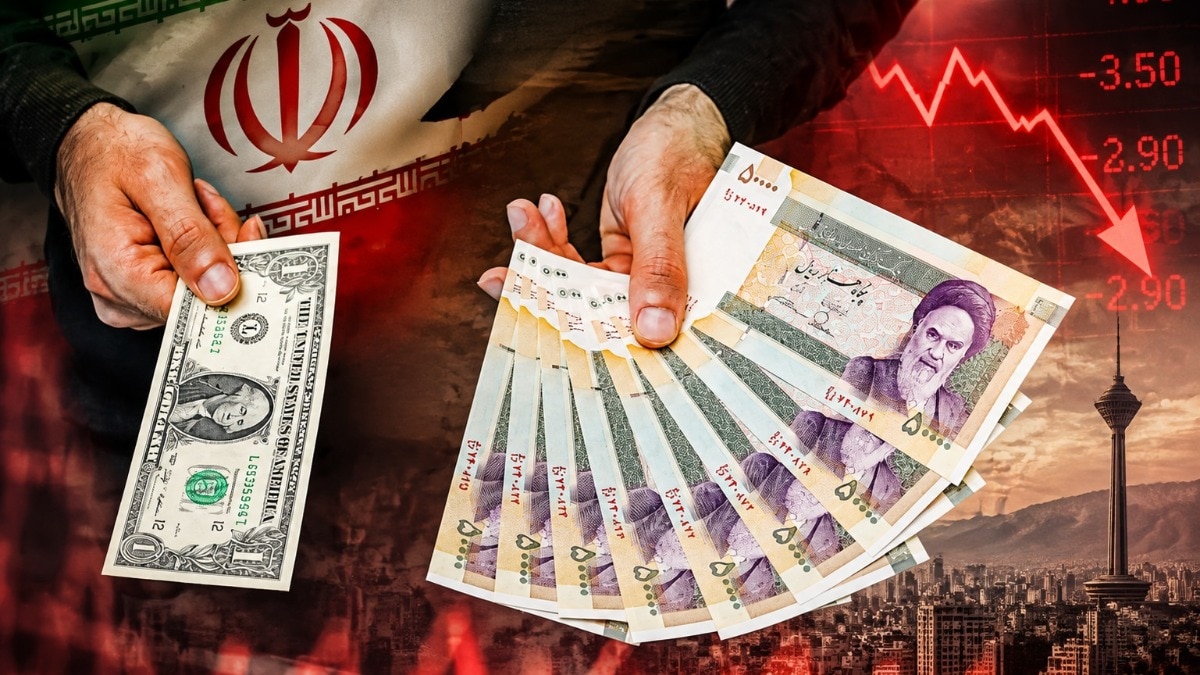
The Iranian Rial has crashed to an unprecedented low against the US Dollar, hitting 2.02 million Rial per dollar in informal markets. This collapse comes as Washington prepares for even more severe 'Economic D-Day' sanctions.
- The Iranian Rial hit a historic low against the US Dollar.
- Informal market rates reached 20.2 lakh (2.02 million) Rial per 1 USD.
- The US is preparing for a new wave of 'Economic D-Day' sanctions.
- UAE has suspended all trade with Iran, dealing a massive blow to Tehran.
The economy of Iran is spiraling into a deep crisis as its national currency, the Rial, has collapsed to record-breaking lows against the US Dollar. In the informal money markets, the exchange rate has touched a staggering 20.2 lakh Rial per 1 USD, significantly higher than the central bank's official rate of approximately 15 lakh Rial. This depreciation reflects the extreme volatility and loss of confidence in the local economy.
A Looming Economic 'D-Day'
This currency crash is occurring against the backdrop of Washington's imminent announcement of even more stringent economic sanctions. US Treasury Secretary Scott Bessent has signaled that these upcoming measures will serve as an 'Economic D-Day,' designed to further squeeze an economy already reeling from war, hyperinflation, and negative growth. The administration aims to intensify the pressure on Tehran through secondary sanctions on any nation continuing to trade with Iran.
The systematic dismantling of Iran's economic infrastructure is becoming a central pillar of US foreign policy.
The economic landscape was already fragile due to double-digit inflation and the fallout from military tensions involving the US and Israel earlier this year. However, the ongoing conflict over the past six months has acted as a catalyst, pushing the Rial into a freefall.
Strategic Importance of the Strait of Hormuz
BozokMedia analysis shows that the economic warfare is intrinsically linked to maritime security. Despite the sanctions, Iran maintains a significant grip on the Strait of Hormuz, a vital global chokepoint through which one-fifth of the world's oil trade passes. Any escalation in this corridor threatens to disrupt global energy markets and spike oil prices worldwide.
While Oman is reportedly in talks regarding the joint management of these waterways to ensure safe passage, the US has issued stern warnings to regional allies against any cooperation that undermines the sanctions regime.
The UAE Factor and Trade Isolation
In a devastating blow to Tehran, the United Arab Emirates (UAE) has officially announced the suspension of all trade with Iran. As one of Iran's largest trading partners and a primary financial hub for re-exports, the UAE's decision significantly limits Iran's ability to access essential imports and manage its foreign exchange reserves.
Frequently Asked Questions
Question 1: Why is the Rial falling so rapidly?
Answer: The rapid decline is driven by intense US economic sanctions, regional warfare, and hyperinflation.
Question 2: What are secondary sanctions?
Answer: Secondary sanctions target third-party countries or entities that continue to conduct business with a sanctioned nation like Iran.