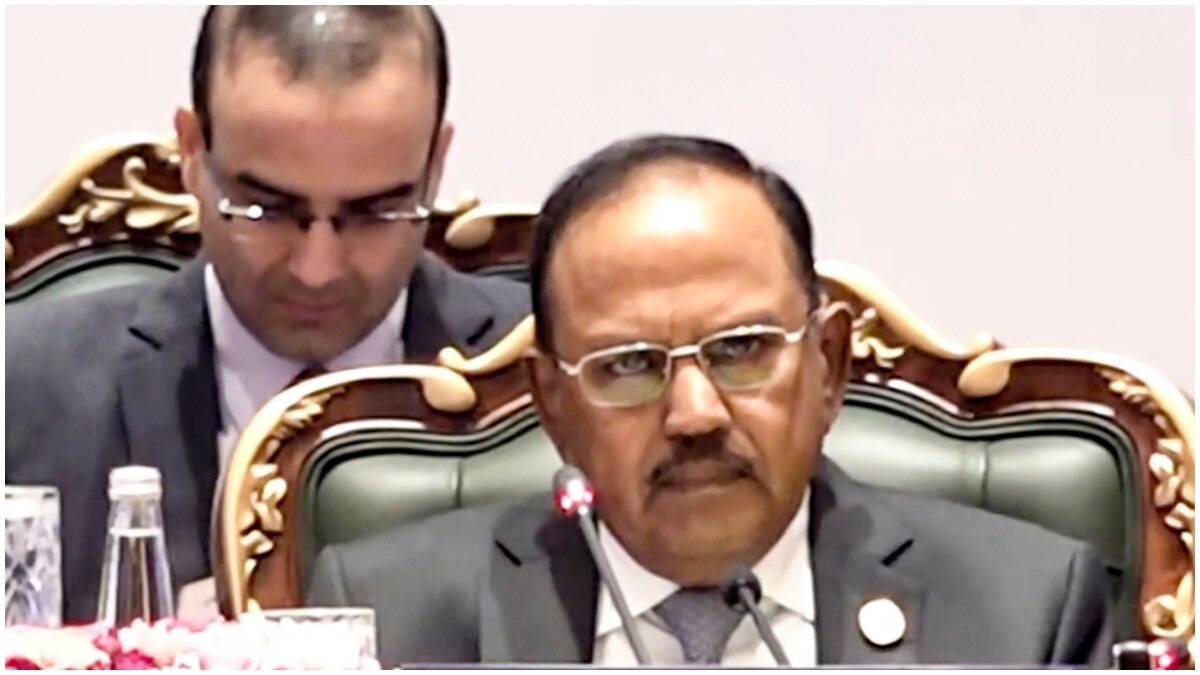
National Security Advisor Ajit Doval has reached Beijing for the 25th round of Special Representatives talks. The meeting comes at a critical juncture with ongoing tensions in Arunachal Pradesh and uncertainty surrounding President Xi Jinping's visit for the BRICS summit.
- NSA Ajit Doval is participating in the 25th round of India-China Special Representatives talks in Beijing.
- Discussions will focus on the boundary dispute, bilateral ties, and regional stability.
- The talks coincide with uncertainty regarding President Xi Jinping's attendance at the upcoming BRICS summit in India.
National Security Advisor Ajit Doval has arrived in Beijing to engage in the 25th round of Special Representatives talks with Chinese Foreign Minister Wang Yi. This high-level meeting aims to address the long-standing boundary dispute between India and China, a matter that has remained a flashpoint for diplomatic tension for years.
The timing of this visit is particularly sensitive. While both nations seek to stabilize relations following the 2020 Galwan Valley clash, uncertainty looms over whether Chinese President Xi Jinping will visit India for the BRICS summit scheduled for mid-September. A visit from Xi could facilitate a crucial meeting with Prime Minister Narendra Modi, potentially resetting the bilateral trajectory.
Why This Matters
BozokMedia analysis shows that the success of this meeting is contingent upon addressing the 'peace and tranquillity' mandate. India has consistently maintained that border stability is a non-negotiable prerequisite for normal diplomatic and economic relations. Any breakthrough in the Special Representatives mechanism could provide the necessary buffer to prevent future military standoffs.
Maintaining peace and tranquillity along the Line of Actual Control is of utmost importance for the overall course of bilateral relations.
A major bone of contention remains Arunachal Pradesh. India has recently rejected Beijing's attempts to rename geographical features in the region, reaffirming that Arunachal Pradesh is an 'inalienable and integral' part of India. The Chinese government's claims over the region continue to pose a significant challenge to New Delhi's sovereignty claims.
Historical Background
The Special Representatives mechanism was established in 2003 to resolve the complex 3,488 km boundary dispute. While it has served as a vital channel for communication to prevent escalation, it has yet to produce a final settlement. The relationship underwent severe strain after the 2020 military standoff in eastern Ladakh, necessitating these ongoing high-level dialogues.
| Feature | India's Position | China's Position |
|---|---|---|
| Arunachal Pradesh | Integral part of India | Claims as 'South Tibet' |
| Border Status | Demands peace/tranquillity | Claims 'generally stable' |
Frequently Asked Questions
1. What is the purpose of the Special Representatives mechanism?
It is a structured channel established in 2003 to negotiate and resolve the India-China boundary dispute.
2. Is there a confirmed visit by Xi Jinping to India?
There is no official confirmation yet, though officials remain optimistic about his participation in the BRICS summit.