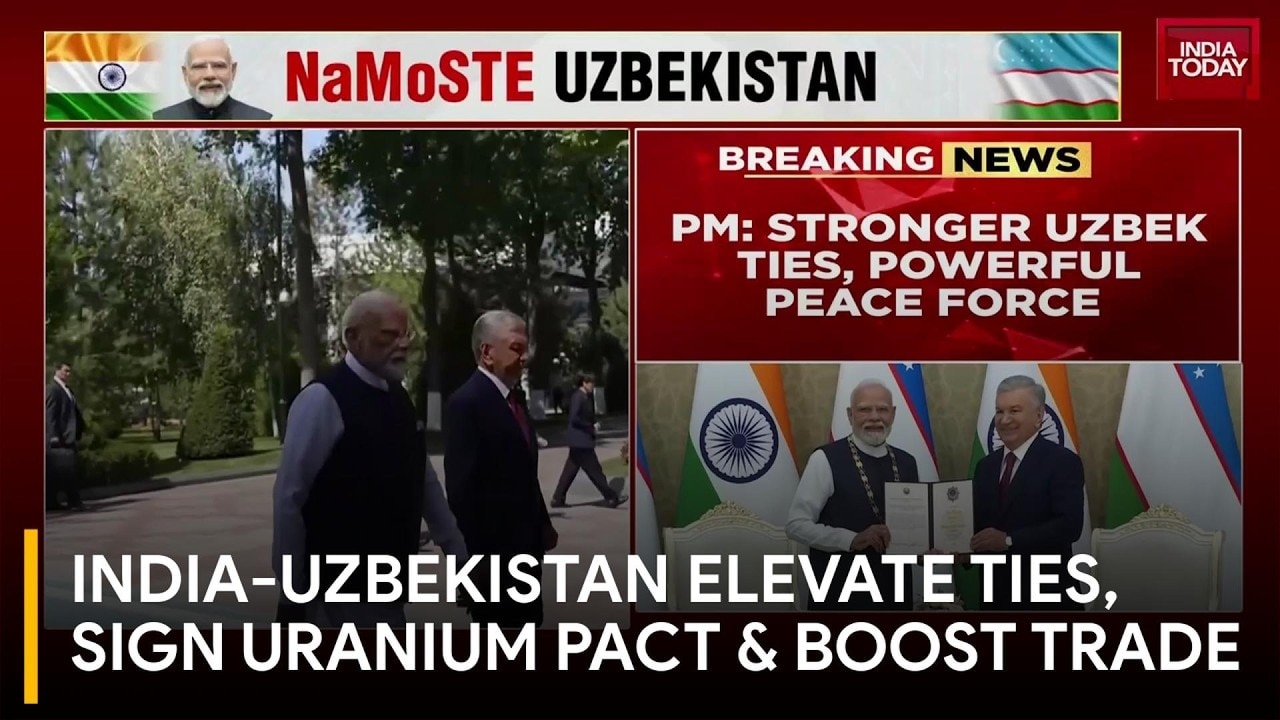
Prime Minister Narendra Modi has elevated India-Uzbekistan relations to a Comprehensive Strategic Partnership, aiming for $5 billion in bilateral trade by 2030.
- India and Uzbekistan have upgraded their relationship to a Comprehensive Strategic Partnership.
- A massive trade target of $5 billion has been set for the year 2030.
- Both nations committed to zero tolerance against terrorism and extremism in the region.
Prime Minister Narendra Modi, during his fourth official visit to Uzbekistan, has marked a significant milestone in bilateral relations. Celebrating the 15th anniversary of their strategic partnership, the visit has transitioned the relationship into a Comprehensive Strategic Partnership, signaling deeper cooperation across multiple sectors.
A cornerstone of this enhanced relationship is the ambitious economic roadmap. The two nations have set a target to increase bilateral trade from the current $1 billion to a staggering $5 billion by 2030. This goal will be supported by intensive collaboration in digital public infrastructure, artificial intelligence, and the extraction of critical minerals.
Expanding Horizons: Defense and Energy
Beyond commerce, the partnership is set to penetrate high-tech and security domains. Key areas of focus include nuclear energy, space exploration, and defense manufacturing. Notably, the shift from mere procurement to defense co-production highlights a maturing security relationship between New Delhi and Tashkent.
Why This Matters
BozokMedia analysis shows that this strategic pivot is essential for India's energy security and its influence in the Central Asian region. By securing ties in critical minerals and nuclear energy, India is insulating itself against global supply chain volatilities.
The elevation of ties to a Comprehensive Strategic Partnership underscores Uzbekistan's role as a pivotal gateway for India in Central Asia.
The social and cultural fabric of the partnership is also being strengthened. Both leaders emphasized the preservation of Uzbekistan's Buddhist heritage, youth exchange programs, and sports cooperation, particularly in the field of chess, which has seen rising talent from both nations.
On the security front, PM Modi reaffirmed a stern stance against regional instability. Both leaders expressed a unified commitment to zero tolerance regarding terrorism, extremism, and separatism, ensuring that regional growth is not hindered by non-state actors.
Frequently Asked Questions
1. What is the new trade goal between India and Uzbekistan?
The goal is to reach $5 billion in bilateral trade by 2030.
2. Which security stance did both leaders adopt?
They adopted a policy of 'zero tolerance' against terrorism, extremism, and separatism.