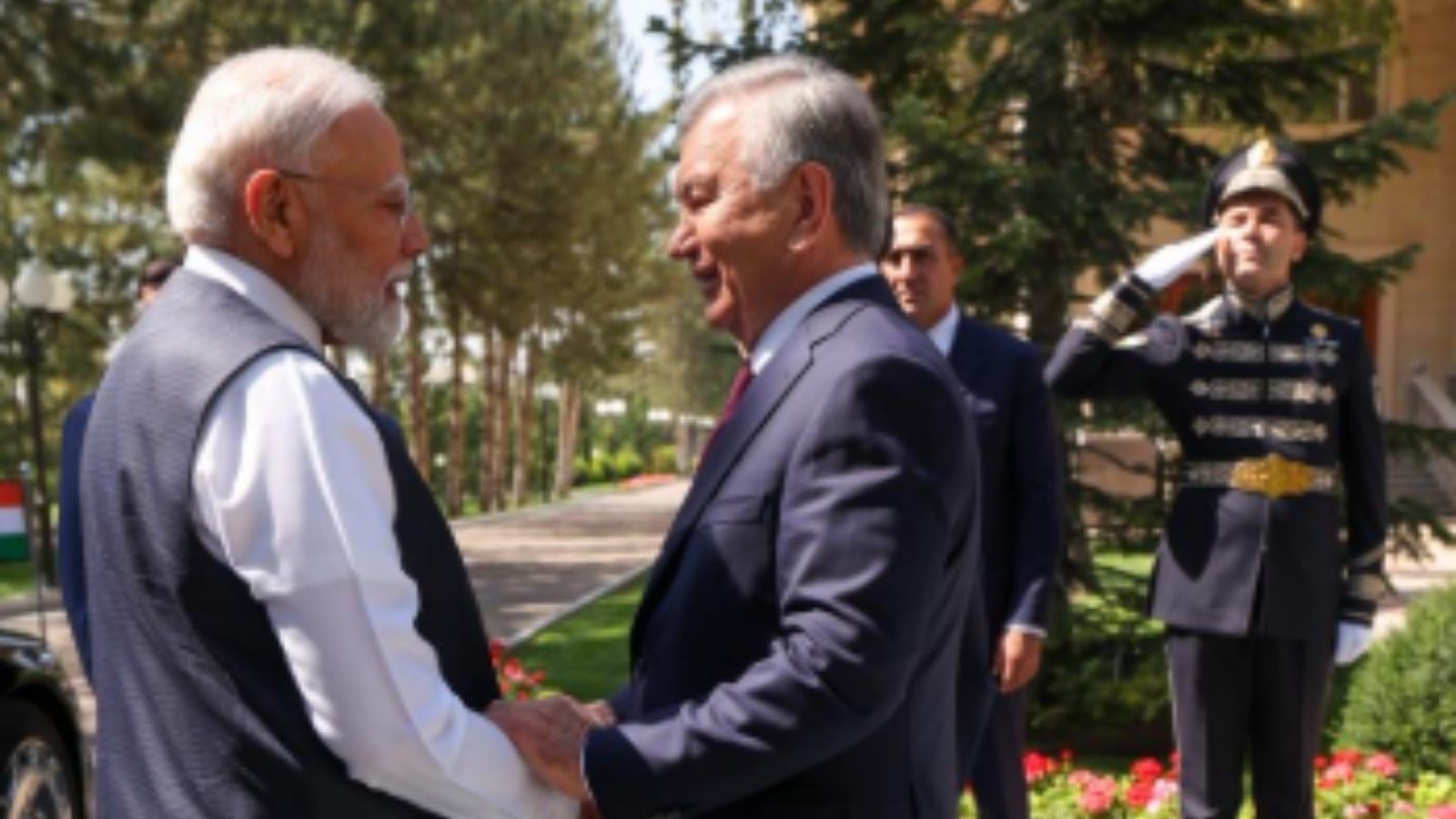
Prime Minister Narendra Modi and Uzbek President Shavkat Mirziyoyev have elevated bilateral ties to a Comprehensive Strategic Partnership, focusing on a long-term uranium supply framework and a $5 billion trade goal by 2030.
- Elevation of ties to a 'Comprehensive Strategic Partnership'.
- Bilateral trade target set at $5 billion by the year 2030.
- Establishment of a long-term framework for uranium supply for civilian nuclear energy.
- Agreement on the restoration of Buddhist sites Fayaz Tepa and Kara Tepa.
Prime Minister Narendra Modi, during his two-day official visit to Uzbekistan, held high-level bilateral talks with President Shavkat Mirziyoyev in Tashkent. The meeting marked a significant milestone in India's engagement with Central Asia, focusing on diversifying energy sources and expanding economic footprints.
According to official spokesperson Randhir Jaiswal, the discussions spanned a wide array of sectors including trade, investment, critical minerals, mining, and defense. A pivotal outcome of the meeting was the agreement to target $5 billion in bilateral trade by 2030, signaling a strong intent to boost economic interdependence. Furthermore, cooperation in digital public infrastructure, specifically the integration of UPI, was highlighted as a key area of growth.
Why This Matters
BozokMedia analysis shows that this strategic pivot toward Uzbekistan is a calculated move to secure India's energy future. By establishing a long-term uranium supply arrangement, India reduces its dependence on a limited set of suppliers for its civilian nuclear program. Moreover, the elevation to a Comprehensive Strategic Partnership allows for deeper military and security coordination in a region often dominated by other global superpowers.
"Securing critical mineral supply chains in Central Asia is no longer optional for India; it is a strategic necessity for the transition to clean energy and nuclear autonomy."
The diplomatic visit also emphasized cultural diplomacy. A Letter of Intent was signed for the conservation of the Fayaz Tepa and Kara Tepa Buddhist sites, reinforcing the historical and spiritual links between India and Uzbekistan. Several other MoUs covering Ayurveda, tourism, and education were also exchanged.
PM Modi highlighted that this elevation comes as the two nations celebrate the 15th anniversary of their strategic partnership. To ensure these goals are met, a Coordination Council at the Foreign Minister level will be established, and the existing joint commission will be upgraded from the secretary level to the ministerial level.
| Metric | Previous Status | New Agreement/Target |
|---|---|---|
| Partnership Level | Strategic Partnership | Comprehensive Strategic Partnership |
| Trade Target | Baseline levels | $5 Billion by 2030 |
| Uranium Supply | Ad-hoc/Limited | Long-term Framework |
| Joint Commission | Secretary Level | Ministerial Level |
Frequently Asked Questions
1. What is the trade target set by India and Uzbekistan?
The two nations have set an ambitious bilateral trade target of $5 billion to be achieved by 2030.
2. Why is the uranium agreement significant for India?
It ensures a stable, long-term supply of uranium, which is essential for India's civilian nuclear power plants to generate clean energy.