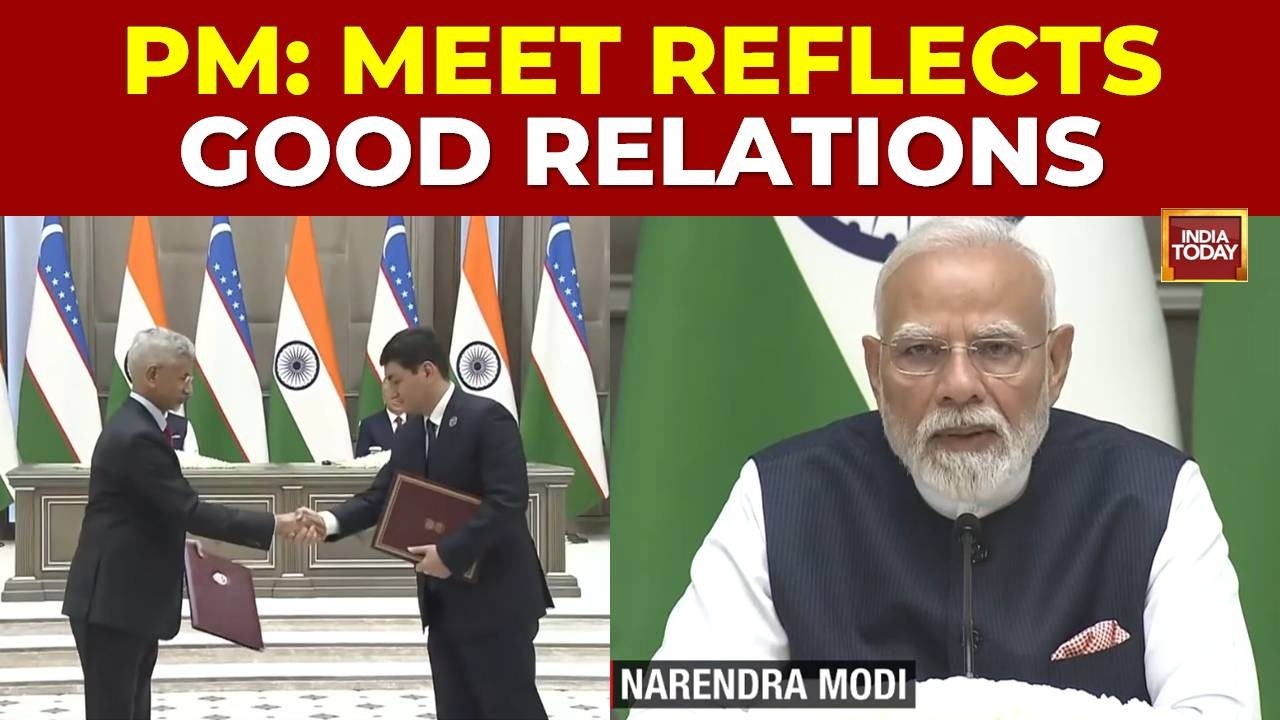
Prime Minister Narendra Modi and Uzbekistan's President Shavkat Mirziyoyev have upgraded their bilateral relationship to a Comprehensive Strategic Partnership, aiming for $5 billion in trade by 2030.
- Bilateral ties upgraded from Strategic Partnership to Comprehensive Strategic Partnership.
- Ambitious target to boost trade from $1 billion to $5 billion by 2030.
- Joint commitment to 'Zero Tolerance' against terrorism, extremism, and separatism.
- Focus on defense co-production, AI, clean energy, and critical minerals.
In a landmark meeting at the Kuksaroy Presidential Palace in Tashkent, Prime Minister Narendra Modi and Uzbekistan President Shavkat Mirziyoyev have paved the way for a new era of bilateral cooperation. The two leaders officially decided to elevate their long-standing 15-year strategic partnership to a Comprehensive Strategic Partnership, signaling a deeper level of integration across multiple sectors.
A primary focus of this upgraded relationship is economic growth. Recognizing the untapped potential, both nations have set a massive target to increase bilateral trade from the current $1 billion to $5 billion by the year 2030. To achieve this, discussions centered on improving market access, enhancing connectivity, and streamlining banking and payment systems to facilitate smoother commerce.
Why This Matters
BozokMedia analysis shows that this move is a cornerstone of India's 'Connect Central Asia' policy. By securing cooperation in critical minerals, clean energy, and digital public infrastructure, India is positioning itself as a vital economic partner in a region that is increasingly central to global geopolitics.
On the security front, PM Modi reinforced a stern stance on regional stability, announcing a joint commitment of zero tolerance against terrorism, extremism, and separatism. This security pact extends into the defense sector, where the focus will shift from mere procurement to direct linkages, co-production, and the co-development of defense technologies between the two nations' industries.
The transition toward defense co-development and a $5 billion trade corridor marks a paradigm shift in India's engagement with Central Asian republics.
Beyond trade and defense, the partnership embraces future technologies and cultural heritage. Cooperation will span Artificial Intelligence (AI), space exploration, nuclear energy, and healthcare. Furthermore, both nations agreed to joint efforts in conserving Buddhist heritage sites and promoting cultural exchange through tourism and Hindi language scholarships.
Frequently Asked Questions
1. What is the main economic goal of this partnership?
The goal is to expand bilateral trade from $1 billion to $5 billion by 2030.
2. How will defense cooperation change?
The partnership will move toward the co-production and co-development of defense equipment and technologies.


