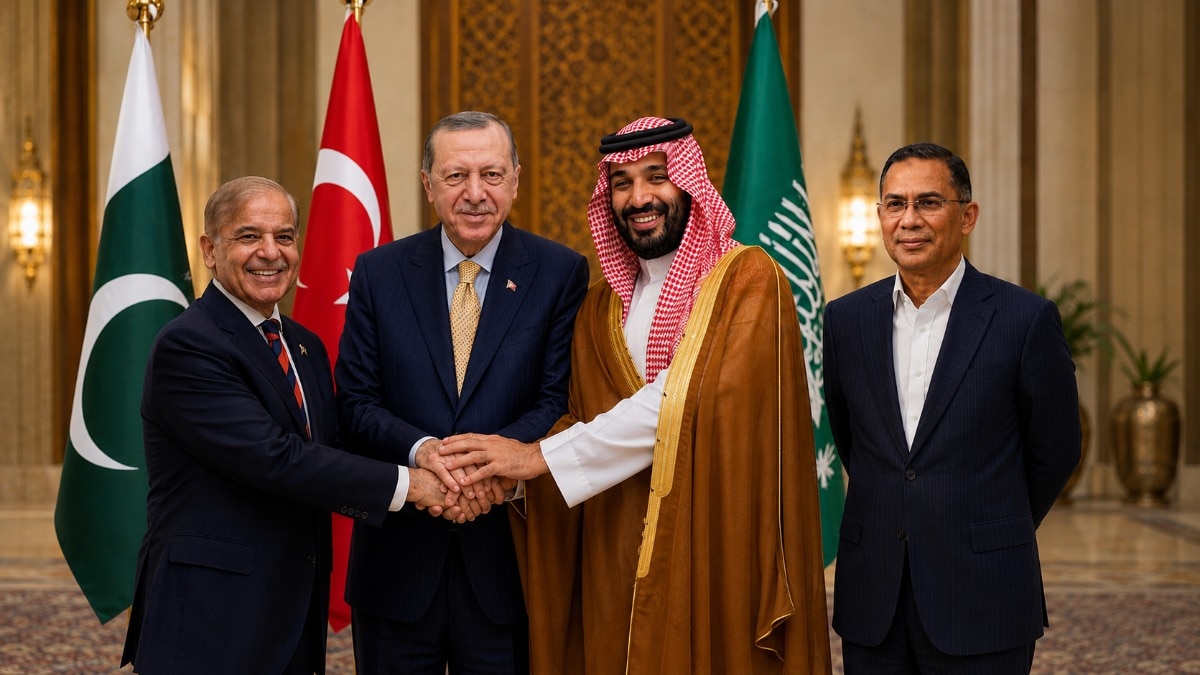
The founding members of the Mecca Joint Defence Agreement are meeting in Istanbul to formalize a strategic military alliance. The discussions on expansion have sparked speculation about Bangladesh and Egypt joining this 'Islamic NATO'.
- Pakistan, Saudi Arabia, and Turkey are holding the first formal Strategic Political and Defence Committee meeting in Istanbul.
- The agenda focuses on military interoperability, joint production, intelligence cooperation, and the creation of a permanent secretariat.
- Expansion is on the table, with Egypt seen as the primary candidate and Bangladesh as a potential strategic addition in South Asia.
The geopolitical landscape of the Muslim world is witnessing a significant shift as the Mecca Joint Defence Agreement Alliance, commonly referred to as the Mecca Pact, moves from a signed document to an operational military mechanism. The first formal meeting of the Strategic Political and Defence Committee in Istanbul marks a critical step in establishing what many analysts are calling an 'Islamic NATO'.
The meeting's agenda is comprehensive, covering everything from defence capabilities and military interoperability to joint intelligence sharing and the fight against terrorism. A primary goal of this summit is the establishment of a permanent secretariat, which would institutionalize the alliance and provide a structured framework for long-term military cooperation between Turkey, Pakistan, and Saudi Arabia.
Why This Matters
BozokMedia analysis shows that the Mecca Pact is not merely a symbolic gesture of solidarity but a calculated move to create a security umbrella independent of Western influence. By integrating the military strengths of Turkey's drone technology, Pakistan's strategic depth, and Saudi Arabia's financial power, the alliance seeks to redefine regional security across the Middle East and South Asia.
The transition of the Mecca Pact from a trilateral agreement to a broader security framework could fundamentally alter the balance of power in the Indian Ocean and the Arabian Sea.
While the initial focus is on the three founding members, the possibility of expansion is a central point of debate. Egypt is currently the front-runner for membership, given its existing role in the Regional-4 (R-4) grouping. Turkish Foreign Minister Hakan Fidan has been vocal about Cairo's inclusion, which would grant the alliance a strategic foothold in North Africa.
For Bangladesh, the prospect of joining the Mecca Pact represents a bold diplomatic ambition. As a major Muslim-majority nation on India's eastern flank, Bangladesh's entry would extend the alliance's reach deep into South Asia. While Dhaka's membership is not imminent, the precedent of expansion set in Istanbul could open the door for Bangladesh in the future.
The high-level delegation in Istanbul underscores the importance of the meet. Turkey is represented by Foreign Minister Hakan Fidan and Defence Minister Yaar Guler; Pakistan is led by Field Marshal Syed Asim Munir and Deputy PM Ishaq Dar; and Saudi Arabia is represented by Prince Faisal bin Farhan Al Saud and Prince Khalid bin Salman.
| Country | Primary Contribution to Pact | Strategic Role |
|---|---|---|
| Turkey | Advanced Defence Tech/Drones | NATO Bridge & Mediterranean Power |
| Pakistan | Nuclear Capability/Manpower | South Asian Strategic Depth |
| Saudi Arabia | Financial Capital/Energy | Arab World Leadership |
Frequently Asked Questions
Q1: What is the primary goal of the Mecca Pact?
The primary goal is to establish a joint defense framework among Muslim-majority nations to enhance regional security, intelligence sharing, and military production.
Q2: Is Bangladesh already a member of the alliance?
No, Bangladesh is not currently a member, but it has expressed interest and is being considered as a potential candidate for future expansion.