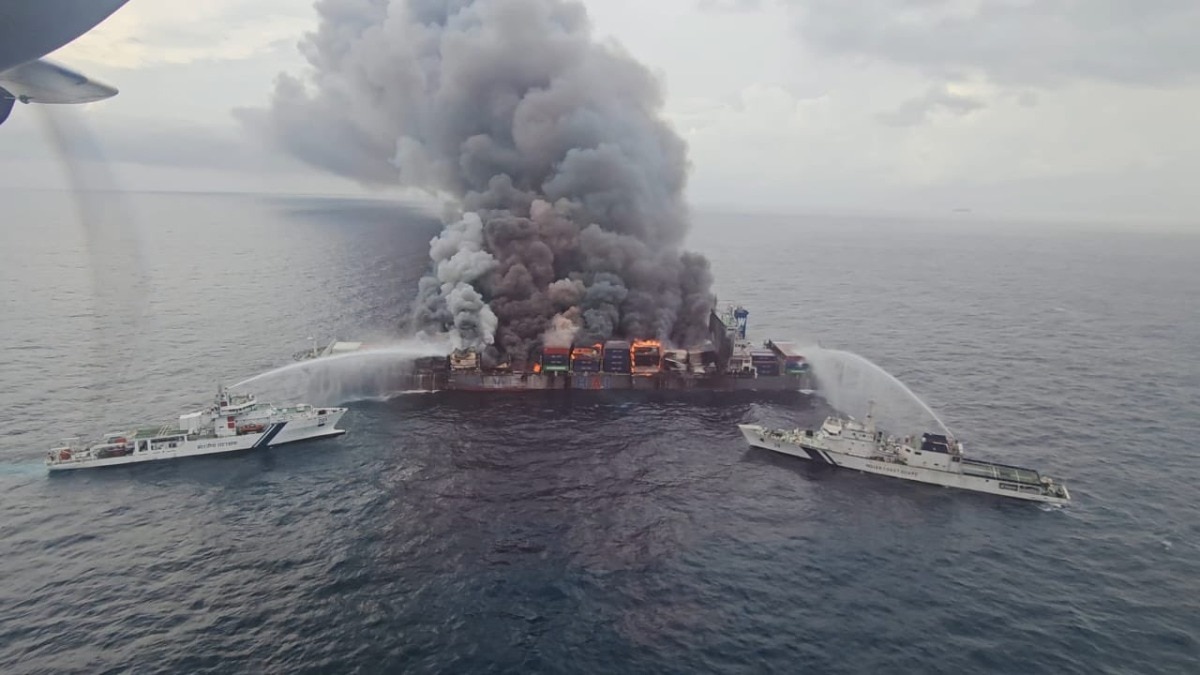
A supertanker has caught fire after striking two naval mines in the Strait of Hormuz. The IRGC claims the vessel ignored navigation rules, escalating tensions between Iran and the United States.
- A supertanker struck two naval mines in the southern part of the Strait of Hormuz.
- The IRGC claims the vessel was traversing an 'unauthorized and illegal' route.
- The collision led to a massive fire, forcing the ship to a complete standstill.
- The incident follows US strikes on Larak Island to neutralize Iranian mine-laying systems.
The Strait of Hormuz, the world's most critical oil transit chokepoint, has once again become a flashpoint for military tension. On Monday, the Islamic Revolutionary Guard Corps (IRGC) announced that a supertanker collided with two naval mines, resulting in a catastrophic fire on board. According to Tehran, the vessel was attempting to navigate a route that Iran deems unauthorized.
The IRGC stated that the "non-compliant supertanker" was operating in the southern reaches of the strait when the explosions occurred. Despite the severity of the fire, the Iranian military has remained tight-lipped regarding the ship's identity, its flag of origin, the cargo it was carrying, or the status of the crew.
Why This Matters
BozokMedia analysis shows that this incident is a calculated move in a larger geopolitical chess game. By utilizing naval mines—weapons that are notoriously difficult to detect—Iran is demonstrating its ability to disrupt global energy flows at will. This serves as a direct challenge to the US-led maritime security initiatives in the Persian Gulf.
"The deployment of naval mines in international shipping lanes is a form of asymmetric warfare designed to create economic instability without direct ship-to-ship combat."
The context of this event is rooted in recent US military operations. The US Central Command (CENTCOM) previously targeted launch systems on Iran's Larak Island, claiming that the IRGC was preparing to seed the strait with mines. The US maintains that while it has cleared existing mines, Iran continues to introduce new hazards into the waterway.
In a bold move, the IRGC has now warned all shipping companies that any vessel violating Iranian navigation rules—or following US military directives over Iranian mandates—will face similar consequences.
| Entity | Claim/Perspective | Primary Objective |
|---|---|---|
| Iran (IRGC) | Vessel used an illegal route | Enforce regional navigation control |
| USA (CENTCOM) | Iran is illegally planting mines | Ensure freedom of navigation |
Frequently Asked Questions
1. Were there any casualties in the supertanker explosion?
The IRGC has not yet released any information regarding the crew's safety or casualties.
2. Why did the US attack Larak Island?
The US claimed that Larak Island was being used as a base for launching naval mines into the strait, posing an immediate threat to international shipping.