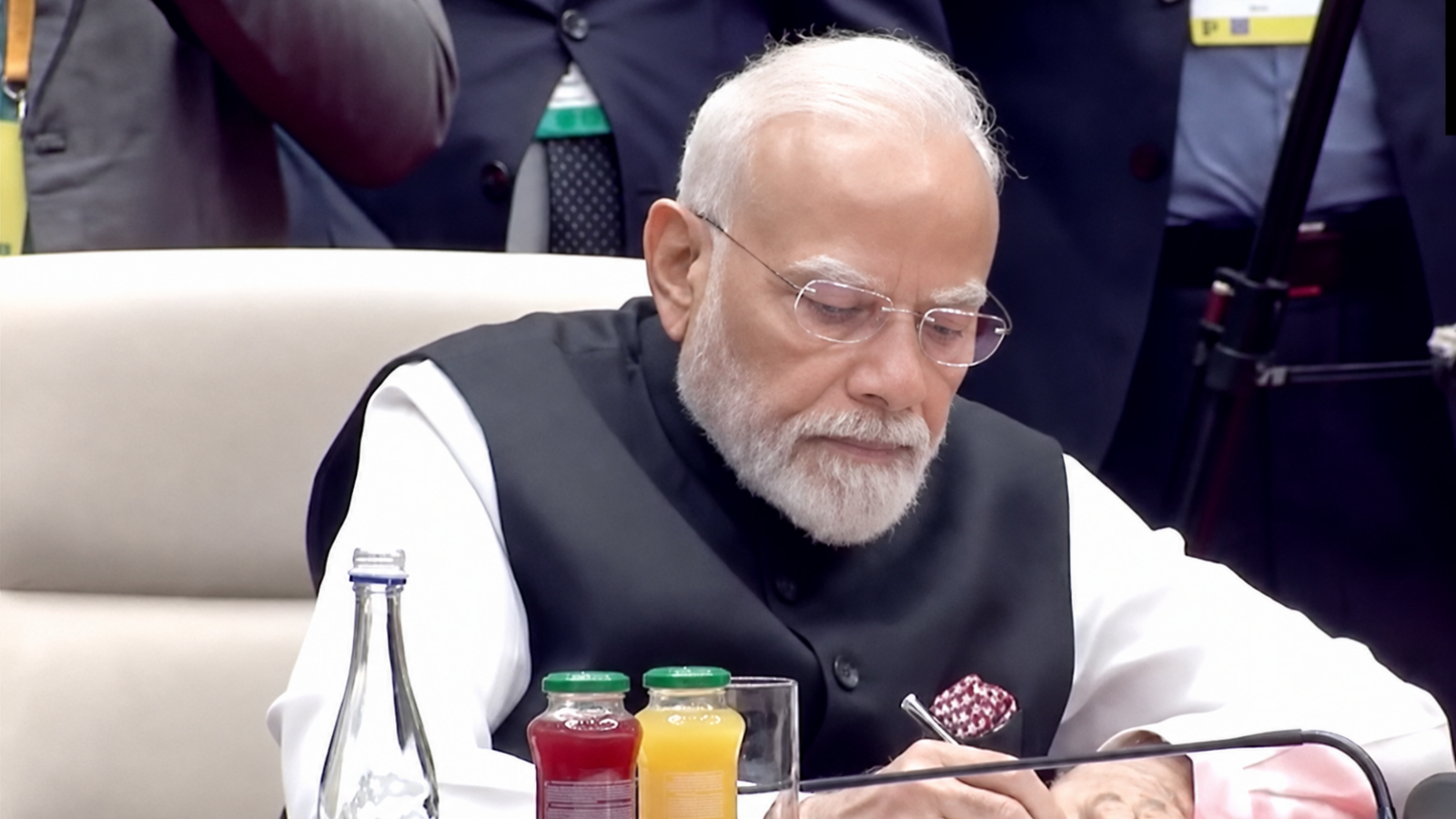
Prime Minister Narendra Modi called for the complete dismantling of the terror ecosystem at the 26th SCO Summit in Bishkek. He warned that nations cannot be allowed to use terrorism as a tool of state policy or a strategic asset.
- Call to dismantle the global ecosystem of funding, recruitment, and radicalization.
- Strict warning against treating terrorism as a 'strategic asset' of state policy.
- Emphasis on dialogue and diplomacy to resolve West Asian and Eurasian conflicts.
- Focus on the 'Global South' and the impact of regional wars on supply chains.
Addressing the 26th Shanghai Cooperation Organisation (SCO) Summit in Bishkek, Kyrgyzstan, Prime Minister Narendra Modi delivered a powerful critique of state-sponsored terrorism. He urged member nations to collaborate in dismantling the entire infrastructure that sustains terror, asserting that the global community must move beyond a mere 'action-reaction' cycle to a proactive eradication strategy.
The Prime Minister highlighted a critical flaw in the current global approach: the existence of 'double standards.' He argued that the fight against terror is compromised when certain nations provide shelter and support to terrorists while claiming to be part of the counter-terrorism effort. By labeling terrorism as a 'strategic asset', some states continue to destabilize regions for geopolitical leverage, a practice PM Modi insisted must end immediately.
Why This Matters
BozokMedia analysis shows that India is strategically leveraging the SCO platform to put pressure on regional actors who engage in proxy warfare. By explicitly mentioning the impact of conflicts on energy security and the Global South, India is shifting the narrative from bilateral disputes to global economic stability, thereby gaining moral and diplomatic high ground.
The transition from a reactive security posture to a systemic dismantling of terror networks is the only way to ensure long-term Eurasian stability.
Turning his attention to Afghanistan, PM Modi linked the stability of the nation to the overall security of Eurasia. He reiterated India's commitment to the Afghan people through humanitarian aid and developmental projects, emphasizing that a peaceful Afghanistan is a prerequisite for a secure region. He also touched upon the volatility in West Asia, noting that such conflicts ripple across the globe, affecting maritime trade and energy security.
Beyond security, the Prime Minister advocated for a 'citizen-centric' approach for the SCO's next 25 years. He suggested that the organization's success should not be measured by high-level summits, but by the tangible opportunities created for entrepreneurs, the technological advancements provided to farmers, and the empowerment of the youth. He also flagged drug trafficking as a silent killer that threatens the demographic dividend of the region.
Frequently Asked Questions
Q1: What does PM Modi mean by terrorism as a 'strategic asset'?
A: It refers to the practice where some nations use terrorist groups as proxies to achieve political or strategic goals in other countries without engaging in direct warfare.
Q2: Which other world leaders attended the 26th SCO Summit?
A: The summit saw the participation of Chinese President Xi Jinping, Russian President Vladimir Putin, and leaders from Pakistan, Iran, Belarus, Kazakhstan, Uzbekistan, and Tajikistan.
