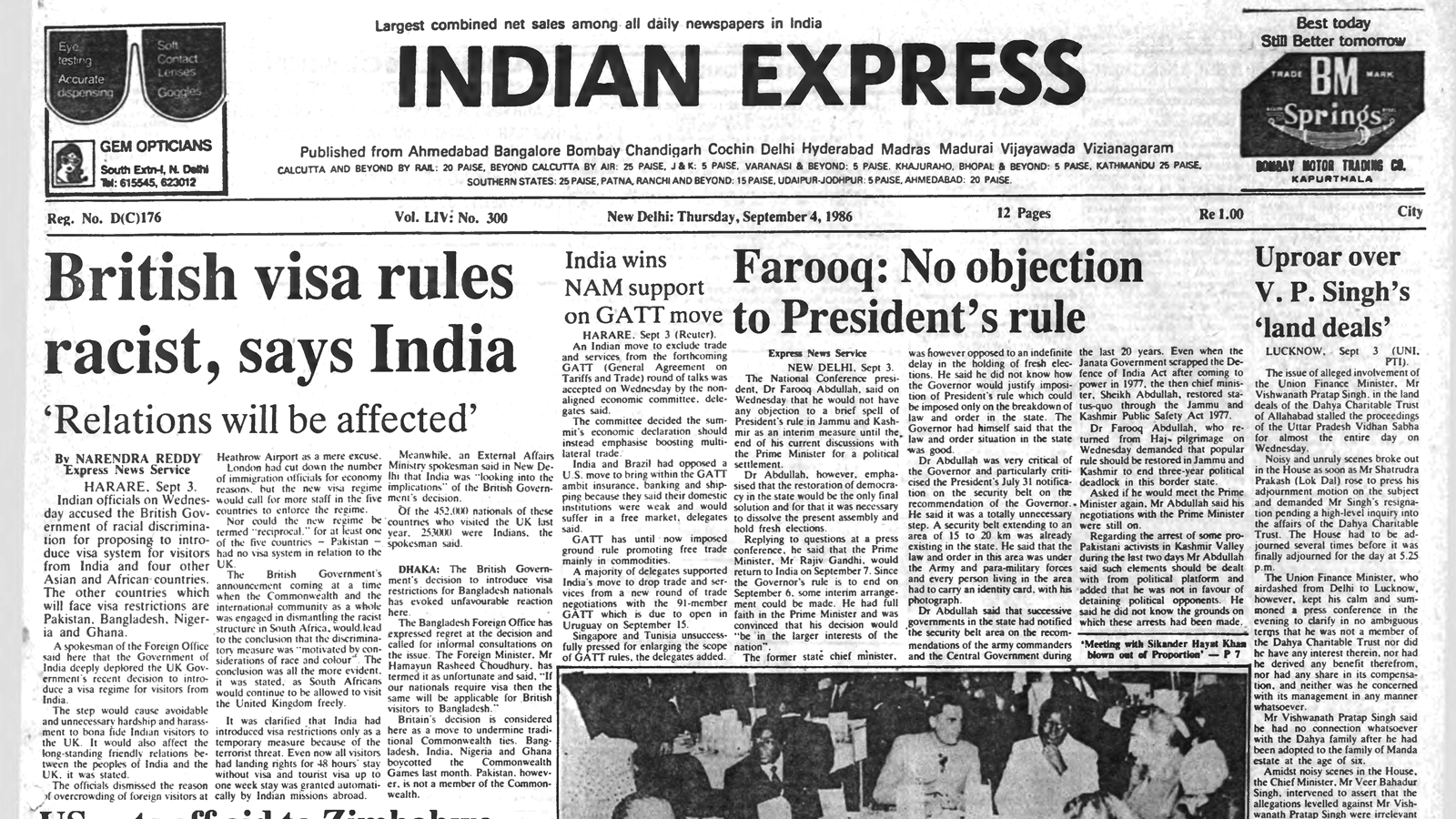
Looking back at September 4, 1986, when Indian officials challenged the UK's proposed visa restrictions. This archival report also covers the V.P. Singh land controversy and Farooq Abdullah's stance on J&K.
- India condemned UK's proposed visa restrictions on Asian and African nations as racist.
- Union Finance Minister V.P. Singh faced intense scrutiny over land deals in UP.
- Farooq Abdullah expressed openness to interim President's Rule in J&K.
- The US halted aid to Zimbabwe citing diplomatic non-compliance.
On September 4, 1986, a significant diplomatic rift emerged between India and the United Kingdom. Indian officials formally accused the British government of racial discrimination following proposals to introduce a stringent visa system for visitors from India and four other nations: Pakistan, Bangladesh, Nigeria, and Ghana. This move was viewed by New Delhi as a targeted attempt to restrict mobility based on nationality and origin, sparking a heated international debate.
Domestically, the political landscape in India was equally turbulent. The Uttar Pradesh Vidhan Sabha witnessed unprecedented chaos as allegations surfaced regarding the involvement of the then Union Finance Minister, V.P. Singh, in land deals associated with the Dahya Charitable Trust in Allahabad. The uproar, led by Lok Dal's Shatrughna Prakash, demanded Singh's immediate resignation. Despite the intense pressure and multiple adjournments, Singh maintained his composure, traveling from Delhi to Lucknow to categorically deny any interest in the trust.
Why This Matters
BozokMedia analysis shows that this period was a crucible for Indian sovereignty. The tension between fighting colonial-era biases in international travel and managing high-stakes domestic corruption allegations highlights the dual challenges faced by the Indian state during the mid-1980s. It was a time when India was asserting its dignity on the global stage while simultaneously navigating complex internal power struggles.
The 1980s marked a transition where India began to more aggressively challenge Western diplomatic norms to protect its citizens' global interests.
In the northern state of Jammu and Kashmir, political maneuvering was also in full swing. Farooq Abdullah, president of the National Conference, made a strategic statement regarding the state's governance. He indicated that he would not object to a brief period of President’s Rule as an interim measure to facilitate political discussions with the Prime Minister. However, he remained firm that the only permanent solution was the restoration of democracy through fresh elections and the dissolution of the current assembly.
On the global stage, the United States took a hardline stance against Zimbabwe. The US government announced a complete halt to new aid, citing the nation's refusal to adhere to accepted norms of diplomatic civility and international practice. This move signaled a growing trend of using economic aid as a tool for diplomatic leverage during the late Cold War era.
Frequently Asked Questions
Question 1: Which countries were affected by the UK's proposed visa rules?
Answer: India, Pakistan, Bangladesh, Nigeria, and Ghana were the primary nations facing these restrictions.
Question 2: What was the core of the controversy surrounding V.P. Singh?
Answer: He was accused of involvement in land deals related to the Dahya Charitable Trust in Allahabad.