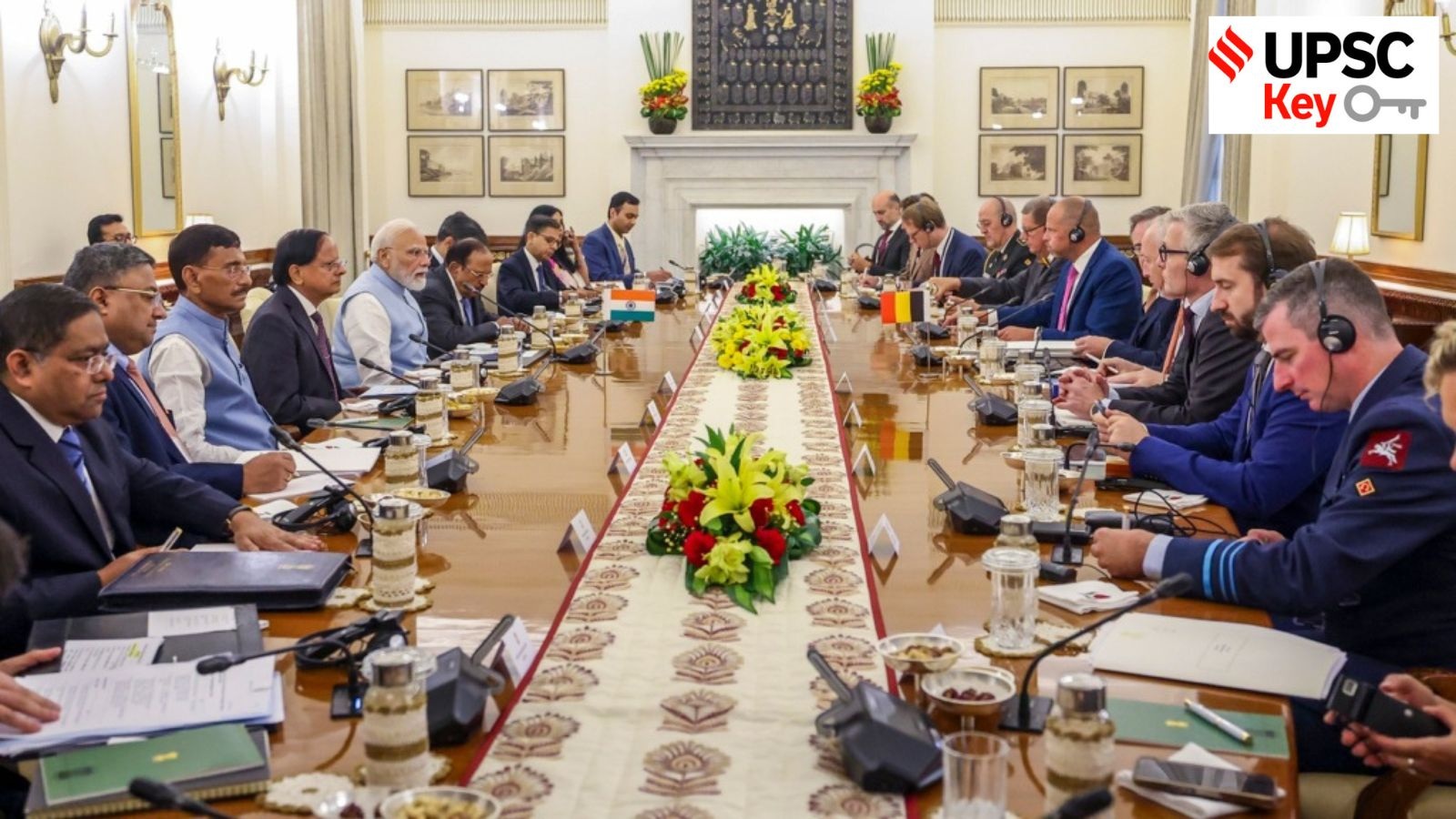
Prime Minister Narendra Modi and Belgian PM Bart De Wever have entered into a series of strategic agreements to bolster defence, semiconductor, and renewable energy cooperation. The pact aims to double bilateral trade and enhance intelligence sharing between the two nations.
- India and Belgium agreed to strengthen defence, intelligence sharing, and semiconductor partnerships.
- A fast-track investment mechanism will be established to double bilateral trade.
- Cooperation will focus on co-development and co-production of drones, rockets, tanks, and munitions.
In a significant diplomatic move, Prime Minister Narendra Modi met with Belgian Prime Minister Bart De Wever in New Delhi to chart a new course for bilateral relations. The meeting resulted in high-level agreements spanning critical sectors including defence, fintech, semiconductors, and renewable energy, marking a transformative era in India-Belgium ties.
The defence component of this partnership is particularly robust. Both nations have agreed to enhance military exchanges and training cooperation. A 'Letter of Intent' was exchanged to facilitate cooperation from government-to-government contacts to actual co-production of military hardware. This includes advanced technologies such as drones, anti-mine systems, rockets, and tanks. Belgian Defence Minister Theo Francken also met with Indian Defence Minister Rajnath Singh to emphasize the growing interconnectedness of security in Europe and the Indo-Pacific.
Why This Matters
BozokMedia analysis shows that this partnership is a strategic masterstroke for India's 'Atmanirbhar Bharat' (Self-Reliant India) initiative. By integrating Belgian expertise in high-end defence manufacturing and semiconductors with India's massive industrial scale, both nations can create a resilient supply chain that bypasses traditional geopolitical bottlenecks.
"I am confident that today’s discussions mark the beginning of a new chapter in our bilateral relations, with defence and security as a key pillar." - PM Narendra Modi
Economically, Belgium stands as a vital partner for India within the European Union. Bilateral trade reached a staggering $13.01 billion in 2025-26. Beyond traditional commerce, the focus is shifting toward emerging technologies. The establishment of an investment fast-track mechanism is expected to catalyze much-needed FDI, building on the $4.2 billion already invested by Belgium in India since 2000.
| Sector | Focus Area | Strategic Objective |
|---|---|---|
| Defence | Drones, Rockets, Munitions | Co-development & Co-production |
| Trade | Doubling Bilateral Volume | Economic Growth & FDI |
| Technology | Semiconductors & Renewables | Future-proofing Supply Chains |
Furthermore, the emphasis on maritime security highlights the shared interest in maintaining stability in the Indo-Pacific and European waters. As Belgium is a key member of both the EU and NATO, this strengthening of ties provides India with a more direct channel to influence and collaborate with European security architectures.
Frequently Asked Questions
1. What are the main sectors covered in the India-Belgium pact?
The pact covers defence, semiconductor manufacturing, renewable energy, intelligence sharing, and bilateral trade expansion.
2. How does this affect India's defence sector?
It facilitates the co-development and co-production of advanced military hardware like drones and rockets, reducing reliance on external imports.
