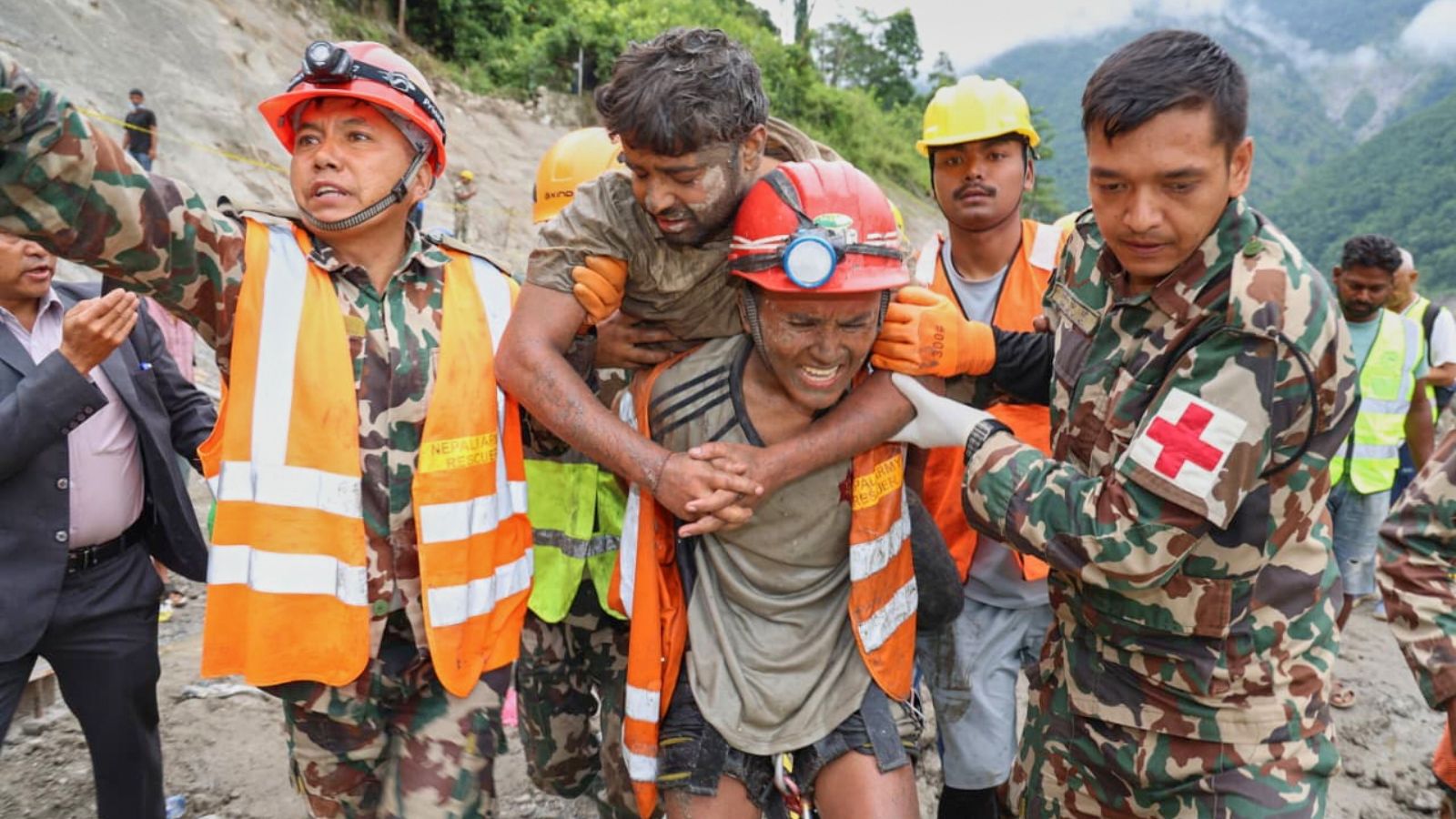
In a breathtaking rescue operation, two workers were pulled alive from a buried tunnel at Nepal's Trishuli-3A hydropower project after surviving 9 days underground.
- Sanjay Sah and Kabir Maharjan were rescued 170m inside the tunnel.
- The rescue took place after 9 days of intense operations following the August 26 floods.
- Rescuers utilized satellite imagery, excavators, and controlled blasts.
- The breakthrough provides hope for hundreds of other missing workers.
In a miraculous turn of events following the devastating floods in Nepal, two workers have been pulled alive from the depths of a buried tunnel at the Trishuli-3A hydropower project. Sanjay Sah, a 30-year-old mechanical foreman, and Kabir Maharjan, a 45-year-old mechanical supervisor, emerged from the darkness after spending nine harrowing days trapped approximately 170 metres underground.
Sanjay Sah’s survival story is one of profound selflessness. During the initial surge of the flood on August 26, Sah reportedly stayed behind to urge his colleagues to flee to safety. While attempting to save others, he became trapped as the entrance to the tunnel was obliterated by a massive influx of mud, rock, and water. Sah later revealed that he maintained his sanity by reciting mantras in the pitch-black darkness.
The Complexity of the Rescue Operation
The rescue mission faced unprecedented geological challenges. The flood had completely altered the landscape, making the tunnel entrance invisible. According to Arnold Dix, president of the International Tunnelling and Underground Space Association, rescuers had to engage in a high-stakes search using old topographic maps, satellite imagery, and helicopter footage to triangulate the entrance's location.
Once the site was identified, the operation turned into a grueling battle against nature. Teams used heavy excavators to move boulders larger than vehicles and deployed powerful pumps to drain the rising floodwaters. In some sections, controlled blasts were necessary to clear the path through the debris-choked tunnel.
"The rescue of Sah and Maharjan is a testament to both human resilience and the precision of modern search-and-rescue technology."
Why This Matters
BozokMedia analysis shows that this successful extraction is a critical turning point in the ongoing disaster response. With approximately 900 workers missing across various hydropower projects and nearly 500 believed trapped in tunnels, this breakthrough serves as a vital proof of concept for rescue teams working in extreme subterranean environments.
The incident also highlights the extreme risks faced by workers in high-altitude hydropower construction, prompting calls for more robust early warning systems and emergency egress protocols in mountainous terrains.
Frequently Asked Questions
Question 1: How deep were the workers trapped?
Answer: The workers were found approximately 170 metres inside the Trishuli-3A tunnel.
Question 2: What caused the tunnel to become buried?
Answer: Massive flash floods on August 26 brought down immense amounts of mud and rock, burying the entrance.