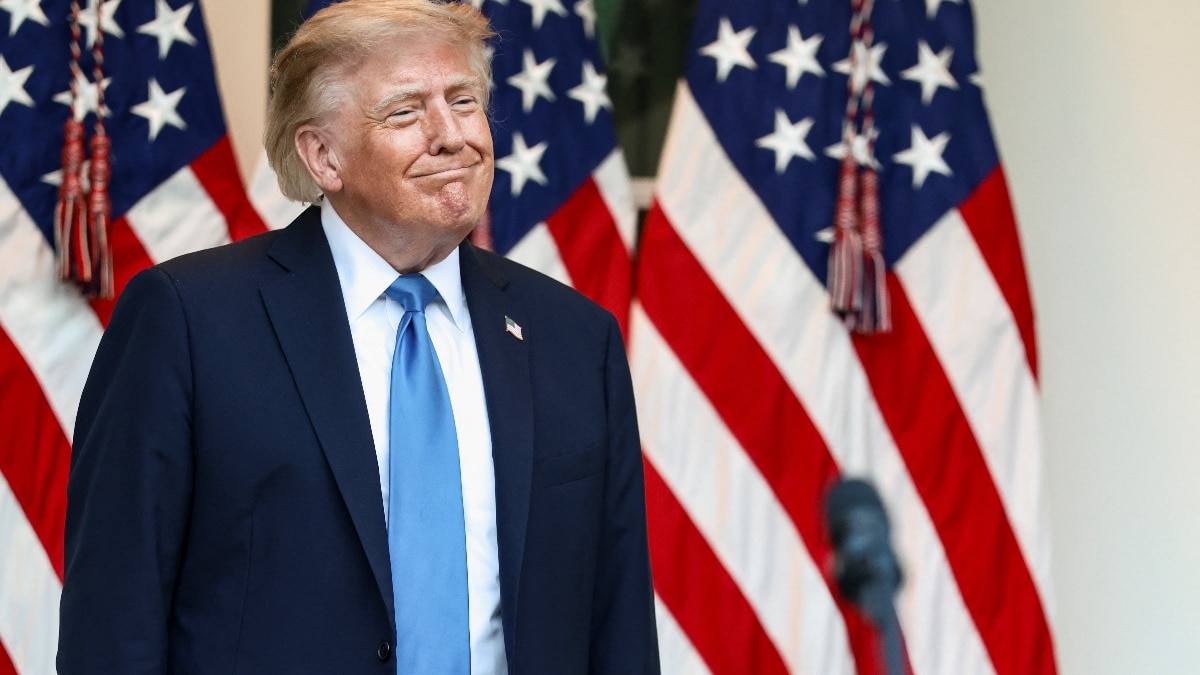
President Donald Trump has dismissed the ongoing conflict with Iran as 'small potatoes,' defending VP JD Vance's refusal to label the intermittent strikes as a full-scale war.
- President Donald Trump described the Iran military conflict as "small potatoes" for the United States.
- Trump supported VP JD Vance's assertion that the ongoing Middle East tensions do not constitute a "war."
- The six-month conflict has resulted in 18 US service member deaths and cost $37.5 billion.
- Trump compared the current casualty rate favorably against the Vietnam War.
President Donald Trump on Friday significantly downplayed the intensity of the ongoing conflict with Iran, labeling the situation as "small potatoes." During an exchange in the Oval Office, Trump defended Vice President JD Vance, who had previously refused to categorize the months of intermittent attacks in the Middle East as a formal "war."
"I can understand what he’s saying," Trump remarked regarding Vance's stance. "I call it a military conflict because it’s small potatoes for us. It’s not a big thing." This rhetoric comes despite the fact that the conflict has already claimed the lives of 18 US service members and drained over $37.5 billion from US taxpayers.
Why This Matters
BozokMedia analysis shows that this linguistic maneuvering is likely a calculated attempt to manage public perception ahead of the November midterm elections. By framing the conflict as a minor military engagement rather than a "war," the administration seeks to minimize political fallout and avoid the heavy legislative and social burdens that a declared war entails.
Labeling a conflict that has cost billions and lives as 'small potatoes' risks alienating a public sensitive to military casualties.
The controversy stems from JD Vance's comments during a White House briefing on Thursday. When asked if the fighting would cease before the November 3 congressional elections, Vance replied, "I wouldn’t call it a war... Right now, there is no active shooting." This claim was made even as Iran retaliated against US strikes by targeting the US Gulf ally, Kuwait.
In an attempt to provide context, Trump drew comparisons between the current situation and past US military involvements. He cited the operation in Venezuela, where no US personnel were lost, and the Vietnam War, where the US lost tens of thousands of lives. Trump argued that the current death toll of 18 is relatively low in the grand scheme of American military history.
Historical Background
The current period of heightened tension between the US and Iran began on February 28. While the US and Israel have primarily utilized airstrikes to target Iranian assets and defang their nuclear program, they have avoided a full-scale ground invasion. At the onset of the hostilities, the Trump administration predicted the conflict would be resolved within weeks.
Frequently Asked Questions
1. Why does the Trump administration refuse to call this a war?
The administration, led by Trump and Vance, views the intermittent nature of the strikes and the lack of large-scale ground troop deployment as evidence that it does not meet the traditional definition of war.
2. What has been the economic impact of the Iran conflict?
As of September 2026, the conflict has cost US taxpayers more than $37.5 billion.