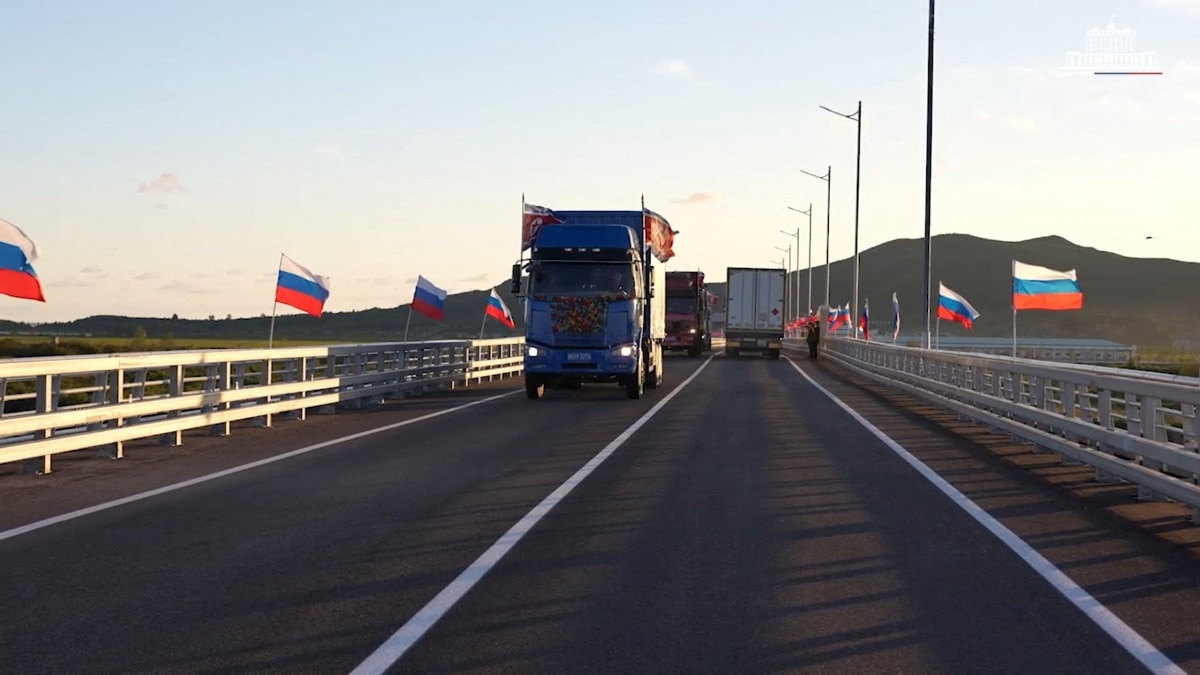
In a major geopolitical milestone, Russia and North Korea have officially opened their first road bridge across the Tumen River, strengthening their strategic and economic ties.
- The 1 KM long two-lane bridge provides the first direct road link between Russia and North Korea.
- Construction followed President Vladimir Putin's 2024 visit to North Korea.
- The bridge will accommodate up to 300 vehicles daily and will eventually support passenger traffic.
In a carefully choreographed display of diplomatic friendship, Russia and North Korea officially opened their first road bridge spanning the Tumen River on Monday. Both nations hailed the structure as a historic milestone in their deepening strategic partnership.
During the inauguration ceremony, Russian Prime Minister Mikhail Mishustin and North Korean Premier Pak Thae Song addressed officials and workers via video link. The event saw the first flag-adorned trucks crossing the 1-kilometer-long, two-lane bridge, marking a significant shift from the makeshift arrangements used for decades.
Historical Background and Context
While direct air and rail links have existed between Moscow and Pyongyang for years, a formal road connection was missing. Since 1959, vehicles had relied on a special arrangement involving planks placed on a nearby rail bridge to cross the border. The new project was greenlit following President Vladimir Putin's high-profile visit to North Korea in 2024.
Symbolically, the bridge is named after Yakov Novichenko, a Red Army soldier credited by Pyongyang with saving the life of North Korea's founding leader, Kim Il Sung, in 1946. This naming underscores the deep-rooted historical ties the two nations seek to emphasize.
Why This Matters
BozokMedia analysis shows that this infrastructure development is a direct consequence of the shifting geopolitical landscape following the conflict in Ukraine. By integrating this bridge into Russia's federal road network, Moscow is creating a seamless transport corridor from Vladivostok to St. Petersburg, facilitating easier movement of goods and potentially military assets.
The bridge is far more than an engineering feat; it is a physical manifestation of the growing Moscow-Pyongyang axis.
Prime Minister Mishustin emphasized that the expansion of cross-border infrastructure would provide a "powerful impetus" for trade, scientific, and technological cooperation. The bridge is expected to be fully operational for passenger traffic by the end of this year.
The strengthening of ties has been particularly evident since 2022, with North Korea providing significant support to Russia, including troop deployments to the Kursk region to assist in defending Russian territory.
Frequently Asked Questions
Question 1: How many vehicles can the new bridge handle daily?
Answer: The bridge is designed to accommodate up to 300 vehicles per day.
Question 2: Will this bridge be used by civilians?
Answer: Yes, while it will immediately begin transporting cargo, it is slated to be fully operational for passenger traffic by the end of 2026.