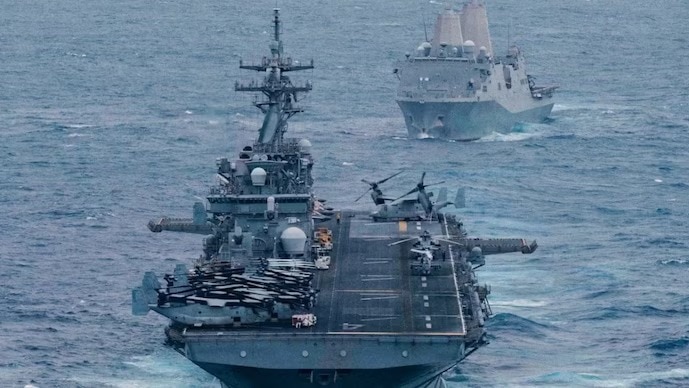
Tensions escalate in the Middle East as Iran launches its second ballistic missile attack on US Navy vessels within three days. The US responded by destroying Iranian-linked oil tankers, sparking fears of a wider regional war.
- Iran launched ballistic missiles at US Navy ships for the second time in three days.
- The US retaliated by attacking three Iranian-linked oil tankers in the Gulf of Oman.
- Shipping traffic in the Strait of Hormuz is severely disrupted, threatening global energy prices.
- Suspicions arise regarding technical missile assistance provided to Iran by Russia or China.
The strategic waters of the Middle East have once again become a flashpoint for global conflict. On Monday, Iran launched a series of ballistic missiles targeting US Navy vessels. According to US officials, this marks the second such provocation within a 72-hour window. While the US military has not yet issued a formal public confirmation of every detail, officials state that no American ships were damaged and no personnel were injured during the Monday strike.
This escalation follows a similar incident on Saturday, where Iran targeted a US aircraft carrier and another missile-equipped warship. Both vessels successfully evaded the strikes. However, a report by the Wall Street Journal indicates growing concern within the Pentagon that Iran is deploying more sophisticated and powerful missile technology, potentially aided by technical transfers from Russia or China.
Why This Matters
BozokMedia analysis shows that this is no longer a mere skirmish but a calculated strategic gamble. By targeting the US Navy, Iran is testing the resolve of the current US administration. Furthermore, the volatility in the Strait of Hormuz—a critical chokepoint for global oil and gas—could trigger a massive spike in energy costs, leading to global economic instability.
"Iran's repetitive missile strikes are a clear signal that they are attempting to redefine the security architecture of the Persian Gulf through force."
In a swift retaliatory move, the United States targeted the economic arteries of the Iranian regime. The US military struck three oil tankers linked to Iran, completely destroying one in the Gulf of Oman and disabling two others. The Pentagon asserts that these vessels were part of a clandestine network used by the Islamic Revolutionary Guard Corps (IRGC) to fund its operations and proxy networks.
Tehran has denied these allegations, claiming instead that its own forces targeted three US-linked ships and three tankers that were allegedly trespassing in restricted zones near the Strait of Hormuz without prior authorization.
The current hostilities follow the collapse of a 60-day ceasefire that expired last month. Despite several diplomatic attempts, no lasting agreement has been reached. US President Donald Trump has characterized the ongoing conflict as "intermittent," denying that it has evolved into a full-scale war. However, Defense Secretary Pete Hegseth has issued a stern warning: any attack on US naval assets will be met with the systematic targeting of Iranian oil infrastructure.
| Faction | Attack Method | Primary Target |
|---|---|---|
| Iran | Ballistic Missiles | US Aircraft Carriers & Warships |
| USA | Precision Air/Naval Strikes | Iranian Oil Tankers & Funding Networks |
Frequently Asked Questions
1. Were any US sailors injured in the attacks?
No, according to official reports, there were no casualties or injuries among US personnel during the recent missile waves.
2. Why did the US target oil tankers instead of military bases?
The US aims to disrupt the IRGC's financial networks and apply economic pressure, signaling that Iran's revenue streams are vulnerable in response to military provocations.