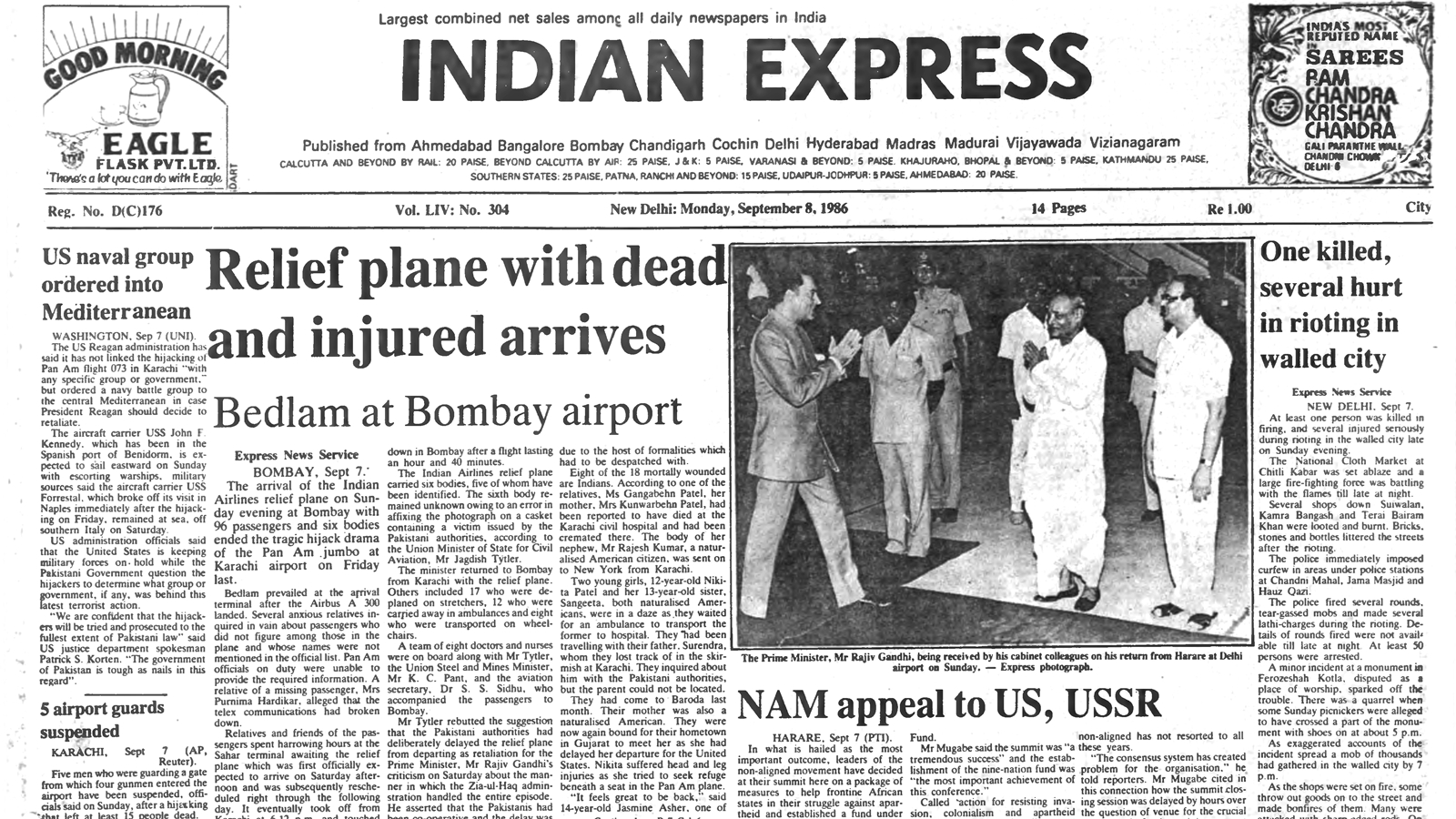
As the Pan Am hijacking drama ended in tragedy at Karachi airport, Prime Minister Rajiv Gandhi slammed Pakistan for its failed rescue operation. This historical deep dive explores the global fallout of the 1986 crisis.
- The Pan Am jumbo jet hijacking ended with the arrival of relief planes carrying bodies and survivors.
- PM Rajiv Gandhi accused Pakistan of 'badly bungling' the rescue operation.
- The US deployed naval assets to the Mediterranean as a show of force.
- The Non-Aligned Movement (NAM) summit in Harare yielded significant outcomes for African states.
On September 8, 1986, a wave of grief and chaos swept through Bombay as the Indian Airlines relief plane touched down. The arrival of the Airbus A300, carrying 96 passengers but also six lifeless bodies, marked the grim conclusion of the Pan Am jumbo jet hijacking at Karachi airport. The arrival terminal was a scene of absolute bedlam, as anxious relatives desperately searched for loved ones who were missing from the official passenger lists.
Rajiv Gandhi’s Defiant Stance Against Pakistan
Amidst the tragedy, then-Prime Minister Rajiv Gandhi remained steadfast in his criticism of the Pakistani administration. Gandhi revealed that Pakistan's President, Gen Ziaul Haq, had personally indicated during discussions in Harare that the hijackers spoke Urdu and Arabic. Gandhi did not mince words, stating that Pakistan had "badly bungled" the rescue operation intended to save the passengers and crew, highlighting a massive failure in international crisis management.
Why This Matters
BozokMedia analysis shows that this incident was a pivotal moment in Indo-Pak relations, exposing the deep-seated mistrust regarding counter-terrorism cooperation. It also served as a catalyst for rethinking aviation security on a global scale during the Cold War era.
The Pan Am crisis was more than a hijacking; it was a geopolitical test of crisis response and international accountability.
The American Response: The administration of US President Ronald Reagan maintained a cautious diplomatic distance, refusing to link the hijacking of Pan Am Flight 073 to any specific government. However, the military response was decisive. A US Navy battle group was ordered toward the central Mediterranean, with the aircraft carrier USS John F Kennedy prepared to sail eastward to demonstrate American resolve in the face of global instability.
Historical Background
The mid-1980s were characterized by high-stakes aviation terrorism. The hijacking of Pan Am 073 became a case study in the complexities of negotiating with hijackers and the immense difficulty of conducting rescue operations in politically sensitive territories like Karachi.
Frequently Asked Questions
Question 1: What was the primary outcome of the Pan Am hijacking?
Answer: The event resulted in significant loss of life and intensified diplomatic tensions between India and Pakistan.
Question 2: How did the United States react to the incident?
Answer: While avoiding direct blame, the US deployed naval forces to the Mediterranean as a strategic precaution.
