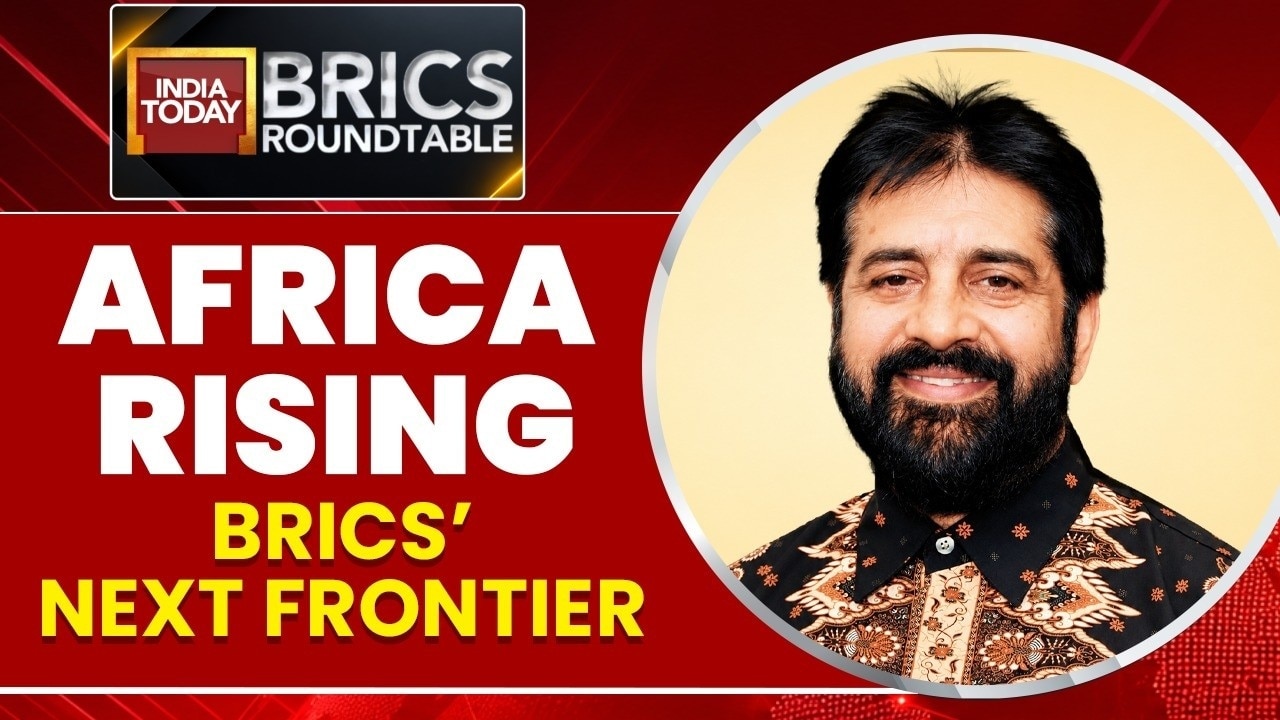
BJP National Vice President Ram Madhav discusses the shift from the post-WWII order to 'hetero polarity,' highlighting India's balanced role in BRICS, G20, and the Quad to empower the Global South.
- BRICS represents over 60% of the global population, serving as a critical voice for the Global South.
- The post-WWII international order is collapsing, giving way to a transitional period of 'hetero polarity.'
- India manages China-related border and trade deficits (approx. $100B out of $159B) bilaterally rather than through multilateral summits.
- There is an urgent need for global ethical frameworks to regulate Big Tech and Artificial Intelligence.
In a comprehensive discourse on global affairs, BJP National Vice President and foreign policy expert Ram Madhav analyzed India's strategic navigation through various international forums. He highlighted that India's involvement in BRICS, the G20, the SCO, and the Quad is not contradictory but a balanced approach to safeguarding national interests while fostering global stability.
Addressing the relevance of these groupings, Madhav emphasized that the Global South is no longer a passive participant in world politics. With BRICS representing a vast majority of the world's population, it has evolved into a powerhouse capable of challenging traditional hegemony and providing alternative leadership for developing nations.
Why This Matters
BozokMedia analysis shows that India is strategically positioning itself as a 'bridge' between the developed West and the developing Global South. By maintaining membership in both the Quad (security-focused) and BRICS (economy-focused), India is avoiding alignment with any single power bloc, thereby maximizing its strategic autonomy in a volatile geopolitical climate.
Regarding India-China relations, Madhav provided critical context on the trade imbalance. With a trade deficit of $100 billion within a total trade volume of $159 billion, the economic strain is evident. However, he maintained that such friction, along with border disputes, is handled via bilateral channels to ensure that multilateral platforms like BRICS remain focused on broader systemic goals.
"The post-World War II order is ending, and we are in an interim transition where uncontrollable forces are arising."
A pivotal part of the discussion was the concept of 'hetero polarity.' Madhav noted that power is shifting away from traditional state-centric models. Today, Big Tech corporations and massive investment funds wield influence comparable to sovereign nations. He called for immediate international regulation regarding AI and resource resilience to prevent corporate overreach from destabilizing global ethics.
Frequently Asked Questions
Q1: Why is BRICS vital for the Global South?
A: It provides a platform for nations representing over 60% of the world's population to coordinate policies and reduce dependence on Western-centric financial and political systems.
Q2: What is 'Hetero Polarity'?
A: It is a systemic shift where power is distributed not just among states, but among non-state actors like tech giants and global investors.


