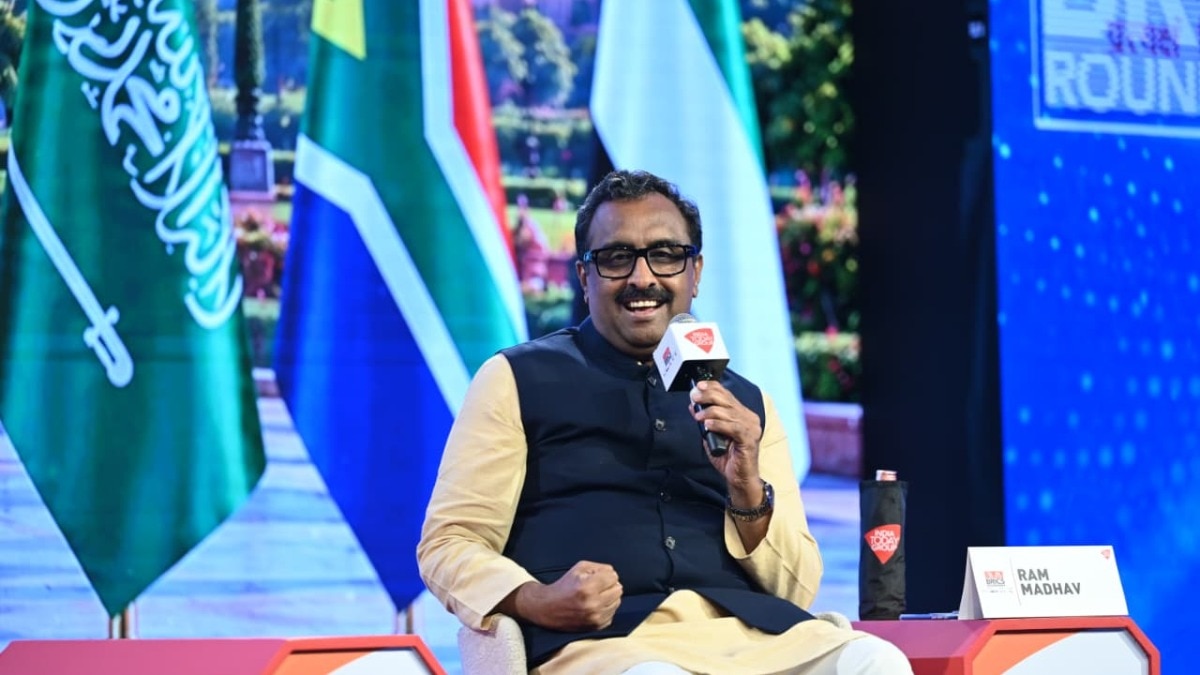
Former spokesperson Ram Madhav outlines India's sophisticated 'multi-alignment' strategy, emphasizing why the nation avoids rigid alliances in favor of mini-lateral groups like I2U2 and BRICS to secure its global interests.
- India is pursuing a policy of strategic autonomy, avoiding permanent alliances to maintain flexibility.
- The rise of 'mini-lateral' groups (e.g., I2U2) is replacing traditional large-scale global blocs.
- BRICS serves as a critical voice for the Global South, despite bilateral tensions with China.
- India leverages multiple platforms like G20, SCO, and QUAD simultaneously to balance global power.
During the 'Sangh Shakti Samvad' session at the India Today BRICS Roundtable, Ram Madhav provided a comprehensive analysis of India's evolving foreign policy. He asserted that the world is entering a transformative era where existing global equations are shifting rapidly. In this volatile landscape, India's active participation in diverse forums—ranging from the G20 and BRICS to the Shanghai Cooperation Organisation (SCO), QUAD, and BIMSTEC—is not a contradiction, but a calculated strategic necessity.
Madhav argued that the concept of a permanent, rigid alliance is becoming obsolete. Instead, the future belongs to a fluid global order where cooperation is based on specific issues and situational requirements. He highlighted that India's philosophy of 'Vasudhaiva Kutumbakam' (The World is One Family) allows it to play a pivotal role in any new multilateral or small-group arrangement that emerges.
Why This Matters
BozokMedia analysis shows that India is effectively pioneering a 'middle-way' diplomacy. By refusing to be a junior partner in any single superpower's camp, New Delhi is positioning itself as a bridge between the West and the Global South. This strategy minimizes risk while maximizing leverage in trade, security, and technology negotiations.
A significant portion of the discussion focused on the utility of BRICS. Addressing criticisms from former Finance Minister P. Chidambaram regarding the lack of tangible gains from the summit, Madhav dismissed such views as a 'grumpy uncle attitude' (naraz phupha attitude). He emphasized that the value of a platform should not be judged solely by immediate outcomes but by its capacity to give a voice to the developing world.
"The 21st century is moving toward a multipolar system where small, focused groups based on strategic interests will become the new power centers."
Regarding the complex relationship with China, Madhav clarified a crucial distinction: BRICS is not a forum for resolving bilateral disputes. While border and trade tensions persist, these will be handled through bilateral channels, whereas BRICS remains focused on the broader agenda of the Global South. He cited the 2022 Bali G20 and India's 2023 G20 presidency as evidence of India's ability to build consensus even amidst severe geopolitical conflicts like the Russia-Ukraine war.
Looking forward, Madhav pointed toward the emergence of 'mini-lateralism.' He cited the I2U2 (India, Israel, UAE, and USA) as a prime example of how small, specialized groups can drive investment, security, and strategic growth more efficiently than massive, slow-moving international organizations.
Frequently Asked Questions
Q1: Why does India stay in both QUAD and BRICS?
India views these as complementary tools. QUAD focuses on Indo-Pacific security, while BRICS addresses the economic and political concerns of the Global South.
Q2: Can India achieve consensus in BRICS given the China conflict?
Yes, because BRICS operates on a consensus model and focuses on global systemic issues rather than bilateral border disputes.

