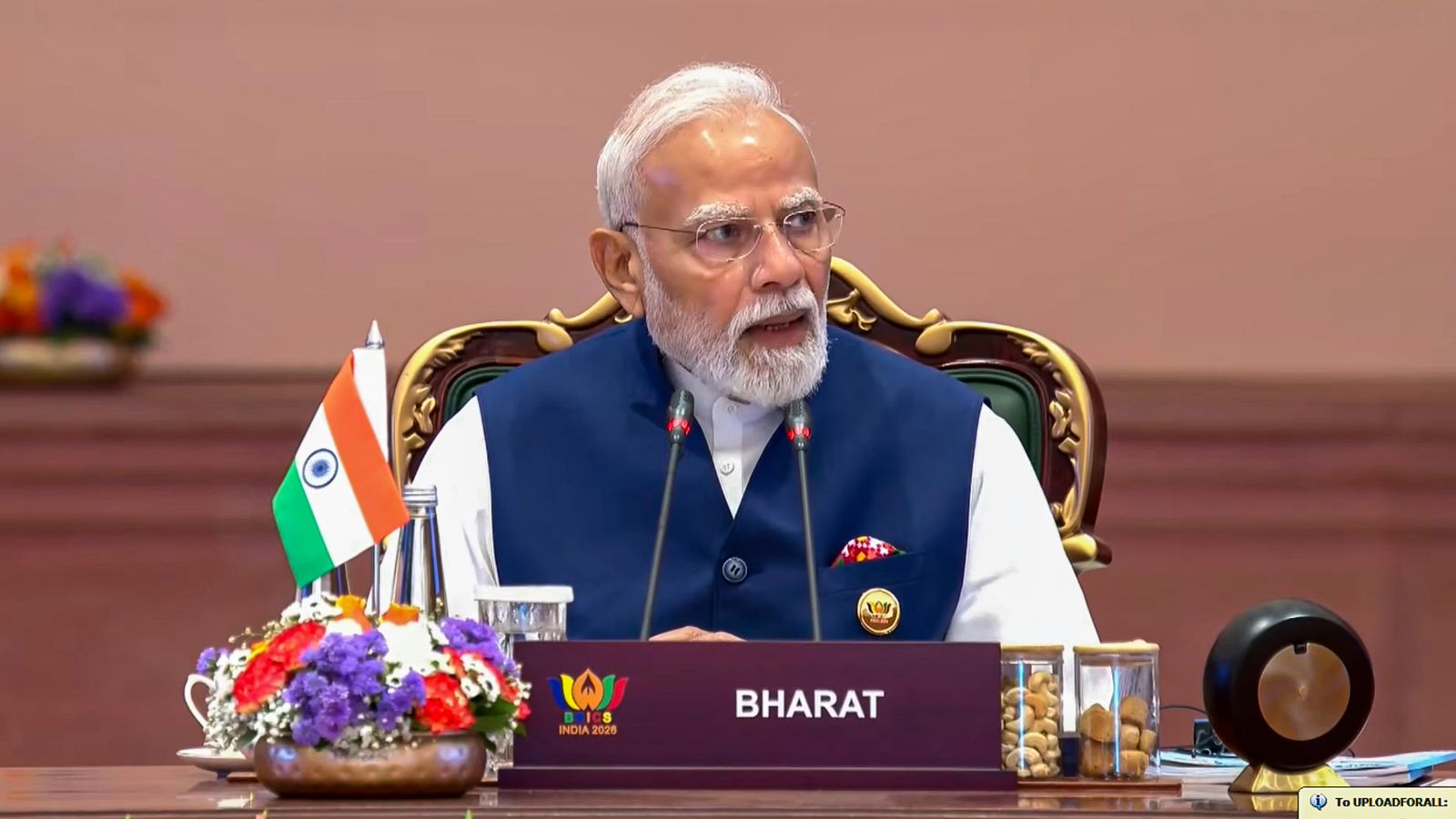
Addressing the BRICS Summit in New Delhi, Prime Minister Narendra Modi warned that the weaponisation of technology and critical minerals could derail global growth. He emphasized resilience, innovation, and inclusive cooperation among member nations.
- PM Modi warned that using critical minerals and technology as geopolitical tools can hinder shared global progress.
- The summit focused on four pillars: Resilience, Innovation, Cooperation, and Sustainability.
- An integrated BRICS early warning system for infectious diseases was agreed upon.
- Proposals include the BRICS Startup Innovation Fund and a Digital Agriculture Network.
On the second day of the BRICS Summit 2026 held at Bharat Mandapam in New Delhi, Prime Minister Narendra Modi delivered a powerful address focusing on global stability. He cautioned the international community against the potential 'weaponisation' of critical minerals and advanced technologies, noting that such actions could create significant hurdles for the collective growth of member nations.
The Prime Minister highlighted that in today's hyper-connected world, no crisis—whether it be a pandemic, climate disaster, or supply chain disruption—remains confined to a single region. He stressed that the increasing global tensions are having a widespread and negative impact on the lives of ordinary citizens, necessitating a more resilient approach among BRICS members.
Why This Matters
BozokMedia analysis shows that the race for critical minerals—essential for electric vehicles, semiconductors, and renewable energy—has become a new frontier in geopolitical competition. By warning against their weaponisation, PM Modi is positioning India as a voice for equitable resource distribution and stable global supply chains, countering the trend of resource nationalism.
Under India's presidency, the summit has centered on four strategic pillars: Resilience, Innovation, Cooperation, and Sustainability. To bolster these, the Prime Minister announced the BRICS Logistics Supply Chain Cooperation Framework and an integrated early warning system to respond to infectious diseases and natural disasters.
The weaponisation of technology and critical minerals can hinder our shared progress. Therefore, we have emphasised inclusivity in the adoption of technology.
To drive economic and technological growth, the Prime Minister proposed the BRICS Startup Innovation Fund and the BRICS Network on Digital Agriculture. The latter aims to integrate AI, geospatial technology, and digital public infrastructure to empower farmers across the BRICS bloc. Furthermore, the BRICS MSME Cooperation Portal was highlighted as a tool to connect small entrepreneurs with global markets and finance.
Addressing sustainability, PM Modi emphasized the balance between human development and environmental protection. Initiatives like the BRICS Digital Centre of Excellence for Smart Grids & Energy Storage were discussed to ensure that clean energy systems become more reliable and accessible for all member nations.
Frequently Asked Questions
1. What does 'weaponisation of minerals' mean in this context?
It refers to countries using their control over essential mineral resources to exert political pressure or gain unfair economic advantages over other nations.
2. How does the BRICS Startup Innovation Fund help?
It is designed to connect startups and incubators within the BRICS nations, fostering scalable solutions and cross-border technological collaboration.