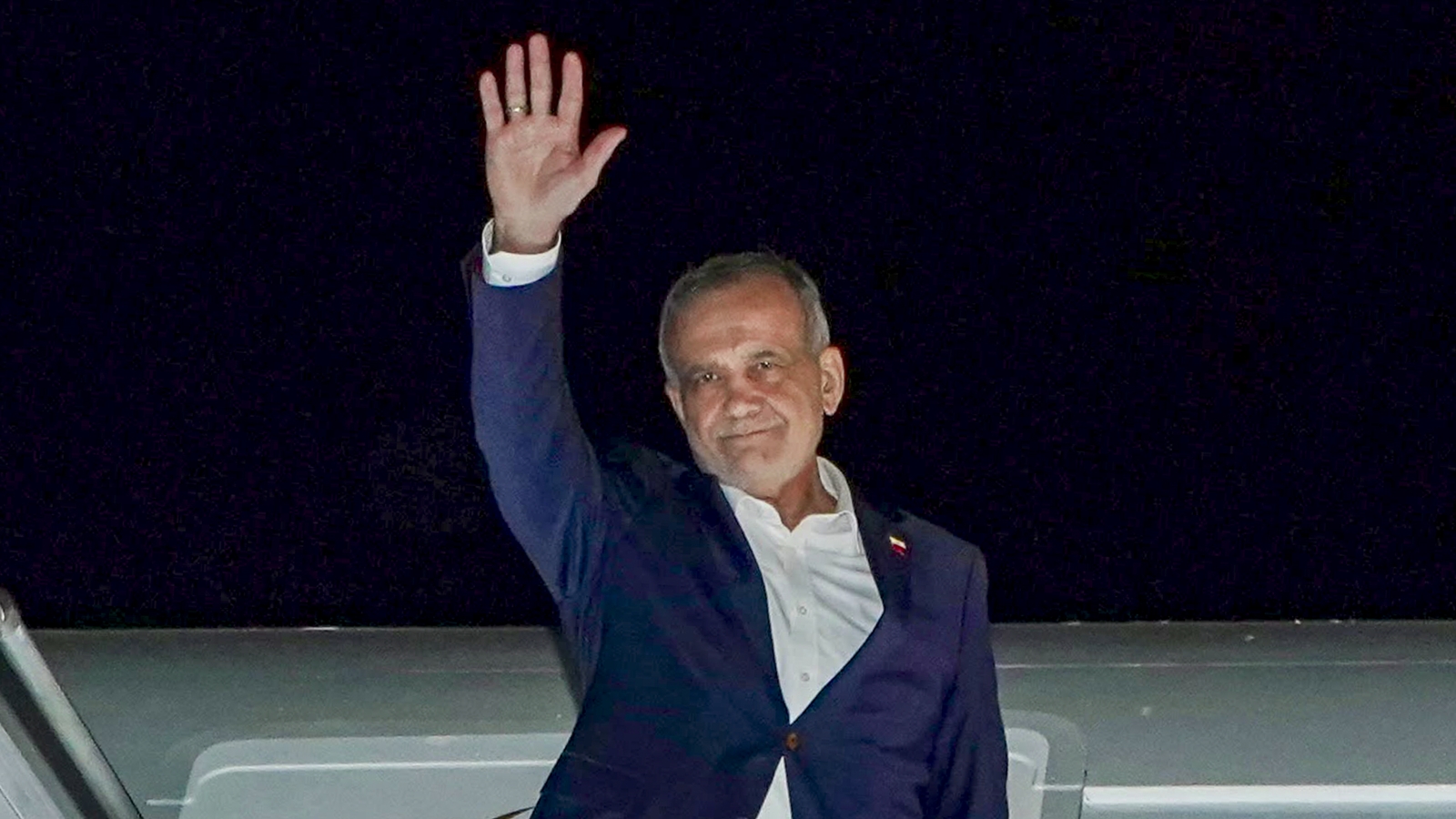
In a landmark meeting at the BRICS Summit in New Delhi, Iranian President Masoud Pezeshkian and the UAE Crown Prince agreed to set aside past hostilities to pursue future economic and regional stability.
- First high-level meeting between Iran and UAE leaders since the onset of the West Asia war.
- Both nations agreed to prioritize future economic cooperation over past geopolitical tensions.
- The meeting coincided with the adoption of a BRICS joint declaration emphasizing regional restraint.
A significant diplomatic breakthrough occurred on the sidelines of the BRICS Summit in New Delhi, marking a rare moment of reconciliation between Iran and the United Arab Emirates (UAE). Iranian President Masoud Pezeshkian met with Abu Dhabi Crown Prince Sheikh Khaled bin Mohamed bin Zayed Al Nahyan, signaling a potential de-escalation in the volatile West Asia region.
Following the high-stakes discussions, President Pezeshkian stated that the two nations had "agreed to put the past behind... and look to the future." This statement comes after months of heightened tension, during which the UAE had faced various regional security challenges. The meeting is being viewed as a crucial opening for dialogue between two sides that have recently been at odds.
Why This Matters
BozokMedia analysis shows that this rapprochement is vital for global energy security. The stability of the Strait of Hormuz, a critical maritime artery for global oil supplies, depends heavily on the relationship between Iran and the Gulf states. Any direct communication between Tehran and Abu Dhabi serves as a buffer against regional escalation that could trigger global economic shocks.
The willingness of Iran and the UAE to engage directly in New Delhi marks a pivot from proxy tensions toward pragmatic economic diplomacy.
The meeting was bolstered by the BRICS joint declaration adopted on Saturday. The declaration expressed deep concern over escalating tensions in West Asia and called for maximum restraint. Crucially, the document acknowledged the territorial sovereignty and the necessity of protecting civilian infrastructure, addressing the specific sensitivities of both Tehran and Abu Dhabi.
Beyond bilateral ties, Pezeshkian also engaged in brief but impactful discussions with the leaders of Russia and China. He noted that a "promising outlook for the expansion of economic cooperation is taking shape," suggesting that the BRICS framework is becoming a significant platform for non-Western economic integration.
This diplomatic movement comes just days before scheduled talks in Oman involving the Gulf Cooperation Council (GCC). These upcoming discussions are expected to focus on transit agreements through the Strait of Hormuz, aiming to ensure the smooth flow of energy and commerce in an increasingly complex geopolitical landscape.
Frequently Asked Questions
Question 1: Where did the Iran-UAE meeting take place?
Answer: The meeting took place in New Delhi, India, on the sidelines of the BRICS Summit.
Question 2: What is the significance of the BRICS joint declaration?
Answer: The declaration calls for restraint in West Asia and emphasizes the protection of sovereignty and energy flows, providing a diplomatic framework for the two nations.