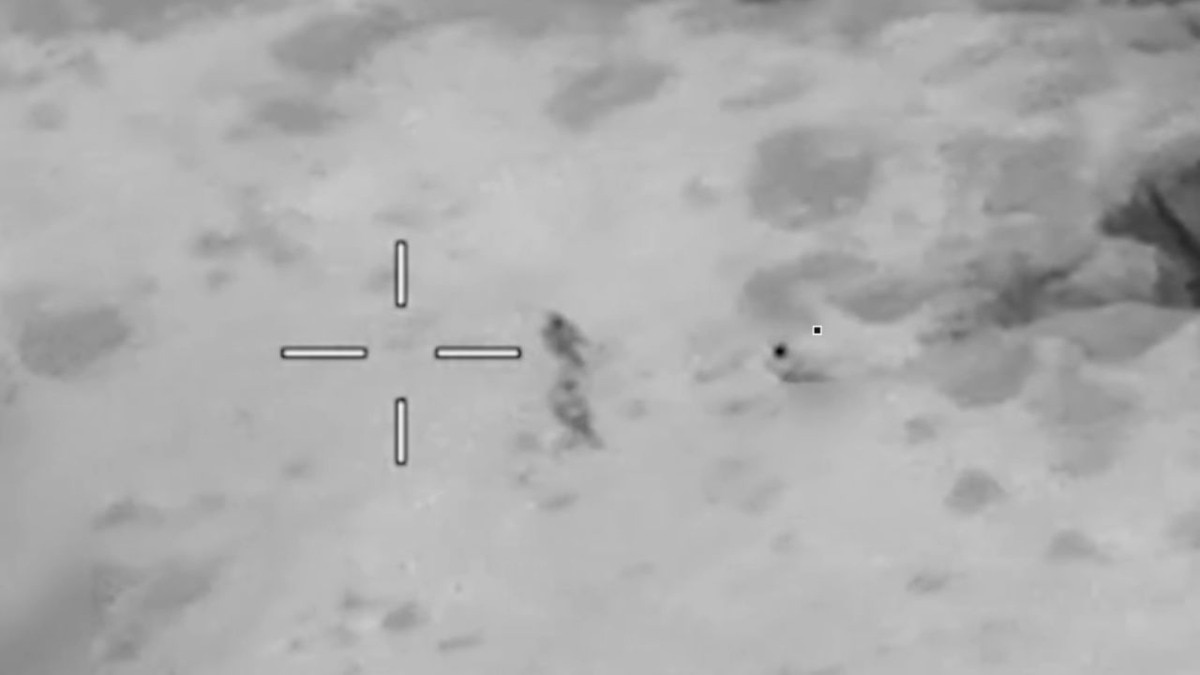
Newly declassified footage has revealed the high-stakes operation to rescue a wounded US Air Force officer stranded in Iran. After his F-15E was shot down, the pilot survived 50 hours in hostile territory during a mission involving CIA deception and heavy air strikes.
In a stunning revelation, declassified footage has shed light on a high-risk mission to recover a wounded US Air Force colonel, known by his call sign 'Bravo', who was stranded in Iran. Following the shoot-down of his F-15E fighter jet in April, Bravo spent nearly two days navigating the treacherous mountainous landscape of Iran while being hunted by enemy forces.
The incident began when an Iranian shoulder-fired missile struck the aircraft near the Isfahan region. The ejection process was catastrophic; Bravo's parachute was damaged, leading to a terrifying free fall at speeds reaching 100 mph. Upon impact, he suffered broken bones in his back, arm, and shoulder, landing miles away from his fellow crew member, 'Alpha'.
Why This Matters
BozokMedia analysis shows that this operation was not merely a tactical rescue but a massive strategic undertaking involving multi-layered intelligence and combat assets. The ability of the US to conduct a large-scale extraction on Iranian soil highlights the complex interplay between special operations and intelligence agencies like the CIA.
To ensure the pilot's safety, the CIA orchestrated a sophisticated deception campaign to mislead Iranian Revolutionary Guard forces. Simultaneously, US bombers and drones conducted precision strikes to create a window of opportunity for the ground extraction team to move in.
'The scale of this mission, involving hundreds of personnel and thousands of support staff, underscores the extreme measures taken to recover a single asset,' noted a defense analyst.
The operation was massive in scope. More than 90 US service members were deployed on the ground, supported by hundreds of personnel in the air. The extraction involved MH-6 'Little Bird' helicopters and search-and-rescue aircraft operating under intense pressure.
The mission faced a final, critical complication when rescue aircraft became stuck at a makeshift airstrip. To prevent sensitive US military technology from falling into Iranian hands, the military made the difficult decision to destroy the marooned aircraft and helicopters on-site.
Historical Background
The tensions between the United States and Iran have long been characterized by military posturing and intelligence warfare. Incidents involving the violation of sovereign airspace often lead to high-stakes confrontations that test the limits of international diplomacy and military capability.
Frequently Asked Questions
Question 1: How long was the pilot stranded?
Answer: The pilot, Bravo, was behind enemy lines for approximately 50 hours.
Question 2: Why did the US destroy its own aircraft?
Answer: To prevent sensitive military technology from being captured by Iranian forces.