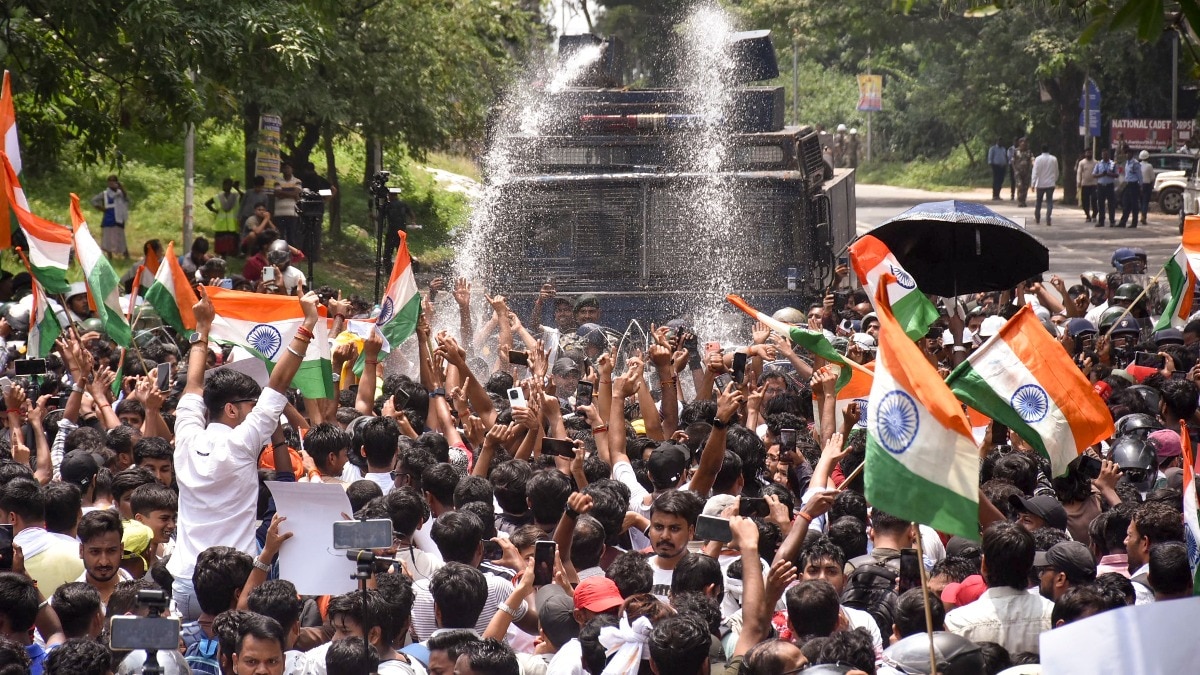
In a major breakthrough for the student movement in Jharkhand, the state government has cancelled the JSSC-CGL exam and all tests conducted by the outsourced agency TDPL. While leader Devendra Mahto ended his hunger strike, three protesters continue to demand a CBI probe.
- Jharkhand government cancels JSSC-CGL and all exams conducted by outsourced agency TDPL.
- JLKM leader Devendra Mahto breaks his 16-day hunger strike following the announcement.
- Three protesters remain on hunger strike, demanding a CBI investigation.
- An exam reforms committee led by IAS Amitabh Kaushal has been established.
Ranchi: The intense student agitation in Jharkhand has reached a significant turning point. Following a marathon Cabinet meeting chaired by Chief Minister Hemant Soren, the state government announced the cancellation of the Jharkhand Staff Selection Commission-Combined Graduate Level (JSSC-CGL) examination, along with all recruitment tests conducted by the outsourced agency TSR Data Processing Pvt Ltd (TDPL) since 2014.
A Victory for the Movement
Devendra Nath Mahto, the prominent leader of the Jharkhand Loktantrik Kranti Morcha (JLKM), ended his grueling 16-day hunger strike around midnight on August 17, 2026. Addressing a press conference, Mahto described the government's decision as a "historic win" for the student community. However, he emphasized that the struggle for systemic change is far from over.
"A CBI or CID inquiry alone cannot provide complete justice to the students," Mahto stated. "We are demanding a guarantee of a leak-proof examination system and absolute transparency in the future. I have a blueprint for this which I will present to the government."
Why This Matters
BozokMedia analysis shows that this crisis highlights the systemic vulnerabilities inherent in outsourcing high-stakes government recruitment to private agencies. While the cancellation provides immediate relief to those seeking fair competition, it exposes a massive breakdown in administrative oversight that has persisted for over a decade.
"It is a victory where no one has to face defeat; the government intends to do good, and the people have won their rights." - Sonam Wangchuk
The Ongoing Resistance
Despite the government's move, the agitation has not fully subsided. Three protesters—Rahul Kranti, Sabita Kumari, and Rupesh Pal—have continued their hunger strike into the 25th day of the movement. Their primary demand remains a comprehensive CBI probe into the alleged irregularities that have plagued the recruitment process.
The government has responded by forming an exam reforms committee headed by senior IAS officer Amitabh Kaushal to recommend measures to strengthen the recruitment process and prevent future malpractices.
Counter-Protests and Social Implications
The decision has not been without controversy. A counter-protest erupted outside the State Secretariat, led by candidates who had already cleared the exams and secured jobs. They argued that the cancellation could potentially render nearly 2,000 individuals jobless, creating a new layer of socio-economic instability.
Frequently Asked Questions
1. What was the primary reason for the exam cancellation?
The exams were cancelled due to alleged irregularities and concerns regarding the integrity of the outsourced agency, TDPL.
2. Is the protest over?
Not entirely. While some leaders have broken their fast, a segment of protesters continues to demand a CBI investigation into the matter.