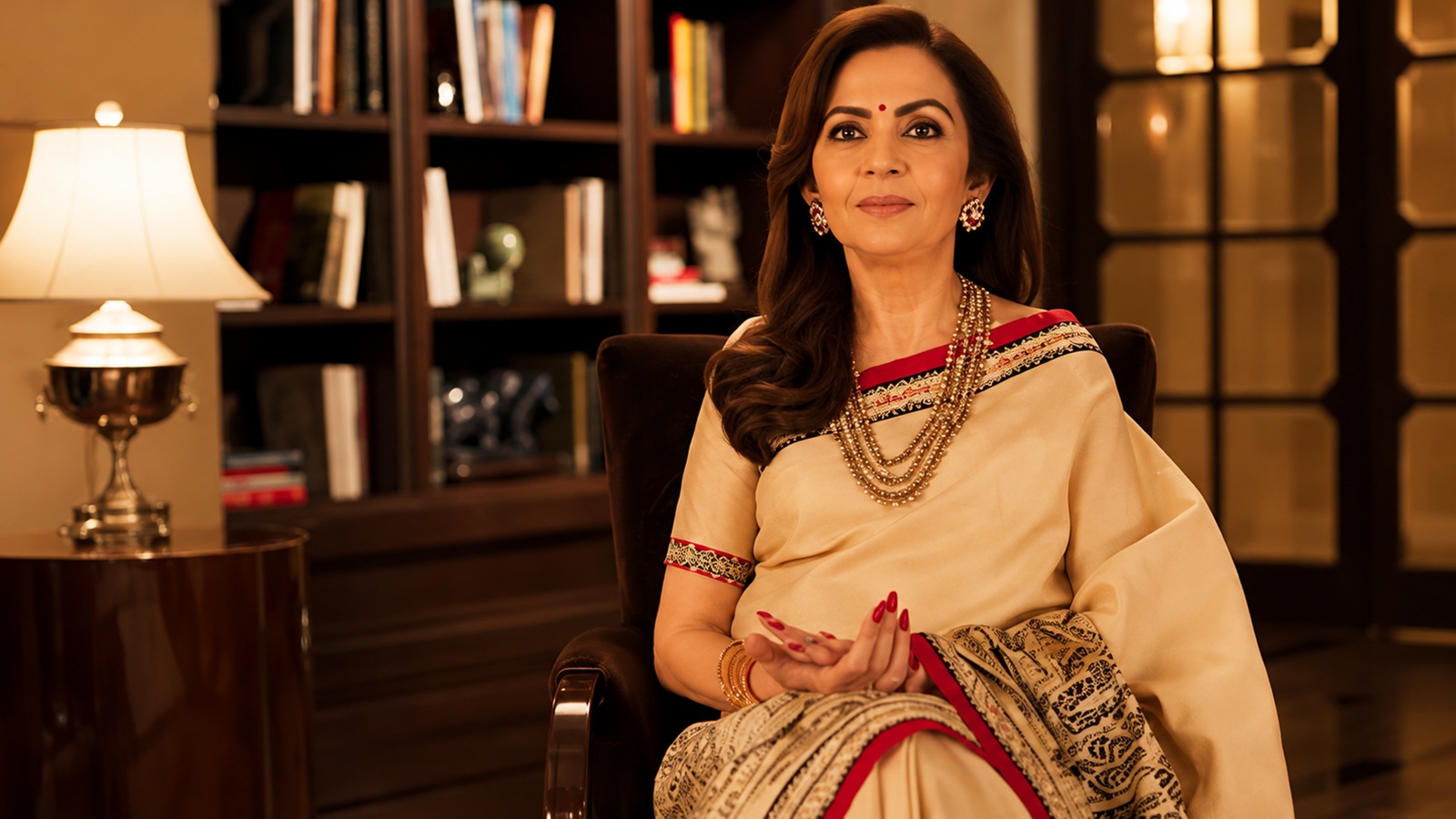
Nita Ambani showcased the splendor of Odisha's Pattachitra art in a specially designed Tussar silk sari featuring the symbolic 'Tree of Life.' The ensemble celebrates India's rich cultural tapestry during the 80th Independence Day celebrations.
- Nita Ambani wore a custom Pattachitra art sari designed by Swadesh.
- The design features the 'Tree of Life,' inspired by the Vedic Ashvattha.
- Crafted on Tussar silk by Raghurajpur weavers and artist Prashanta Moharana.
To commemorate India's 80th Independence Day, Nita Ambani made a profound statement of cultural pride at the Grand Theatre of NMACC in Mumbai. Appearing at the launch of 'The Great Indian Musical: Civilization to Nation,' the Reliance Industries director donned a masterpiece that seamlessly blends luxury with ancient tradition.
The ensemble, exclusively designed by Swadesh, features the revered Pattachitra art form of Odisha. Painted by renowned artist Prashanta Moharana on luminous Tussar silk, the sari serves as a canvas for the 'Tree of Life.' This central motif, inspired by the Vedic Ashvattha, symbolizes the interconnectedness of all existence and the continuity of life.
Why This Matters
BozokMedia analysis shows that when global icons like the Ambani family adopt regional handicrafts, it creates a massive economic ripple effect for local artisan clusters. By elevating Pattachitra from temple walls to high-fashion runways, the brand Swadesh is helping transition traditional folk art into the global luxury segment.
The integration of sacred Vedic symbols like the Ashvattha into modern couture marks a significant evolution in India's contemporary fashion identity.
Pattachitra is a sacred art form with roots tracing back to the 5th century. Traditionally practiced by 'Patuas' in the temple towns of Odisha, it uses natural pigments to narrate divine tales. While Odisha's style is deeply devotional, the tradition extends to Bengal, known as 'Patachitra,' where artists use 'Pater Gaan' (songs) to accompany their visual storytelling.
Historical Background
The term 'Pattachitra' is derived from the Sanskrit words 'Patta' (cloth) and 'Chitra' (painting). For centuries, these artists have acted as visual historians, using long scrolls and meticulous details to preserve mythology and social narratives, making it one of the most enduring storytelling mediums in South Asia.
Frequently Asked Questions
1. What is the significance of the 'Tree of Life' on the sari?
It represents the Vedic Ashvattha, symbolizing creation, continuity, and the cosmic connection of all living beings.
2. Where does Pattachitra art originate?
It is a traditional art form originating from the temple-town traditions of Odisha, India.