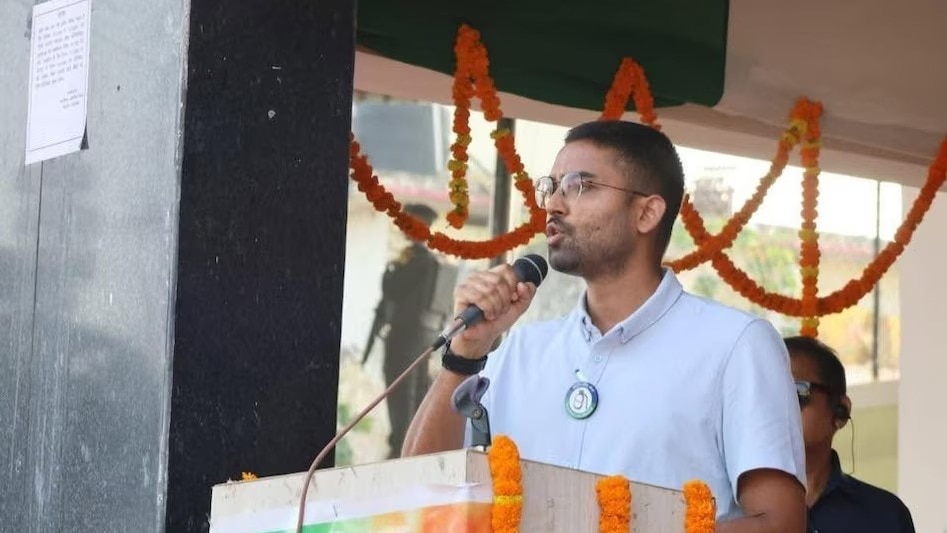
The Supreme Court has demanded an explanation from the Bihar government regarding the continued tenure of Panchayati Raj Minister Deepak Prakash, who has held office for over seven months without being elected to the legislature.
Key Takeaways
- The Supreme Court questioned the legality of Deepak Prakash's ministerial tenure.
- The Minister has not been elected to either the Assembly or the Council for over 7 months.
- The case revolves around the interpretation of Article 164(4) of the Constitution.
- The bench is headed by Chief Justice of India Surya Kant.
New Delhi: In a significant constitutional observation, the Supreme Court on Thursday confronted the Bihar government over the reappointment of Deepak Prakash as the Panchayati Raj Minister. A bench led by Chief Justice of India (CJI) Surya Kant questioned how the state continues to retain a minister who has not secured membership in either House of the Bihar Legislature for more than seven months.
The petitioner's counsel emphasized that 7 months and 22 days have elapsed since the appointment, yet the individual remains in office. The core of the dispute lies in whether the state government attempted to bypass constitutional mandates by reappointing the minister to effectively reset the six-month clock.
Why This Matters
BozokMedia analysis shows that this case sets a critical precedent for federalism and constitutional morality in India. The ability of a state government to circumvent the spirit of the law through technical reappointments threatens the fundamental principle that executive power must stem from elected representatives. This ruling will define the boundaries of ministerial appointments across all Indian states.
The legality of executive appointments must never be sacrificed at the altar of political expediency.
According to the petition filed by Rakesh Kumar Singh, Prakash was first appointed on November 20, 2025. Under Article 164(4), he was required to become a member of the Legislature by May 20, 2026. The plea contends that the subsequent reappointment was an unconstitutional maneuver to extend his term indefinitely without an election.
Historical Background
Article 164(4) of the Indian Constitution is a safeguard designed to ensure accountability. It stipulates that a person who is not a member of the Legislature can be appointed as a minister, but must obtain membership within six months, failing which they must vacate the office. This prevents the creation of a permanent 'non-elected' executive class.
Frequently Asked Questions
1. What is the constitutional violation alleged in this case?
The allegation is that the minister is violating Article 164(4) by holding office beyond six months without being an elected member.
2. What was the Supreme Court's immediate reaction?
The Court expressed concern over the retention of a minister without election and has asked the state to explain the situation.