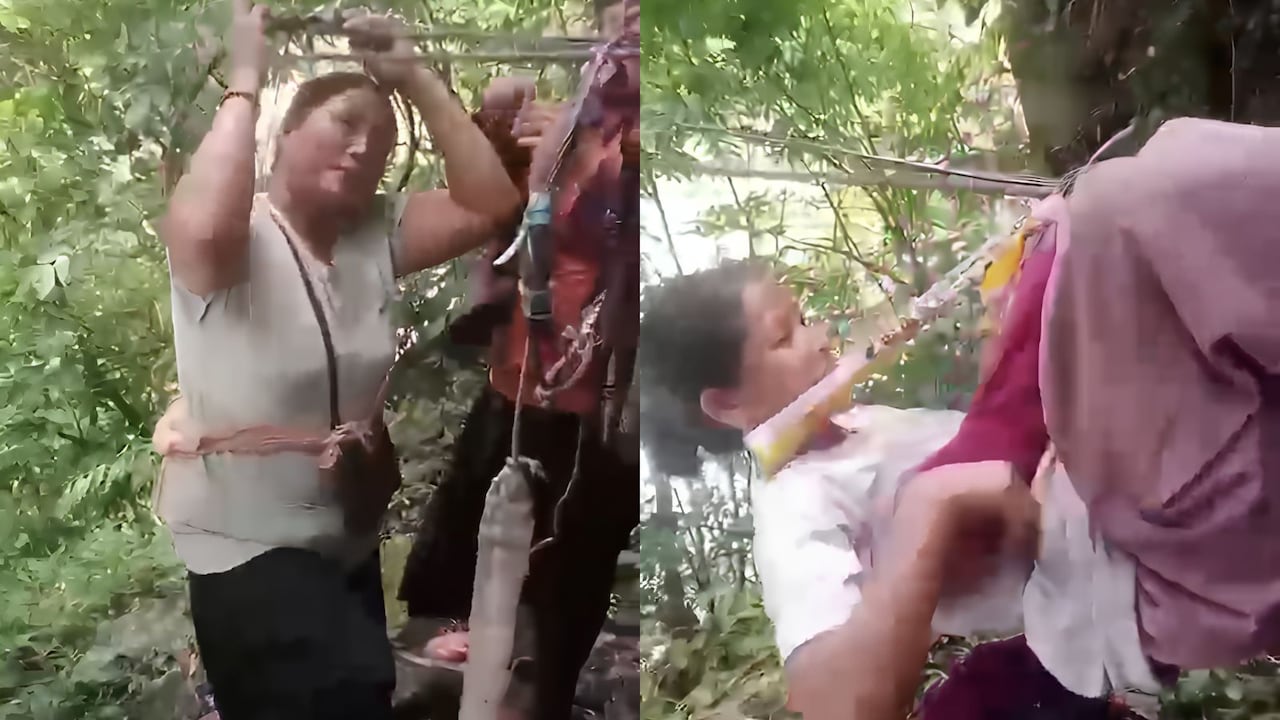
A shocking video from Arunachal Pradesh's Anjaw district shows local women crawling upside down on a single rope to cross a turbulent river, highlighting the severe lack of basic infrastructure in India's border regions.
Key Takeaways
- Local women in Arunachal's Anjaw district risk their lives daily by crawling upside down on ropes to cross a river.
- The lack of a proper bridge forces farmers to use hazardous methods to reach their agricultural fields.
- The incident highlights the glaring infrastructure deficit in India's strategically crucial border areas.
A spine-chilling video emerging from the remote Anjaw district of Arunachal Pradesh has exposed the harsh realities of infrastructure deficit in India's border regions. The footage depicts local women, carrying heavy agricultural baskets on their backs, securing themselves with a harness before crawling upside down along a single wire rope suspended over a roaring river. This hazardous journey is their daily routine just to reach their fields for farming.
Geographical Challenges and Administrative Gaps
The Anjaw district, which shares a sensitive border with China, is characterized by its rugged mountainous terrain, steep gorges, and fast-flowing rivers. While these features make the region scenic, they present monumental challenges for daily commute. In the absence of pedestrian or suspension bridges, the indigenous communities are forced to rely on indigenous, highly dangerous ropeways (commonly known as zip-lines or wire crossings) to sustain their livelihoods.
| Feature | Current Reality (Anjaw Rope Crossing) | Required Standard Infrastructure |
|---|---|---|
| Safety Level | Extremely High Risk (Fatal falls possible) | 100% Safe (All-weather pedestrian/motorable bridges) |
| Economic Impact | Restricted access to agricultural fields, lower productivity | Seamless transport of crops, boosting local economy |
| Emergency Services | Virtually inaccessible during heavy rains | Immediate access to healthcare and administration |
Why This Matters
BozokMedia analysis shows that while the Indian government has significantly accelerated strategic military infrastructure development along the Line of Actual Control (LAC), civilian infrastructure in remote border villages like those in Anjaw remains severely neglected. This disparity forces local populations, who act as the nation's first line of defense, to live under primitive and life-threatening conditions.
Improving last-mile connectivity in these border districts is not just a humanitarian necessity but also a geopolitical imperative. If border villages depopulate due to a lack of basic amenities like bridges, roads, and healthcare, it weakens India's territorial vigilance and strategic hold over these highly sensitive areas.
"Civilian infrastructure in border districts is the bedrock of national security; neglecting basic connectivity for local communities undermines our strategic posture." - Infrastructure & Defense Analyst
Frequently Asked Questions
Q1: Why is infrastructure development so slow in Arunachal Pradesh's Anjaw district?A1: The challenging mountainous terrain, frequent landslides, dense forests, and high costs of construction in remote border areas significantly delay infrastructure projects.
Q2: What are the risks faced by locals due to the lack of bridges?A2: Locals risk drowning, severe injuries from falls, and complete isolation from medical facilities, especially during the monsoon season when rivers swell.
