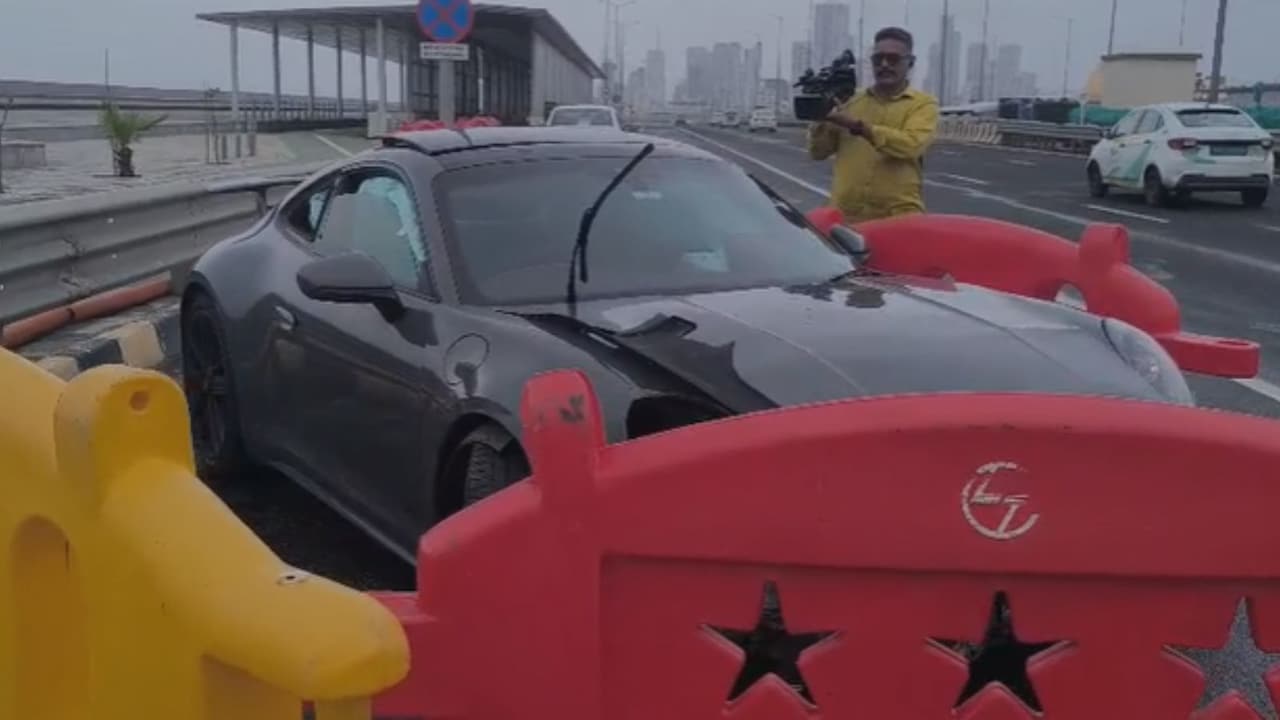
A high-speed Porsche luxury car crashed into a divider on Mumbai's newly opened Coastal Road. While the driver escaped miraculously due to timely airbag deployment, the incident has sparked fresh debates on speed limits and safety on high-speed urban corridors.
Key Takeaways
- A speeding Porsche luxury car rammed into a divider on Mumbai's iconic Coastal Road.
- The driver escaped unhurt as the vehicle's airbags deployed instantly upon impact.
- The accident caused temporary traffic congestion on the high-profile marine corridor.
A high-end Porsche sports car met with a severe accident on Mumbai's high-profile Coastal Road. The vehicle, reportedly traveling at a high velocity, lost control and rammed violently into the road divider. The impact was so severe that the front portion of the luxury vehicle was completely mangled, scattering debris across the lanes.
Despite the devastating impact of the crash, the driver walked away without any major injuries. Police officials confirmed that the vehicle's advanced safety systems, specifically the rapid deployment of airbags, played a critical role in saving the driver's life. Emergency services and local police rushed to the spot to clear the wreckage and restore the flow of traffic, which was disrupted for over an hour.
Historical Background
The Mumbai Coastal Road, officially known as the Dharmaveer Swarajya Rakshak Chhatrapati Sambhaji Maharaj Coastal Road, is a landmark infrastructure project designed to ease traffic between South Mumbai and the western suburbs. Opened recently to the public, the road features a speed limit of 80 km/h, which is frequently violated by speed enthusiasts. High-performance supercar accidents have been on the rise in Indian metros, raising questions about whether drivers possess the training required to handle such high-horsepower machines on public roads.
Why This Matters
This incident highlights a growing metropolitan challenge: the intersection of high-speed infrastructure and high-performance luxury vehicles. As Indian cities upgrade to world-class expressways and coastal roads, the temptation for speeding increases exponentially. BozokMedia analysis shows that while infrastructure development significantly reduces travel time, it also necessitates stricter speed enforcement and advanced camera surveillance to prevent fatal high-speed crashes.
Furthermore, this crash underscores the critical importance of vehicular safety ratings and active safety features. While a luxury car's safety tech saved a life today, a similar crash involving a budget car without advanced crumple zones and multi-stage airbags could have resulted in a fatality. This sharp contrast emphasizes the urgent need for uniform safety standards across all vehicle segments in India.
| Feature / Parameter | Mumbai Coastal Road Standards | General City Roads (Mumbai) |
|---|---|---|
| Speed Limit | 80 km/h (reduced to 60 km/h in tunnels) | 30 - 50 km/h |
| Surveillance | High-tech speed cameras & ANPR systems | Manual policing & standard CCTV |
| Access Control | Restricted (No two/three-wheelers allowed) | Open to all vehicle types |
"Modern supercars possess immense power that can become uncontrollable within seconds on urban roads; strict speed enforcement on high-speed corridors like the Coastal Road is no longer optional, but a life-saving necessity." - Road Safety Expert
Frequently Asked Questions
Q1: What is the speed limit on the Mumbai Coastal Road?
A1: The speed limit is set at 80 km/h on straight stretches, 60 km/h inside the undersea tunnels, and 40 km/h at turnings and entry/exit points.
Q2: Why are two-wheelers and three-wheelers banned on the Coastal Road?
A2: To prevent accidents and ensure smooth, high-speed transit, slow-moving vehicles, two-wheelers, and three-wheelers are prohibited from using the corridor.