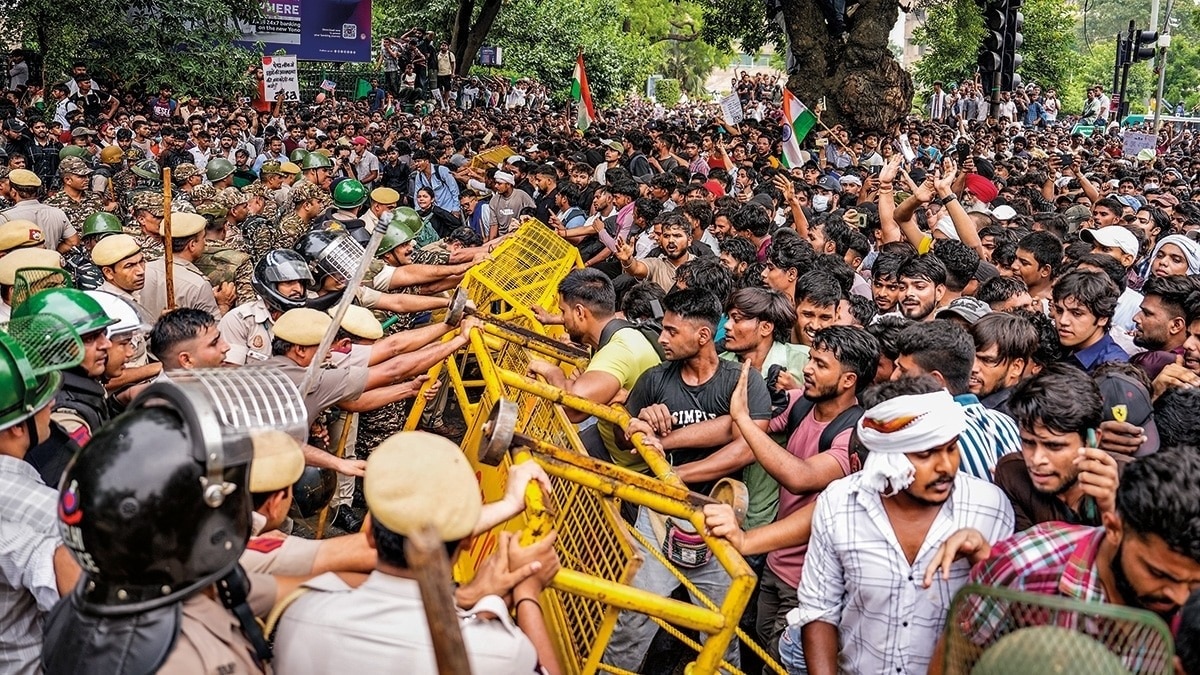
Retired Delhi police officials argue that media coverage of the July 20 student march has been one‑sided, overlooking injuries to officers. They explain the graded crowd‑control protocol and defend the use of non‑lethal weapons such as pellet guns.
Key Takeaways
- Retired officers claim the police are being unfairly portrayed by the media.
- They outline the graded response sequence and the role of non‑lethal weapons.
- A call for public recognition of police sacrifices and constraints.
New Delhi — Following the July 20 march to Parliament, a group of retired Delhi Police non‑gazetted officers held a press conference at the Press Club of India to defend the force’s actions. They said the debate had become “one‑sided” and ignored the injuries sustained by 128 police personnel.
Historical Background
Delhi has witnessed several student movements in recent years, notably the 2020 anti‑CAA protests and the 2022 university fee hike demonstrations. In each case, police employed a graded response—water cannons, tear gas, then lathi charge—sparking public debate over law‑enforcement tactics.
Key Statements from Retired Officers
Former Uttar Pradesh DGP and Rajya Sabha MP Brij Lal said, “In nearly 38 years of service I have handled numerous law‑and‑order situations. Everyone questions what the police did, but no one asks who assaulted the 128 police personnel.” He explained that the standard operating procedure starts with water cannons, moves to tear gas, and only then to a lathi charge, with baton strikes deliberately avoiding vital body parts.
Lal also defended pellet guns, describing them as “a non‑lethal crowd‑control option” and noting that the Supreme Court has upheld their legality. “A pellet gun is a 12‑bore shotgun introduced so police do not have to resort to rifles. It has been unnecessarily turned into a villain,” he said.
Retired ACP Rajender Pathania appealed to the younger generation, stating, “Police personnel are not fragile; they deserve greater public understanding.” He emphasized that officers must differentiate between genuine protesters and criminal elements, yet service conduct rules prevent them from publicly defending themselves.
Why This Matters
BozokMedia analysis shows that the narrative surrounding crowd‑control tactics influences public trust in law‑enforcement agencies, which in turn affects the legitimacy of democratic protests.
"Effective communication of police protocols is essential to bridge the gap between security forces and civil society," says security analyst Dr. Ananya Mehta.
Frequently Asked Questions
Question 1: Why were pellet guns used during the protest?
Answer: They are a non‑lethal option intended to disperse crowds while minimizing serious injuries.
Question 2: What is the police’s graded response protocol?
Answer: The sequence typically starts with water cannons, followed by tear gas, then lathi charge, and finally non‑lethal weapons such as batons or pellet guns.