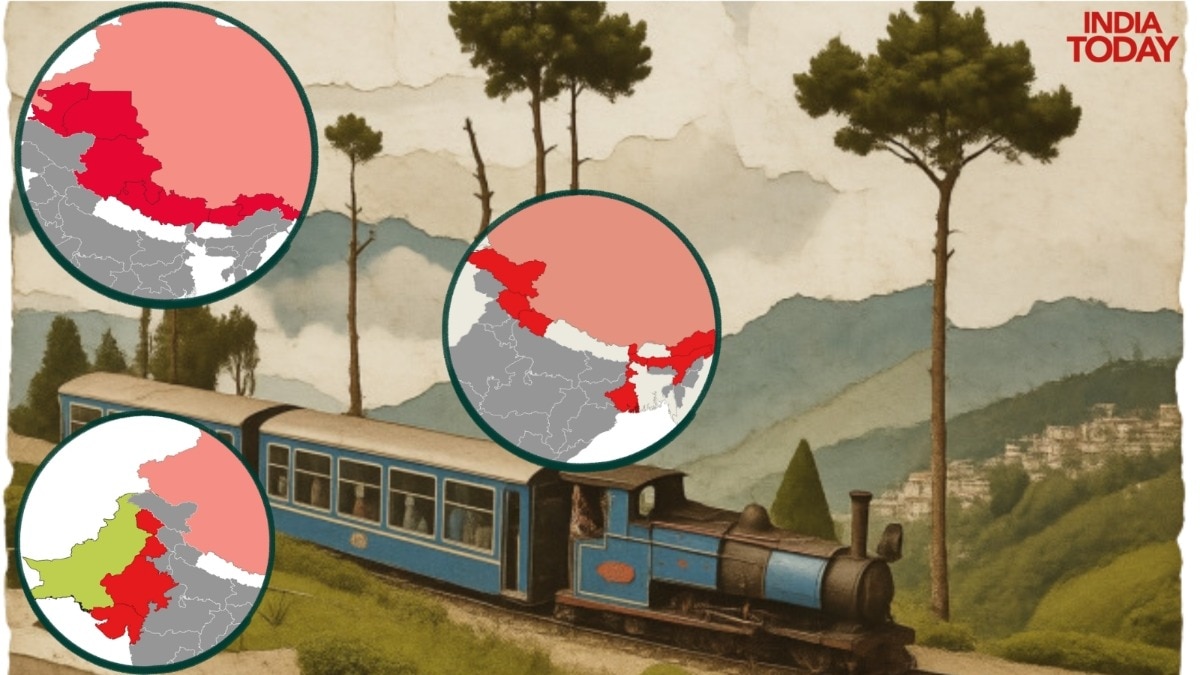
While India accelerates its strategic railway push along its borders, an OSINT analysis reveals that nearly two-thirds of these critical projects remain in the planning or sanctioned stages. This delay poses significant strategic challenges compared to China's rapid infrastructure expansion.
Key Takeaways
- India has identified 41 rail projects along the China and Pakistan borders since 2021.
- Only 2 of these 41 projects are fully operational, while 28 remain as mere proposals or designs.
- China's rail network in Tibet provides a significant logistical advantage for rapid military movement.
- The difficult Himalayan terrain remains a massive hurdle for Indian engineering and speed.
India is intensifying its efforts to build a strategic railway network along its borders to bolster military mobility. However, a comprehensive analysis by the India Today OSINT team reveals a sobering reality: a vast majority of these ambitious projects are currently stuck in the bureaucratic and design phases, existing primarily on paper.
The Execution Gap
According to official documents and parliamentary replies, there are 22 rail projects facing China and 19 facing Pakistan. Despite the momentum, the physical reality on the ground tells a different story. Out of the 41 tracked projects, only two have reached completion. The rest are scattered across various stages: 11 are under construction, 12 are in the design/sanctioned stage, and 16 are still just proposals.
Why This Matters: BozokMedia Analysis
BozokMedia analysis shows that this discrepancy is not just an infrastructure issue but a profound national security concern. The geographical disparity between India and China is stark. While India struggles with the north-to-south alignment of Himalayan ridges, China benefits from flatter terrain that allows for parallel rail lines close to the Line of Actual Control (LAC).
The ability to move troops and heavy artillery rapidly across high-altitude terrain is the ultimate decider in modern Himalayan warfare.
China's Lhasa–Nyingchi railway, operational since 2021, has already transformed the strategic landscape, allowing the PLA to move resources closer to the Arunachal Pradesh sector with unprecedented speed.
Comparison: India vs. China Border Infrastructure
| Metric | Indian Border Rail Projects | Chinese Border Rail Projects |
|---|---|---|
| Total Identified Projects | 41 | 14+ (Directly Relevant) |
| Completed Projects | 2 | 1 (Major Corridor) |
| Primary Terrain Challenge | High-altitude Himalayan ridges | Flat Tibetan Plateau |
| Strategic Status | Planning & Execution Phase | Operational & Expanding |
Frequently Asked Questions
1. Why are so many Indian border rail projects still 'on paper'?
The primary reasons include the extreme cost of construction in high altitudes, complex geological challenges, and the need for multi-ministry approvals.
2. How does China's rail network affect India's security?
China's ability to use rail for 'dual-use' (civilian and military) means they can reinforce their border positions much faster than India can via road-only routes.