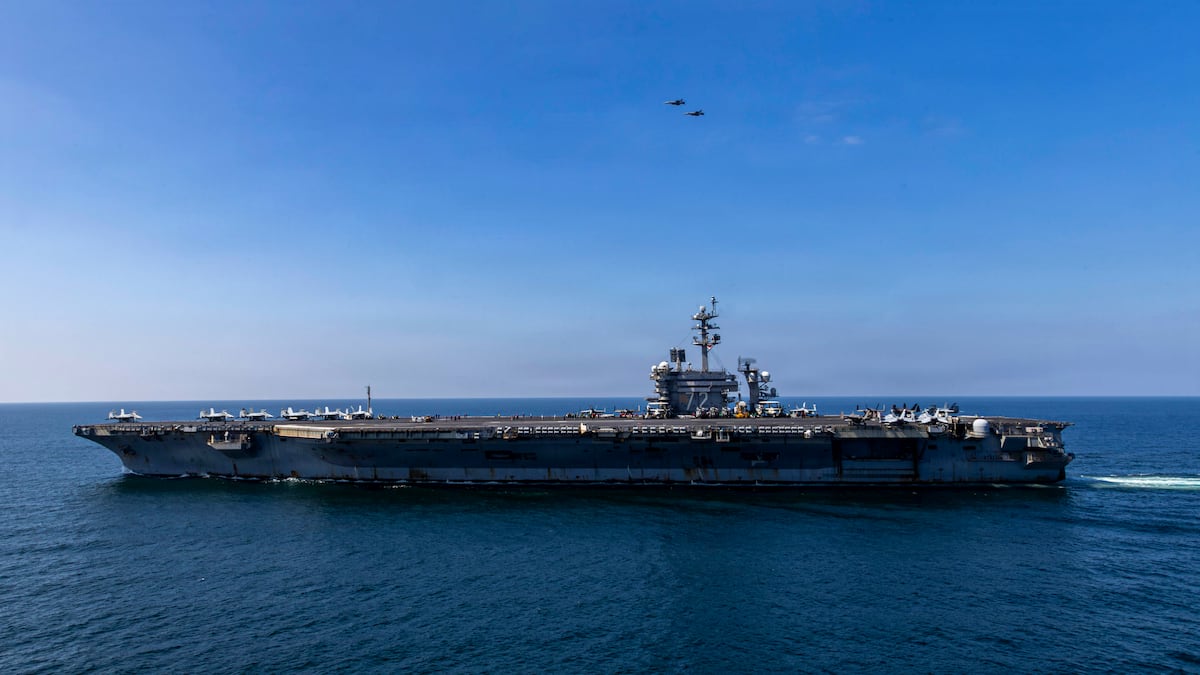
Families of sailors aboard the USS Abraham Lincoln report multiple attempts by crew members to go overboard due to extreme exhaustion and mental health struggles during an indefinite deployment.
Key Takeaways
- Multiple sailors on the USS Abraham Lincoln have reportedly attempted to jump overboard due to extreme burnout.
- The deployment, originally set to end in May, has been extended indefinitely.
- Families are raising urgent concerns regarding mental health, communication gaps, and living conditions.
- The Navy is providing counseling services but has not released the exact number of self-harm incidents.
The crew of the USS Abraham Lincoln is facing a profound mental health crisis, with families reporting multiple instances of sailors attempting to go overboard. The strain comes as the aircraft carrier, supporting U.S. military operations in the Middle East, remains on an extended deployment that was originally expected to conclude in May.
Annabelle Loma, a resident of San Diego, shared a harrowing account of her husband, a 13-year veteran who is now on medical hold after attempting to jump from the carrier. Loma expressed fears that his career might be ruined by a dishonorable discharge due to what she describes as extreme burnout. "He’s scared," Loma said, highlighting the psychological toll of prolonged service without a clear end date.
Why This Matters
BozokMedia analysis shows that the intersection of operational security and sailor well-being is reaching a breaking point. When military deployments are extended without transparent timelines, the resulting uncertainty creates a vacuum of hope, directly impacting the psychological readiness of the force. This crisis underscores the need for more robust mental health support systems that can adapt to the rigors of combat-adjacent environments.
The psychological endurance of a crew is as critical to mission success as the operational readiness of the vessel itself.
In a separate incident, a sailor was credited with saving a shipmate's life by physically intervening before the individual could go overboard. While the Navy has deployed deployment-resilience counselors and chaplains, families remain skeptical, citing difficulties in communicating with their loved ones and witnessing their declining mental states through sporadic emails.
Historical Background
Aircraft carrier deployments are notoriously grueling, often involving months of high-tempo operations. Historically, the mental health of service members has been a secondary concern to operational objectives, but the modern military is increasingly recognizing 'deployment fatigue' as a significant risk factor for self-harm and operational errors.
Frequently Asked Questions
Question 1: Why has the deployment been extended?
Answer: The extension is linked to ongoing U.S. military operations in the Middle East, though no specific return date has been announced for security reasons.
Question 2: What support is the Navy providing?
Answer: The Navy states that counselors, chaplains, and medical professionals are available to assess and support the psychological readiness of the crew.