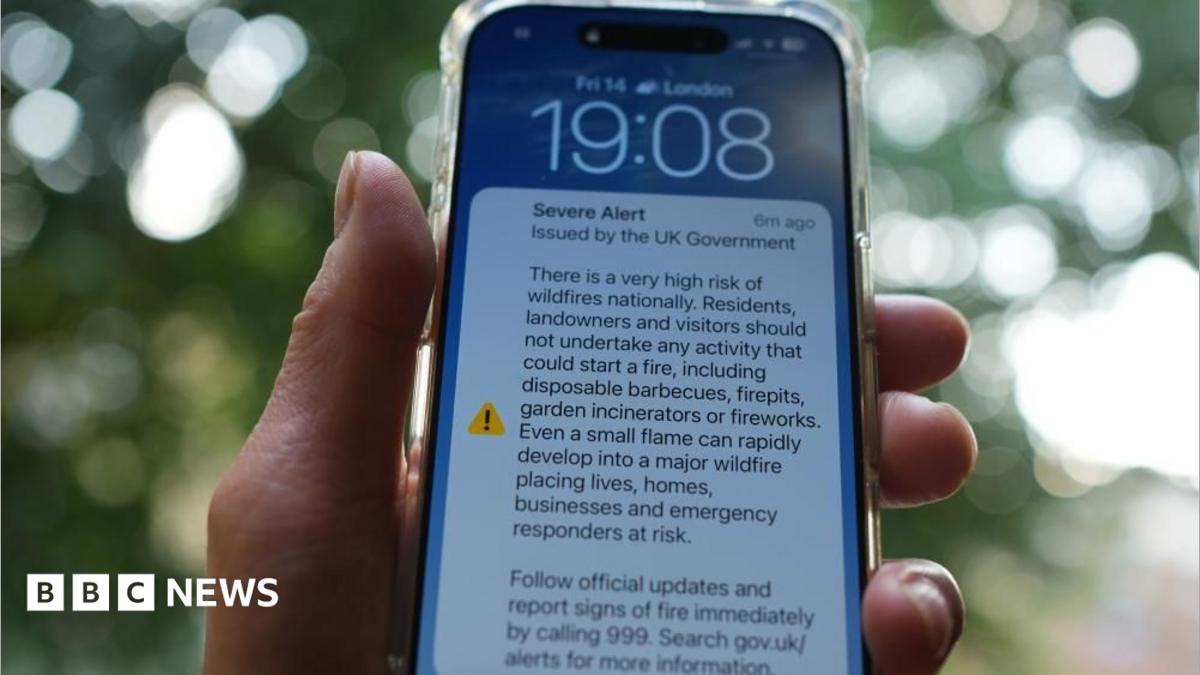
The UK government has stood by its decision to issue a nationwide emergency alert for wildfires, despite warnings from charities that the move endangered domestic abuse survivors.
- Millions received a 'severe alert' regarding high wildfire risks across England and Wales.
- Domestic abuse charities warn that unannounced alerts expose secret phones used by survivors.
- The alert was triggered by frontline fire services amid 43 active fires and 11 major incidents.
The British government has formally defended the deployment of an emergency mobile phone alert system used to warn citizens of escalating wildfires across England and Wales. Describing the action as 'entirely appropriate,' officials emphasized that the urgency of the environmental crisis outweighed the procedural criticisms following the event.
Last Friday, millions of devices emitted a loud notification warning of a 'very high risk of wildfires nationally.' The Prime Minister's spokesperson stated that the alert was issued following a direct request from frontline fire and rescue services. At the peak of the crisis, emergency services were managing 43 separate fires and 11 major incidents, a scale that stretched national resources to their limits and necessitated military intervention.
Why This Matters
BozokMedia analysis shows that while the emergency alert system is a powerful tool for disaster management, its lack of nuance regarding domestic safety protocols reveals a critical gap in governmental risk assessment. The tension between mass public safety and individual survival strategies for abuse victims highlights a systemic failure in pre-alert communication.
"The efficiency of a public warning system is measured not just by how many people it reaches, but by whether it inadvertently harms the most vulnerable members of society."
The backlash has been led primarily by domestic abuse charities, including Women's Aid. Veronica Oakeshott, head of external affairs at the charity, pointed out that survivors often rely on hidden secondary phones to access lifesaving support or plan their escape. The sudden, loud nature of the alert, sent without prior warning, could have alerted abusers to the existence of these devices, potentially placing women and children in immediate danger.
Further controversy erupted over the linguistic rollout of the alert. Politicians from Reform UK and the Conservatives questioned why the notification appeared in Welsh before English. The government responded by citing the Welsh Language Act, which mandates that alerts be issued in Welsh, noting that bilingual delivery is attempted whenever possible.
| Perspective | Key Argument |
|---|---|
| Government | Priority is keeping the public safe during resource-strained crises. |
| Advocacy Groups | Lack of forewarning jeopardizes the safety of domestic abuse survivors. |
| Fire Services | Alerts successfully reduced the number of new wildfire incidents. |
Frequently Asked Questions
1. Why was the alert sent without prior notice?
The government acted on direct requests from frontline services to prevent further wildfire spread during a period of extreme resource strain.
2. What are charities requesting for future alerts?
Organizations like Women's Aid are calling for a window of forewarning to allow vulnerable individuals to secure or hide their devices.