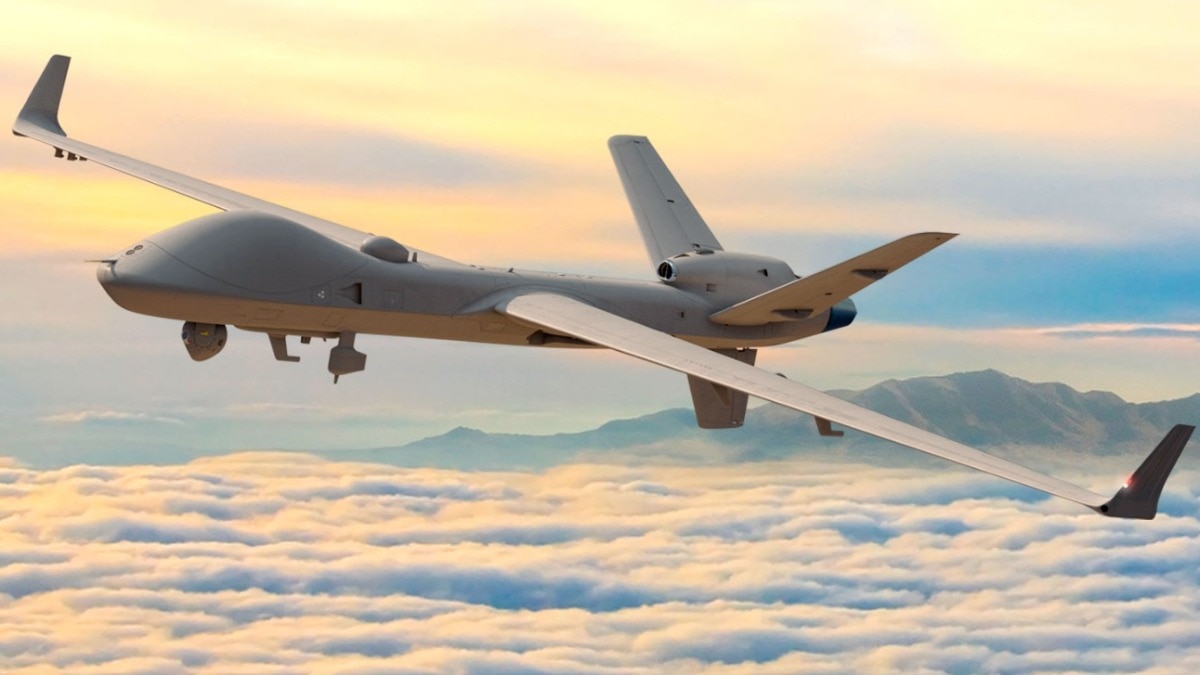
The Indian Ministry of Defence has inked a Rs 1,943 crore agreement with US-based General Atomics to lease two MQ-9B Sea Guardian drones, significantly boosting the Indian Navy's maritime surveillance.
- India signed a lease agreement worth Rs 1,943 crore with General Atomics.
- Two MQ-9B Sea Guardian High-Altitude Long-Endurance (HALE) drones will be added to the fleet.
- The contract is valid for a duration of 30 months.
The Ministry of Defence has officially announced a strategic pact with the American defense giant General Atomics Aeronautical Systems to lease two MQ-9B Sea Guardian remotely-piloted aircraft for the Indian Navy. The deal, valued at approximately Rs 1,943 crore, is designed to enhance India's tactical edge in the Indian Ocean Region (IOR).
The agreement was signed in the presence of the Additional Secretary and Director General (Acquisition) of the Department of Defence. This is not India's first foray into this technology; the Navy already operates two Sea Guardian drones leased a few years ago, proving the efficacy of these assets in challenging maritime environments.
Why This Matters
BozokMedia analysis shows that this lease agreement serves as a critical bridge while India awaits a larger procurement of these assets. By integrating these HALE drones, India is effectively countering the growing naval presence of adversarial powers in the IOR, ensuring that no movement goes unnoticed in its backyard.
"The deployment of MQ-9B aircraft transforms maritime domain awareness from reactive patrolling to proactive intelligence gathering."
The MQ-9B Sea Guardian is equipped with state-of-the-art sensors and sophisticated payloads, allowing it to operate at high altitudes for extended periods. This capability provides persistent intelligence, surveillance, and reconnaissance (ISR) coverage over vast oceanic stretches, enabling the Indian Navy to respond to threats with unprecedented speed and accuracy.
| Feature | MQ-9B Sea Guardian | Conventional Patrol Aircraft |
|---|---|---|
| Endurance | Extremely High (HALE) | Limited by Pilot Fatigue |
| Operation | Remotely Piloted | Crew-manned |
| Primary Role | Persistent ISR | Intermittent Patrol |
Historically, the Indian Navy has relied on a mix of manned aircraft and ships for surveillance. However, the shift toward unmanned systems like the MQ-9B reflects a global trend toward 'network-centric warfare,' where data and persistence are more valuable than raw firepower.
Frequently Asked Questions
1. What are the primary capabilities of the MQ-9B Sea Guardian?
It is a High-Altitude Long-Endurance (HALE) drone capable of persistent intelligence, surveillance, and reconnaissance (ISR) using advanced sensors.
2. What is the duration of the lease agreement?
The contract signed with General Atomics is for a period of 30 months.