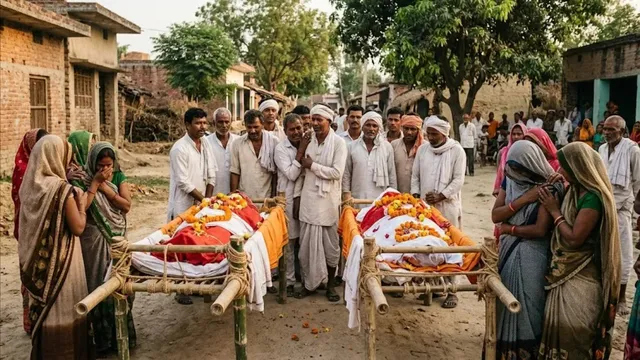
In Ratasar, Balia, 80‑year‑old Saral Kanaujia’s death was followed by his wife Munniya Devi’s sudden passing, leading to a simultaneous funeral that moved the entire community.
Key Takeaways
- 80‑year‑old Saral Kanaujia passed away.
- Wife Munniya Devi died during his funeral procession.
- Both were cremated together in a joint ceremony.
Event Overview
In the village of Ratasar, Balia’s Anand Nagar (Ward 14), a heartbreaking scene unfolded on Sunday. On Saturday night, 80‑year‑old Saral Kanaujia died, and his body was taken about 50 metres from his home for the final rites.
While the procession was underway, news arrived that his wife Munniya Devi had also breathed her last. The gathered relatives and villagers were left stunned, and the funeral procession was immediately returned to the house.
Both bodies were prepared together, and according to local customs, a single cremation was performed at the same site, leaving onlookers in tears.
Historical Background
Indian culture places immense value on marital bonds, and joint funerals for spouses are often seen as a symbol of family unity, especially in rural Uttar Pradesh where such practices are common.
Why This Matters
BozokMedia analysis shows that such joint funerals highlight deep emotional bonds and often spark discussions on elderly care and mental health in rural India.
"Conducting a joint funeral underscores the strength of communal support during grief," says sociologist Dr. Anshu Sharma.
Frequently Asked Questions
Q: Was the joint funeral in line with local customs?
A: Yes, both were cremated together following regional traditions.
Q: What social lessons can be drawn from such incidents?
A: It highlights the importance of family unity and the need for better elderly care and mental health support.