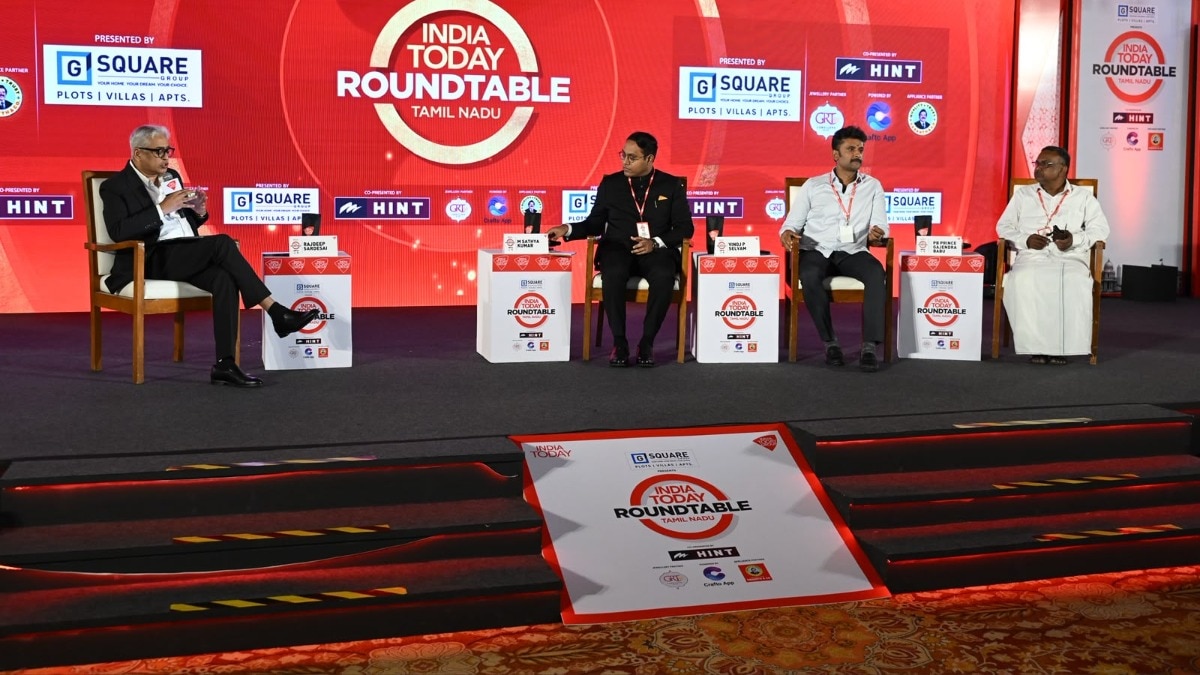
A high-stakes debate at the India Today Tamil Nadu Roundtable has exposed the deep rift between the Centre's National Education Policy (NEP) and Tamil Nadu's commitment to state autonomy and social justice.
- Clash between NEP's three-language formula and Tamil Nadu's two-language policy.
- Severe disagreement over the implementation of NEET and its impact on equity.
- Concerns regarding the centralization of education and loss of state autonomy.
- Calls for strengthening government schools over private educational dominance.
The India Today Tamil Nadu Roundtable recently became a battleground for a fierce ideological conflict regarding the National Education Policy (NEP) 2020 and the National Eligibility cum Entrance Test (NEET). The discussion highlighted the growing friction between the Union Government's vision of standardized education and Tamil Nadu's insistence on regional autonomy and linguistic identity.
M Satyakumar, National Spokesperson for TVK, launched a scathing critique of the NEP, arguing that it undermines the state's longstanding two-language policy. He asserted that the push for a three-language formula is perceived not as an educational upgrade, but as a strategic move by the Centre to introduce Hindi into the state's education system, thereby eroding the cultural and political autonomy of Tamil Nadu.
Conversely, Vinod Sharvam, State Secretary of the BJP Tamil Nadu, defended the policy as a necessary step toward modernization. He argued that equipping students with a broader range of languages and vocational skills is essential for global competitiveness. Sharvam challenged the narrative of 'Hindi imposition,' noting that even some regional schools incorporate three languages into their curriculum to benefit students.
Why This Matters
BozokMedia analysis shows that this clash represents a fundamental struggle over the nature of Indian federalism. Education is a concurrent subject, but when the Centre leverages policy to create uniformity, it often ignores the socio-political nuances of the South. This debate is a canary in the coal mine for future conflicts regarding linguistic hegemony and administrative control.
Education should not be a tool for homogenization but a mechanism for empowerment that respects regional diversity.
Adding a critical dimension to the debate, educationist PB Prince Gajendra Babu analyzed the NEP through the lens of social justice. He argued that the policy lacks a robust framework to protect first-generation learners and marginalized communities. According to Babu, the focus should shift from high-stakes entrance exams to the systemic overhaul of government schools, ensuring permanent staffing and modern infrastructure to bridge the divide between private and public education.
The discourse on NEET further polarized the panel. While the Centre views NEET as a meritocratic standard, critics in Tamil Nadu argue it favors those who can afford expensive coaching. Gajendra Babu suggested that medical admissions should return to being based on normalized Class 12 marks, arguing that strengthening higher secondary education is more vital than increasing the difficulty of a single entrance exam.
| Issue | Centre/NEP Perspective | Tamil Nadu/Opponents Perspective |
|---|---|---|
| Language Policy | Three-Language Formula (Modernization) | Two-Language Policy (Cultural Identity) |
| Entrance Exams | National Standard (NEET) | 12th Grade Marks/State-led Selection |
| Governance | Centralized Quality Standards | Decentralized Social Justice Model |
Frequently Asked Questions
1. Why is Tamil Nadu opposing the NEP 2020?
The primary objections are the three-language formula, which is seen as a move to impose Hindi, and the perceived over-centralization of educational governance.
2. What is the core argument against NEET in the state?
Critics argue that NEET creates an unfair advantage for wealthy students who can afford coaching, thereby harming social justice and equity in medical admissions.