A massive supply chain failure and alleged black-marketing have crippled Rajasthan's Pannadhay Bal Gopal Yojana, leaving millions of students without essential nutrition. Investigations reveal government-supplied milk powder being diverted to commercial sweet shops.
- 58% statewide supply deficit in the Pannadhay Bal Gopal Yojana milk scheme.
- Allegations of government milk powder being diverted to commercial 'mawa' manufacturers.
- Critical nutritional gaps: 33.3% of children under five in Rajasthan are underweight.
- 17 educational districts reported zero milk deliveries to schools.
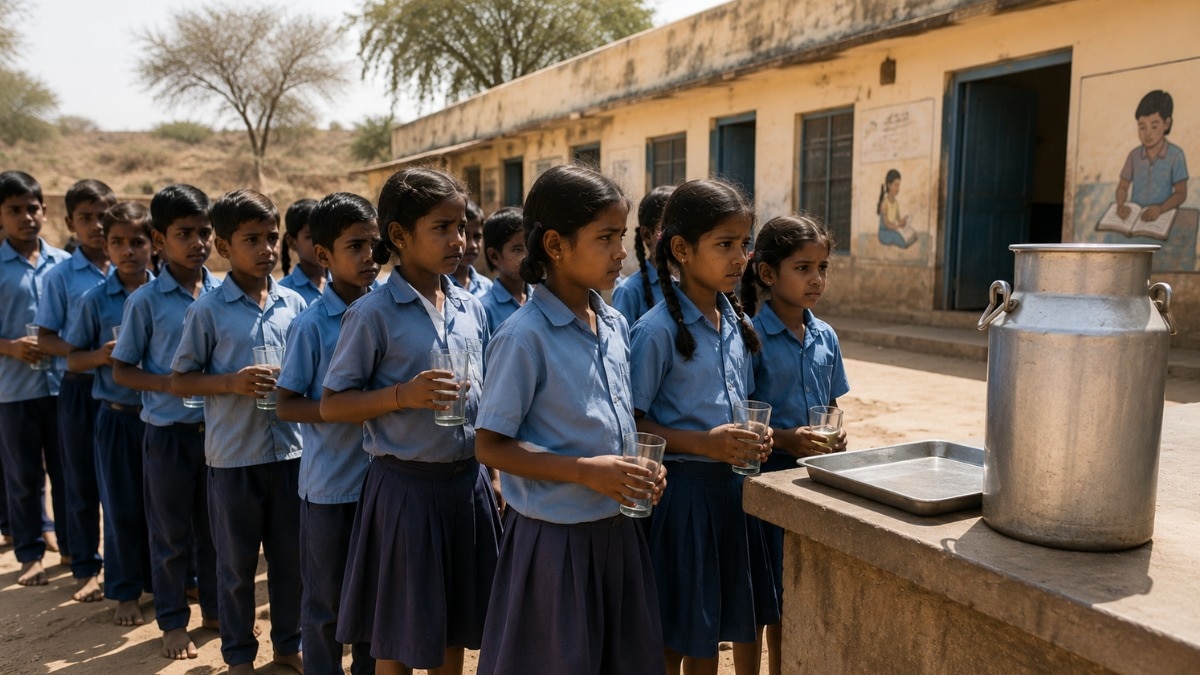
The state of Rajasthan is currently grappling with a burgeoning nutrition crisis as its flagship school milk program, the Pannadhay Bal Gopal Yojana, has reportedly spiraled into a systemic failure. Designed to provide hot milk to over 6.9 million students across 65,000 government schools, the scheme is now facing a staggering 58 per cent supply deficit, turning a vital health initiative into a mere bureaucratic promise.
Internal data from the education department paints a grim picture of the logistics collapse. Out of a required 3,756.43 metric tonnes of skimmed milk powder for a recent three-month period, only 1,573.81 tonnes were actually supplied. This represents a failure rate of nearly 60%. The crisis is most acute in districts like Alwar, Bharatpur, Udaipur, Bikaner, and Kota, where distribution has come to a complete standstill.
Why This Matters
BozokMedia analysis shows that this is not merely a logistical glitch but a profound failure of governance and oversight. When essential nutritional supplements are siphoned off, the state isn't just losing money—it is compromising the cognitive and physical development of an entire generation. In a state where stunting and wasting are already prevalent, the absence of this supplement exacerbates existing health vulnerabilities.
The scandal deepened with the discovery of a thriving black market. In Jaipur's Chithwadi village, police intercepted 3,000 kg of milk powder explicitly marked 'Not for sale—for school supply only'. This stock was allegedly being diverted to commercial manufacturers of mawa (khoya). Investigators believe that school attendance records were manipulated to hide the theft, creating a paper trail of 'consumption' while the actual product was sold for profit.
The diversion of nutrition-critical resources to the commercial market is a severe violation of child rights and a failure of the state's fiduciary duty to its most vulnerable citizens.
Adding to the chaos is the threat of food safety. With fresh procurement stalled, some schools are reportedly holding onto old stocks. The education department has had to issue urgent warnings to check expiry dates, as some of the seized black-market stock was already expired, posing a direct health risk to students if it had reached the classrooms.
The political fallout has been immediate. Former CM Ashok Gehlot has accused the current BJP government of deliberately throttling welfare programs. Meanwhile, the Bhajan Lal Sharma administration is under pressure to explain the massive gap between allocation and delivery. The Rajasthan Cooperative Dairy Federation (RCDF) remains at the center of the procurement failure.
| Metric | Required Amount | Actual Supplied | Deficit % |
|---|---|---|---|
| Milk Powder (3-Month Period) | 3,756.43 MT | 1,573.81 MT | ~58% |
Frequently Asked Questions
Q1: What is the Pannadhay Bal Gopal Yojana?
It is a Rajasthan government scheme providing hot milk to primary and upper-primary students in government schools to combat malnutrition.
Q2: How was the milk powder diverted to the black market?
It is alleged that officials manipulated school attendance and consumption records to show the milk was used, while actually selling it to commercial sweet shops.