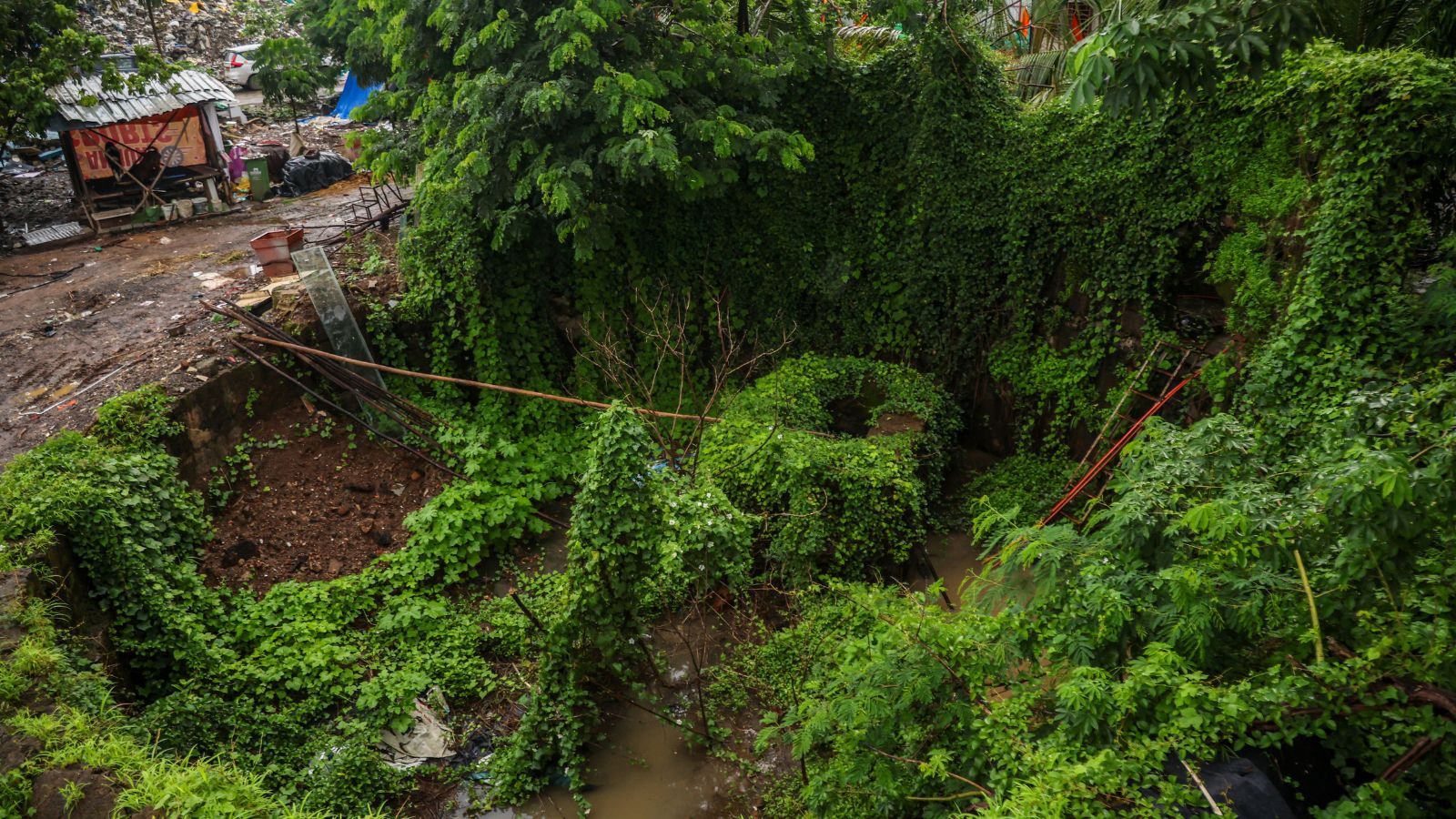
A hidden 400-year-old Portuguese military bastion has been rediscovered in Wadala, Mumbai. Despite its historical significance as a coastal defense outpost, the structure is currently battling decay and bureaucratic neglect.
- A 400-year-old Portuguese bastion was discovered by locals and history enthusiasts in Wadala, Mumbai.
- The structure served as a strategic coastal defense outpost overlooking Mahul creek.
- Evidence suggests the bastion was used by both the Portuguese (16th-17th century) and later the British.
- Despite recommendations for state protection, the monument remains neglected and overgrown with vegetation.
In a startling discovery that highlights the layers of history buried beneath Mumbai's urban sprawl, a 400-year-old Portuguese bastion has emerged from the ruins in Wadala. Located along the Eastern Freeway and overlooking the Mahul creek, the structure remained hidden for decades under piles of debris and dense vegetation until local residents and history buffs took the initiative to uncover it in 2021.
The discovery was spearheaded by Samadhan Jugdhar, a local leader, and Chandan Vichare, a history enthusiast. Together, they coordinated with heritage experts and architects to alert the Brihanmumbai Municipal Corporation (BMC) and the Directorate of Archaeology and Museums of the Maharashtra government. Upon professional inspection, the structure was identified as a 'bastion'—a projecting part of a fortification designed to allow defenders to fire upon attackers.
According to Mayur Thakare of the Directorate of Archaeology, this bastion was a critical component of Mumbai's early coastal defense system. Unlike the Mazgaon Fort, which was systematically destroyed by the British, this particular structure likely survived because the British found it useful and continued to utilize it after taking control of the region in 1661.
Why This Matters
BozokMedia analysis shows that the discovery of the Wadala bastion is not merely an archaeological find but a testament to the city's resilient geography. It reveals how colonial powers—first the Portuguese and then the British—utilized the same strategic vantage points to control the Arabian Sea. The fact that such a significant military outpost remained unnoticed until 2021 underscores the urgent need for a systematic urban heritage survey in Mumbai.
The survival of this bastion suggests a rare continuity of military utility between the Portuguese and British administrations, making it a unique architectural hybrid.
Historically, Wadala was known as Varella during the Portuguese era and fell under the Mahim Kasba. The area was primarily composed of salt pans farmed by the local Kunbi community (known as Kurumbees). Interestingly, while the political administration shifted from Portuguese to British rule, the local land use and geographical divisions remained remarkably stable for centuries.
Architecturally, the bastion is a circular structure featuring octagonal internal projections, constructed using random-rubble masonry and lime-sand mortar. It is equipped with gun holes and slits for defense, and uniquely, contains a rectangular water storage system. Analysis reveals two distinct phases of construction: the primary Portuguese build (16th-17th century) and subsequent British reinforcements using stone veneers (17th-18th century).
| Feature | Portuguese Phase | British Phase |
|---|---|---|
| Timeline | 16th - 17th Century | 17th - 18th Century |
| Construction | Random-rubble masonry | Stone veneer reinforcements |
| Purpose | Primary Coastal Defense | Strategic Outpost/Maintenance |
Despite its validated historical value, the path to official protection has been sluggish. While the Ratnagiri Divisional Office was instructed to propose the site as a state-protected monument, the process has stalled. Currently, the bastion is in a state of limbo; locals are forbidden from cleaning it to avoid disturbing evidence, while nature continues to reclaim the stone walls.
Frequently Asked Questions
Q1: Where exactly is the Portuguese bastion located?
It is located in Wadala, Mumbai, along the Eastern Freeway, overlooking the Mahul creek.
Q2: Why is this bastion still standing while others were destroyed?
Experts believe the British likely used the structure after the Portuguese departure, which saved it from the demolition that befell other sites like Mazgaon Fort.


