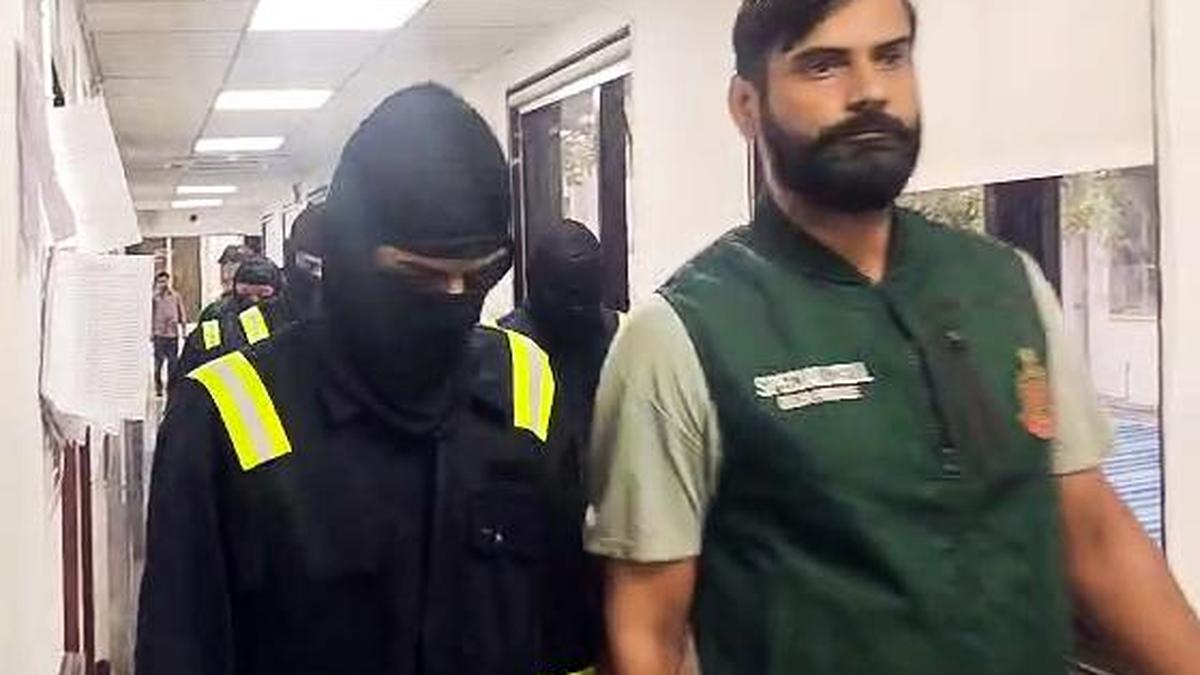
In a massive security breakthrough, the Delhi Police Special Cell has arrested eight individuals linked to Pakistan's ISI and the underworld, thwarting planned attacks on strategic government buildings in Delhi and Mumbai.
- Eight suspects arrested for plotting terror attacks in Delhi, Mumbai, Punjab, and Chandigarh.
- Module linked to Pakistan's ISI, gangster Munna Jhingada, and Shahzad Bhatti.
- Recovery of Glock pistols, hand grenades, and coordinates of high-security government targets.
- Evidence suggests the use of drones for weapon delivery.
The Delhi Police Special Cell has successfully neutralized a dangerous terror module operating under the influence of Pakistan's Inter-Services Intelligence (ISI) and the organized criminal underworld. In a series of coordinated raids, eight individuals were apprehended for plotting large-scale attacks on strategic government and non-government installations across the National Capital Region (NCR) and Mumbai.
According to Anil Shukla, Commissioner of Police (Special Cell), the arrests have averted potential catastrophes. The police have seized critical digital evidence, including videos, photographs, and precise GPS coordinates of security establishments that were being targeted for strikes. The investigation reveals a complex web of coordination involving handlers based in Pakistan and Dubai.
The conspiracy involves Munna Jhingada, a close associate of Dawood Ibrahim, and Shahzad Bhatti, a Pakistan-based gangster. Jhingada, who spent 17 years in a Bangkok prison before being extradited to Pakistan, reportedly utilized his prison connections to recruit agents. One such recruit, Ang Kami Lama, a 66-year-old Nepali citizen, was sent to Delhi to manage logistics and funding for the operation.
Why This Matters
BozokMedia analysis shows that the shift toward using social media platforms like Instagram and WhatsApp for terror recruitment signifies a dangerous evolution in asymmetrical warfare. The involvement of third-country nationals (Nepali citizens) as logistics providers indicates a strategic attempt by the ISI to mask the origin of the conspiracy and bypass traditional intelligence filters.
The integration of drone-based weapon delivery and encrypted social media coordination marks a critical shift in the operational tactics of ISI-backed modules in India.
The module first came to light following the arrest of Vijay and Nitish Paswan in Pune and Jharkhand. Subsequent technical surveillance led to the capture of Taoqeer Rizwan and Arbaz Khan in Mumbai. The final blow was dealt on Saturday at 1 a.m. on the Mehrauli-Badarpur road, where police intercepted Manjeet Singh, Gagandeep Singh, and Harvinder Singh. The police recovered four hand grenades, two Glock pistols, and 25 live cartridges from them.
Investigators are now scrutinizing the role of other Nepali-origin nodes and the specific drone routes used to drop weapons within Indian borders. The operation underscores the persistent threat posed by the nexus between state-sponsored intelligence agencies and the global criminal underworld.
| Entity | Role/Connection | Location/Base |
|---|---|---|
| Munna Jhingada | Mastermind/Associate of Dawood Ibrahim | Pakistan |
| Shahzad Bhatti | Gangster/Handler | Pakistan |
| Ang Kami Lama | Logistics & Finance | Nepal/Delhi |
| Special Cell | Counter-Terrorism Operation | New Delhi |
Frequently Asked Questions
Q1: How were the weapons delivered to the operatives?
Preliminary investigations suggest that the weapons, including pistols and grenades, were dropped by drones to avoid detection at checkpoints.
Q2: Which cities were the primary targets of this module?
The primary targets were strategic locations in Delhi, Mumbai, Punjab, and Chandigarh.
