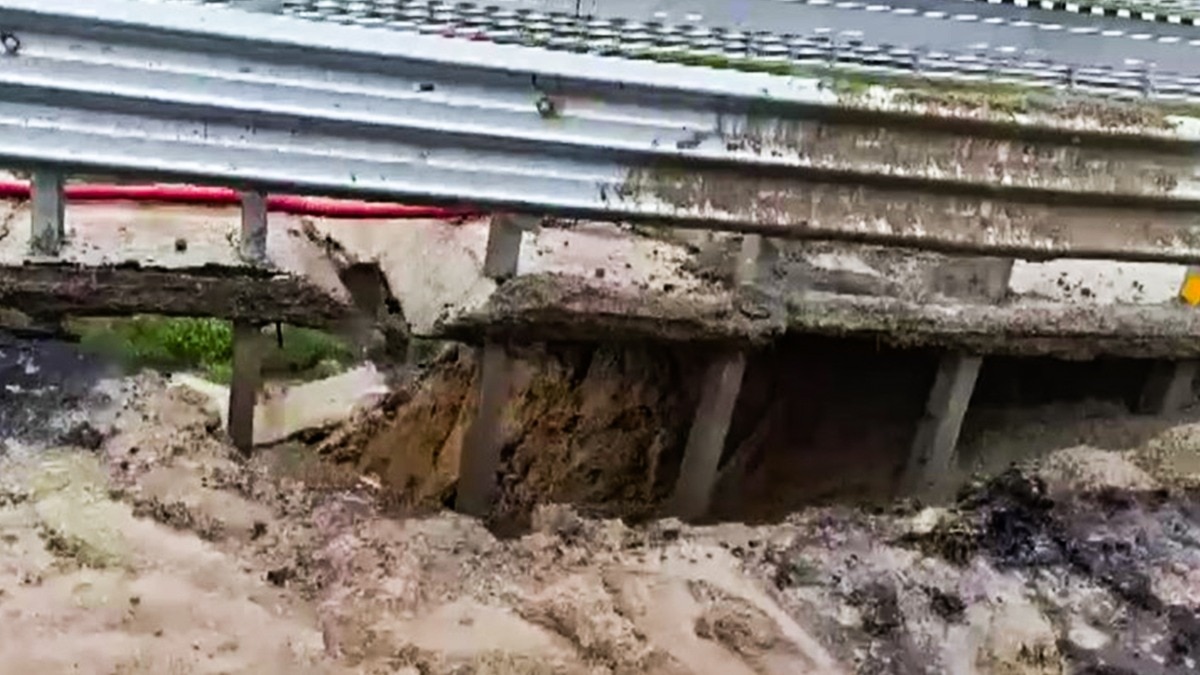
A massive 10-metre-deep crater has emerged on the prestigious Rs 36,000-crore Ganga Expressway following torrential rainfall, raising serious questions about construction quality.
- A 10-metre-deep crater has formed on the Ganga Expressway after heavy rains.
- The project, costing Rs 36,000 crore, is one of India's most ambitious infrastructure ventures.
- Concerns are rising over the quality of materials and engineering oversight.
In a shocking lapse of infrastructure integrity, a massive 10-metre-deep crater has opened up on the Ganga Expressway, a project valued at a staggering Rs 36,000 crore. The collapse occurred following a period of intense rainfall, which appears to have compromised the sub-surface stability of the highway, leading to a sudden and catastrophic cave-in.
The Ganga Expressway is designed to be a game-changer for connectivity in Uttar Pradesh, aiming to reduce travel time significantly between eastern and western parts of the state. However, this structural failure has cast a shadow over the project's timeline and the reliability of its construction standards. Local authorities have cordoned off the affected area to prevent accidents, while engineers scramble to assess the extent of the damage.
Why This Matters
BozokMedia analysis shows that such failures in high-budget 'mega-projects' often point toward a systemic failure in soil testing or the use of substandard filling materials. When a project of this magnitude suffers a collapse so early in its lifecycle, it suggests a potential gap between the contractual quality specifications and the actual ground-level execution.
"The appearance of a sinkhole of this magnitude on a newly constructed expressway indicates a critical failure in drainage management or geotechnical stabilization."
The incident has sparked a heated debate among policymakers and urban planners regarding the auditing process of public works. With thousands of crores of taxpayers' money invested, the demand for a third-party forensic audit of the expressway's construction is growing louder.
Historical Background
The Ganga Expressway is part of a broader strategy to modernize India's logistics network. Similar incidents of road cave-ins have been reported across various states during monsoon seasons, often attributed to the 'filling' process where loose soil is not sufficiently compacted before the asphalt layer is applied.
| Feature | Projected Standard | Observed Failure |
|---|---|---|
| Structural Integrity | High-load capacity | 10-metre collapse |
| Weather Resistance | All-weather durable | Rain-induced cave-in |
| Investment | Rs 36,000 Crore | Questionable ROI on quality |
Frequently Asked Questions
Q1: Is the entire Ganga Expressway unsafe for travel?
A1: While the crater is localized, authorities are conducting safety checks on other vulnerable stretches.
Q2: Who is responsible for the repair of this crater?
A2: The construction agency and contractors are typically liable for defects under the project's warranty and maintenance clauses.