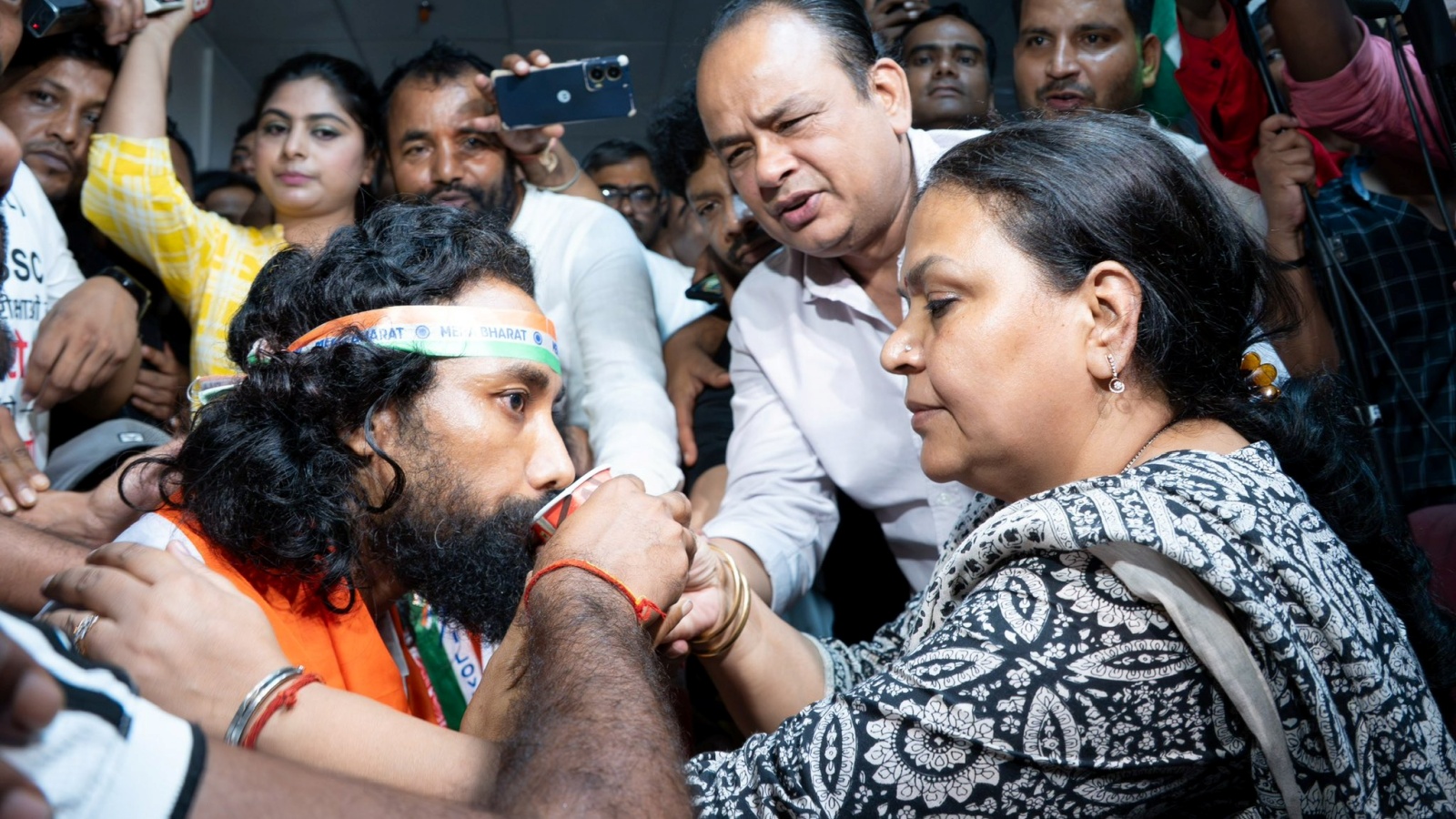
After a grueling 16-day hunger strike, student leader Devendra Nath Mahato broke his fast following Chief Minister Hemant Soren's decision to cancel the JSSC-CGL examination and order a CBI probe into irregularities.
- JSSC-CGL and all TDPL-conducted exams cancelled by Jharkhand Government.
- CBI probe ordered to investigate recruitment irregularities since 2014.
- Student leader Devendra Nath Mahato ended a 16-day hunger strike at Sadar Hospital, Ranchi.
- Protesters demand systemic reforms to prevent future paper leaks and political influence in hiring.
In a significant victory for student activism in Jharkhand, student leader Devendra Nath Mahato ended his 16-day hunger strike on Monday night at Sadar Hospital in Ranchi. The fast, which began on July 2, concluded after Chief Minister Hemant Soren announced the immediate cancellation of the JSSC-CGL examination and all other recruitment tests conducted by the TDPL. The hunger strike was broken in the presence of state ministers Dipika Pandey Singh and Irfan Ansari.
The government's decision extends beyond mere cancellation; CM Soren has ordered a comprehensive CBI probe into exam irregularities, tracing back to systemic errors since 2014. This move is expected to be formally ratified by the state Cabinet. Minister Irfan Ansari confirmed that Mahato and fellow protesters Rajesh Prasad and Umme Habiba underwent medical screenings and were found to be in stable condition, with normal blood pressure and sugar levels.
Why This Matters
BozokMedia analysis shows that this event marks a pivotal shift in the relationship between the Jharkhand state administration and its youth. The willingness of the government to concede to a hunger strike and involve a central agency like the CBI suggests a growing public intolerance for recruitment scams. It highlights a critical failure in the state's current examination machinery, where judicial remedies were insufficient, forcing students to resort to extreme forms of protest to achieve justice.
"This victory proves that collective, peaceful action can achieve results where legal frameworks often fail, signaling a new era of student-led accountability in Indian governance."
The political landscape in Jharkhand has also reacted sharply. The BJP, leading the opposition in the Assembly, has backed the demand for a CBI probe. Former CM Babulal Marandi challenged the government to address all remaining student demands, arguing that a transparent probe would validate the fairness of the recruitment process if the government has nothing to hide.
Adding a dimension of national solidarity, renowned activist Sonam Wangchuk connected with Mahato via video call to congratulate the students. Wangchuk praised the tenacity of the protesters and expressed hope that the government and the public would collaborate to fix the structural flaws in the education and recruitment system.
Despite the victory, Mahato emphasized that the struggle is not over. He called for a complete overhaul of the recruitment system to ensure that paper leaks and political nepotism are permanently eliminated. The movement aims to transform recruitment agencies from flawed entities into transparent, job-providing institutions.
Frequently Asked Questions
Q1: Why was the JSSC-CGL exam cancelled?
The exam was cancelled following widespread allegations of irregularities and a prolonged protest led by students, leading the CM to order a CBI investigation.
Q2: Who is Devendra Nath Mahato?
He is a prominent student leader in Jharkhand who led a 16-day hunger strike to demand fairness and transparency in state recruitment exams.