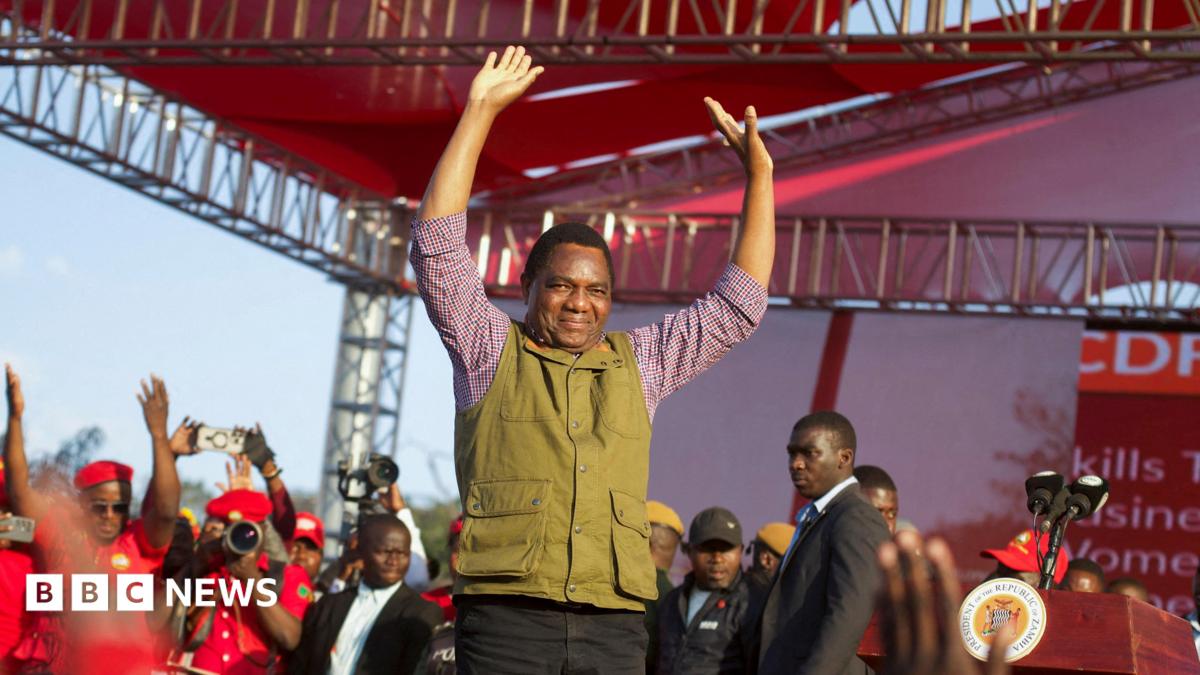
President Hakainde Hichilema has been re-elected for a second five-year term in Zambia, overcoming allegations of irregularities and political tension to secure a decisive victory.
- President Hakainde Hichilema won re-election with 60% of the total vote.
- Main challenger Brian Mundubile secured 38%, while other candidates trailed significantly.
- The election was marred by reports of opposition arrests and allegations of voting irregularities.
- International observers noted concerns over media freedom and the brief suspension of vote counting.
In a decisive victory for the United Party for National Development (UPND), President Hakainde Hichilema has been officially declared the winner of Zambia's presidential election. The electoral commission confirmed that Hichilema secured 60% of the vote, granting him a second five-year mandate to lead the Southern African nation. The announcement triggered massive celebrations in the capital, Lusaka, where supporters clad in red flooded the streets to welcome their leader.
The path to victory was not without friction. Hichilema's closest rival, 55-year-old Brian Mundubile, who garnered 38% of the vote, had prematurely claimed victory and alleged widespread voting irregularities. The tension peaked following a series of raids by security forces on Friday, leading to the arrest of several opposition figures accused of plotting an insurrection—a claim Mundubile dismissed as a complete fabrication.
Why This Matters
BozokMedia analysis shows that while Hichilema's victory maintains a semblance of stability, the friction between the ruling party and the opposition highlights a growing polarization within Zambian politics. The use of security forces against political opponents, combined with the brief suspension of vote counting by the electoral commission, risks eroding the public's trust in the democratic process, regardless of the final tally.
The balance between maintaining national security and upholding democratic freedoms remains the most critical challenge for Zambia's second-term administration.
Historically, Zambia has been lauded as a beacon of democratic stability in Africa. Since returning to multiparty democracy in 1991, the nation has maintained a consistent record of peaceful transfers of power through the ballot box. However, the current climate of accusations—including Mundubile's claim that armored vehicles were used to storm his residence—suggests a shift toward a more volatile political atmosphere.
International and regional observers, including the Southern African Development Community (SADC) and the European Union (EU), described the polling day as largely peaceful. However, they raised red flags regarding late electoral reforms and uneven access to media during the campaign period. The EU specifically warned that restrictions on the opposition may have created an "uneven contest," potentially skewing the democratic nature of the race.
| Candidate | Party/Affiliation | Vote Share | Outcome |
|---|---|---|---|
| Hakainde Hichilema | UPND | 60% | Winner (Re-elected) |
| Brian Mundubile | Opposition | 38% | Defeated |
| Other Candidates | Various | 2% | Defeated |
Frequently Asked Questions
Q: Did the opposition challenge the results?
A: While Brian Mundubile alleged irregularities and military interference at tallying centers, it remains officially unclear if a formal legal challenge will be filed in court.
Q: Why was the vote counting suspended?
A: The electoral commission briefly paused counting due to reports of violence against polling staff and the theft of marked ballot papers in certain regions.