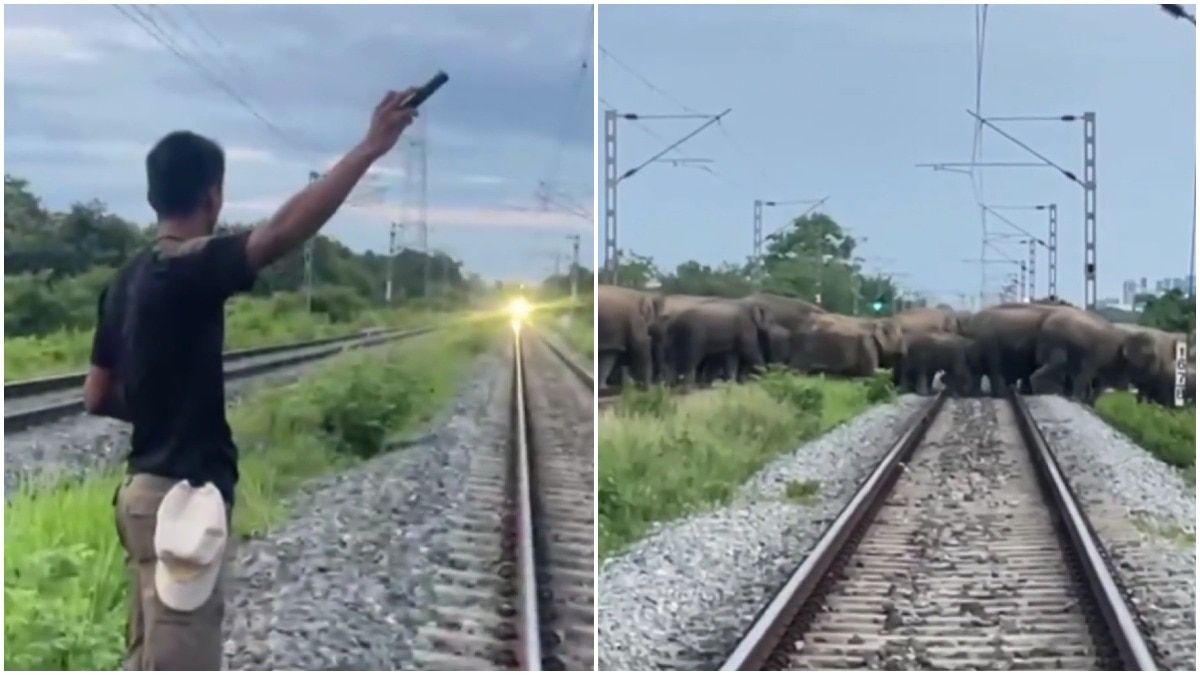
In a remarkable display of wildlife protection, forest officials in Assam's Hojai stopped an approaching train to allow a large elephant herd to cross the tracks safely.
- Forest personnel in Hojai, Assam, successfully intercepted a train to prevent a collision with elephants.
- CM Himanta Biswa Sarma highlighted the incident as part of the 'Corridors of Safety' initiative.
- The event has sparked renewed debate regarding permanent wildlife infrastructure.
A significant incident in the Hojai district of Assam has highlighted the delicate balance between infrastructure and wildlife conservation. Forest department personnel were captured on video performing a critical intervention by signaling an approaching train to stop, allowing a large herd of elephants to cross the railway tracks without incident.
Assam Chief Minister Himanta Biswa Sarma shared the footage on his official X account, praising the vigilance of the forest staff. The video shows a forest official standing precariously near the tracks, using hand signals to alert the oncoming train as its headlights approach from the distance. The timely intervention prevented what could have been a catastrophic collision.
The elephant herd, consisting of both adults and juveniles, emerged from the dense vegetation adjacent to the tracks. Under the watchful eyes of the forest officials, the animals moved steadily across the railway line, ensuring the entire group transitioned safely from one side to the other.
Why This Matters
BozokMedia analysis shows that as railway networks expand through ecologically sensitive zones, the risk of human-wildlife conflict intensifies. Chief Minister Sarma described these preventative measures as "Corridors of Safety," noting that forest personnel are stationed along most elephant corridors that intersect with rail lines to mitigate such risks.
Immediate tactical interventions like these are vital, but they are a temporary bandage on a much larger infrastructural wound.
While the immediate action was widely lauded, the incident has ignited a broader discussion regarding long-term solutions. Many environmentalists and citizens argue that relying solely on manual intervention is unsustainable and prone to human error.
| Strategy | Method | Pros/Cons |
|---|---|---|
| Manual Intervention | Stopping trains via forest staff | Immediate but high-risk/temporary |
| Structural Solutions | Underpasses & Overbridges | Permanent but expensive/long-term |
| Habitat Management | Dedicated Wildlife Corridors | Ecologically sound but requires land |
Public discourse following the video has emphasized the need for wildlife underpasses and elevated railway sections. The consensus among experts is that for true coexistence, the infrastructure must adapt to the animals' natural migratory patterns rather than forcing animals to navigate around human-made obstacles.
Frequently Asked Questions
1. Why are elephants frequently found on railway tracks in Assam?
Many railway lines in Assam pass directly through traditional elephant migratory routes and dense forest habitats.
2. What are 'Corridors of Safety'?
They are designated areas where forest officials monitor elephant movements to alert railway authorities, preventing accidents.